Hi, with a van de graaff generator, does the voltage increase with a higher RPM motor or a different material?
It depends on where your losses are occurring, and whether you have a "serious" Van de Graaf generator or just a "toy" good mainly for making hair stand on end.
In theory, as long as the charge collecting sphere is accumulating charge, and the charge does not "leak off," there is no limit to how much voltage the sphere will charge to. In practice, charge will reach a level where corona discharge (ionization of air) occurs, draining the charge from the sphere. Motor speed affects only the rate of charge accumulation, not the final voltlage. Materials are important if you are using the triboelectric effect to separate charges for deposition on the insulating belt, but again that only affects the rate of charge accumulation, not the final voltage on the sphere.
The basic principle of a modern Van de Graaf generator applies an electrical charge to a non-conductive belt or chain by means of either corona discharge or electrostatic induction. It then moves the charge, by mechanically moving the belt or chain, to the inside of a conductive sphere insulated from ground. The charge is extracted, again by induction, and deposited on the sphere where it accumulates since there is no intentionally conductive path to discharge the sphere.
Note that in a Van de Graaf generator there is a continuous transfer of charge from the bottom of the generator (at Earth potential) to the conducting sphere at the top. Assuming the transported charges do not "leak off" by conduction down the insulating support column, the sphere will continue to accumulate charge as long as charge is being transported to it.
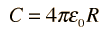
An isolated sphere has a certain capacitance, determined by its radius and the dielectric constant of the air around it. The voltage that is developed on the sphere is calculated from V = Q/C, where Q is the charge in coulombs deposited on the sphere and C is the capacitance in farads. Nowhere is it stated that this voltage has anything to do with the speed of the belt or the materials used because it doesn't. The maximum voltage of a Van de Graaf generator mainly depends on how much voltage can be developed on the sphere before it causes the surrounding air to break down and corona discharges to occur. If you want higher voltage from your Van de Graaf generator, fit it with a larger sphere and a taller, better insulated, support column.
The triboelectric effect has no part in a modern commercial Van de Graaf generator design. Also, rubberized belts are becoming scarce and are being used less frequently. The belts also wear more quickly and are less stable than a pellet-chain design. In fact, it is not unusual to find a Van de Graaf accelerator that started life with a belt to now be fitted with a
Pelletron charging system manufactured by the National Electrostatics Corporation (NEC). The NEC website has
a nice animation showing how charge is transported using their Pelletron system.
You could also make a Van de Graaf generator by charging up ping-pong balls and using vacuum suction to deliver the charged balls up into a conducting sphere. By using a coaxial tube arrangement, you could shoot the charged balls up a center tube slightly larger in inside diameter than the diameter of the ping-pong balls and recover them down a much larger outer tube for recirculation at the bottom. Examine the design of the machine used to select lottery numbers for ideas on how to recirculate the balls.