series parallel RC circuit help

Laplace

Apr 4, 2010
1,252
Joined
Apr 4, 2010
Messages
1,252
It says " fully charged" when it should read " energized".
But the capacitors are "energized" from the time t=0+ onward. How is the student expected to know that the answer requires a calculation for t>6τ when the capacitors have become fully charged? Note that the technical jargon "fully charged" means as energized as the capacitors will ever become in this circuit.
 

Ratch

Mar 10, 2013
1,102
Joined
Mar 10, 2013
Messages
1,102
But the capacitors are "energized" from the time t=0+ onward. How is the student expected to know that the answer requires a calculation for t>6τ when the capacitors have become fully charged? Note that the technical jargon "fully charged" means as energized as the capacitors will ever become in this circuit.

Fully energized means the caps are energized as much as is practical for that application.

Ratch
 

Martaine2005

May 12, 2015
5,276
Joined
May 12, 2015
Messages
5,276
Fully energized means the caps are energized as much as is practical for that application.
Agreed....
Fully energized....
Naughty teacher....
The OP hasn't returned as per!

We have done transistor, done capacitor!
I know, resistors!!....

Martin
 

Laplace

Apr 4, 2010
1,252
Joined
Apr 4, 2010
Messages
1,252
Slang is like a foreign language, or communicating with grunts and gestures. It usually is not descriptive to the layperson who is not knowledgeable about a subject. Those in the know can blow smoke rings at each other to communicate, but slang can be confusing or impede learning for beginners. Example: How many beginners will think that a capacitor has more electrons within it than it had before when they hear a capacitor is "charged"? The correct descriptive language is always understood the right way.
Beginners need to pay their dues and learn the technical jargon of the profession. There is no other way. For the layperson who is not knowledgeable about the subject, they don't have the technical background to understand these abstract concepts so getting electronics professionals to use a new vocabulary is the least of their problems.
I never said you have to give the amount of energy contained in a capacitor in energy units. There is no reason you cannot say that a capacitor is energized to a X number of volts or energized to a Y number coulombs of imbalance. I said that energizing is a more descriptive and less confusing word than charging.
On the contrary, speaking of "energizing" implies the basic mechanism of the capacitor is to store energy when in reality the capacitor stores charge in equal and opposite amounts. Energy is more confusing because of the nonlinear relationship between energy and charge, whereas speaking of charging the capacitor to a voltage will emphasize the linear relationship between voltage and charge. "Energizing the capacitor to a voltage" is just so lame.
You said that protons and electrons were the ultimate natural unit of charge. I was pointing out that although they are the smallest discrete charge available, we do not use their charge as a standard unit. Their charge is defined in coulombs, a MKS unit.
So you did notice I called the charge on a proton/electron a natural unit and not a standard.
The number of time constants needed depends on the application, not the authors of electronics books. Suppose you were de-energizing a one million volt capacitor from a lightning machine. Wouldn't you want to go 12 time constants to get the voltage down to 6 volts, instead of 6 time constants and still have over 2400 volts across the capacitor?
Unfortunately, the book Electronics for Dummies did not have a chapter for million-volt lightning machines. That must be why their time-constant explanation came with the caveat, "For all practical purposes..."
You misstate the conditions. There are two nodes, but the capacitor is applying an opposite voltage equal to the applied voltage. The net voltage is zero, so no current is present even though a conducting path is in place. This is not the same situation as having an applied voltage with no counter voltage and no conducting path. In both cases, no current exists for that static state, but the circuits are different, and will have different responses to perturbations.
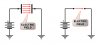
The stated conditions are correct; however, to prevent further misinterpretations I have provided a visual diagram. This applies to the fully-charged steady state condition of the capacitor, so there is no reason to mention 'perturbations'. True, the two circuits are different, but in the steady state they both appear the same.
Open-Circuit.png
The circuit on the left is immediately recognized as a fully-charged capacitor between the two nodes. The circuit on the right is recognized as an open circuit between the nodes. In reality, the only difference between the two is the relative magnitude of the capacitance between the nodes. The open circuit has an electric field present between the nodes, and a small stray capacitance that is usually not shown on schematic diagrams. The fully charged capacitor behaves the same as the open circuit while in its steady state, having an electric field between the plates and no current flow at either node. The conclusion must be that a fully charged capacitor in the steady state is an open circuit.
 

Ratch

Mar 10, 2013
1,102
Joined
Mar 10, 2013
Messages
1,102
Beginners need to pay their dues and learn the technical jargon of the profession. There is no other way. For the layperson who is not knowledgeable about the subject, they don't have the technical background to understand these abstract concepts so getting electronics professionals to use a new vocabulary is the least of their problems.
Beginners should first learn that the jargon or slang does not usually describe what is really happening. Professionals should not use jargon to communicate with laypersons.
On the contrary, speaking of "energizing" implies the basic mechanism of the capacitor is to store energy when in reality the capacitor stores charge in equal and opposite amounts.
The purpose of a capacitor is to store energy. Accumulated voltage and charge imbalance are useful side effects.
Energy is more confusing because of the nonlinear relationship between energy and charge, whereas speaking of charging the capacitor to a voltage will emphasize the linear relationship between voltage and charge.
Why is a nonlinear relationship confusing? How does "charging" a cap to a voltage emphasize the linear relationship? Nothing is mentioned of voltage and charge imbalance.
"Energizing the capacitor to a voltage" is just so lame.
Why is that? How is "Charging the capacitor to a voltage" better while being wrong?
So you did notice I called the charge on a proton/electron a natural unit and not a standard.
And such a small unit that it is not practical.
Unfortunately, the book Electronics for Dummies did not have a chapter for million-volt lightning machines. That must be why their time-constant explanation came with the caveat, "For all practical purposes..."
Yes, using many time constants to drain (de-energize) the energy from a high voltage cap is very practical.
The stated conditions are correct; however, to prevent further misinterpretations I have provided a visual diagram. This applies to the fully-charged steady state condition of the capacitor, so there is no reason to mention 'perturbations'. True, the two circuits are different, but in the steady state they both appear the same.
View attachment 22929
The circuit on the left is immediately recognized as a fully-charged capacitor between the two nodes. The circuit on the right is recognized as an open circuit between the nodes. In reality, the only difference between the two is the relative magnitude of the capacitance between the nodes. The open circuit has an electric field present between the nodes, and a small stray capacitance that is usually not shown on schematic diagrams. The fully charged capacitor behaves the same as the open circuit while in its steady state, having an electric field between the plates and no current flow at either node. The conclusion must be that a fully charged capacitor in the steady state is an open circuit.
Would you represent a open switch such as you might use to control a DC appliance as a fully energized capacitor that opposes the voltage? That might be fun to watch when you short out the capacitor to turn on the light. A circuit does not stay in one state forever, so the two methods of stopping current are not the same when consideration is given to changes that might occur.

Ratch
 

dorke

Jun 20, 2015
2,342
Joined
Jun 20, 2015
Messages
2,342
Guys,
This thread has "spilled so many words".
"Much Ado About Nothing...(almost)" .;)
or put in layman's therms:
What happened to the K.I.S.S. method?:rolleyes:
 

dorke

Jun 20, 2015
2,342
Joined
Jun 20, 2015
Messages
2,342
To emphasize my point,
put some inductors in the circuit
By your method you need to add some "magnetic energy" terms :eek:
While mine stays exactly the same.
I rest my case...;)
 

Ratch

Mar 10, 2013
1,102
Joined
Mar 10, 2013
Messages
1,102
Guys,
This thread has "spilled so many words".

What's wrong about that? They were needed and used.

"Much Ado About Nothing"... ;)

Quoting Shakespeare are you? Correct understanding is important

or put in layman's therms:
What happened to the K.I.S.S. method?:rolleyes:

Please articulate how "simple" got violated. New ways of perceiving something does not necessarily mean complication.

Laplace:What could be simpler than a fully charged capacitor being equivalent to an open circuit?

A fully energized capacitor not being equivalent to an open circuit.

Dorke:To emphasize my point,put some inductors in the circuit

To what end or purpose?

t --> infinity (i.e steady state)...

No, infinity does not mean steady state. An exponential function can go on for an infinite amount of time and still not reach a steady value.

By your method you need to add some "magnetic energy" terms :eek: .

Whose method? What are magnetic energy terms? What are capacitive energy terms?

While mine stays exactly the same.
I rest my case...;)

What stays the same? You never had a cogent statement/case to start with.

Ratch
 

dorke

Jun 20, 2015
2,342
Joined
Jun 20, 2015
Messages
2,342
Ratch,
"Hopelessly Pedantic" ?
To the point of being deaf ,but always needs to have the last word?

This indeed hopeless...
I'm out of here,never to return!
 

Laplace

Apr 4, 2010
1,252
Joined
Apr 4, 2010
Messages
1,252
We have done transistor, done capacitor!
I know, resistors!!....
I would have thought that in recognition of the Duality Principle* for electronics you might have chosen, INDUCTORS! After 6τ in an RC circuit we say the capacitor is fully charged because the capacitor stores charge. But in an RL circuit after 6τ we say the inductor is, what? Do we even have a word for it? What does the inductor store?

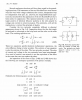
*For those not well versed in the Duality Principle I have attached a short extract from "Network Analysis, 3rd edition" by Van Valkenburg, 1974.
 

Attachments

  • duality-principle.png
    duality-principle.png
    210.6 KB · Views: 75
Last edited:

Ratch

Mar 10, 2013
1,102
Joined
Mar 10, 2013
Messages
1,102
I would have thought that in recognition of the Duality Principle for electronics you might have chosen, INDUCTORS! After 6τ in an RC circuit we say the capacitor is fully charged because the capacitor stores charge. But in an RL circuit after 6τ we say the inductor is, what? Do we even have a word for it? What does the inductor store?

Why, it stores energy within its magnetic field. I heard of a duality principle for light, but not for electronics. If there is any current present in an inductor, it would not be wrong to say it is energized. Whenever it forms a magnetic field, energy is being stored.

Ratch
 
Top