Slang is like a foreign language, or communicating with grunts and gestures. It usually is not descriptive to the layperson who is not knowledgeable about a subject. Those in the know can blow smoke rings at each other to communicate, but slang can be confusing or impede learning for beginners. Example: How many beginners will think that a capacitor has more electrons within it than it had before when they hear a capacitor is "charged"? The correct descriptive language is always understood the right way.
Beginners need to pay their dues and learn the technical jargon of the profession. There is no other way. For the layperson who is not knowledgeable about the subject, they don't have the technical background to understand these abstract concepts so getting electronics professionals to use a new vocabulary is the least of their problems.
I never said you have to give the amount of energy contained in a capacitor in energy units. There is no reason you cannot say that a capacitor is energized to a X number of volts or energized to a Y number coulombs of imbalance. I said that energizing is a more descriptive and less confusing word than charging.
On the contrary, speaking of "energizing" implies the basic mechanism of the capacitor is to store energy when in reality the capacitor stores charge in equal and opposite amounts. Energy is more confusing because of the nonlinear relationship between energy and charge, whereas speaking of charging the capacitor to a voltage will emphasize the linear relationship between voltage and charge. "
Energizing the capacitor to a voltage" is just so lame.
You said that protons and electrons were the ultimate natural unit of charge. I was pointing out that although they are the smallest discrete charge available, we do not use their charge as a standard unit. Their charge is defined in coulombs, a MKS unit.
So you did notice I called the charge on a proton/electron a natural unit and not a standard.
The number of time constants needed depends on the application, not the authors of electronics books. Suppose you were de-energizing a one million volt capacitor from a lightning machine. Wouldn't you want to go 12 time constants to get the voltage down to 6 volts, instead of 6 time constants and still have over 2400 volts across the capacitor?
Unfortunately, the book Electronics for Dummies did not have a chapter for million-volt lightning machines. That must be why their time-constant explanation came with the caveat, "For all practical purposes..."
You misstate the conditions. There are two nodes, but the capacitor is applying an opposite voltage equal to the applied voltage. The net voltage is zero, so no current is present even though a conducting path is in place. This is not the same situation as having an applied voltage with no counter voltage and no conducting path. In both cases, no current exists for that static state, but the circuits are different, and will have different responses to perturbations.
The stated conditions are correct; however, to prevent further misinterpretations I have provided a visual diagram. This applies to the fully-charged steady state condition of the capacitor, so there is no reason to mention 'perturbations'. True, the two circuits are different, but in the steady state they both appear the same.
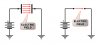
The circuit on the left is immediately recognized as a fully-charged capacitor between the two nodes. The circuit on the right is recognized as an open circuit between the nodes. In reality, the only difference between the two is the relative magnitude of the capacitance between the nodes. The open circuit has an electric field present between the nodes, and a small stray capacitance that is usually not shown on schematic diagrams. The fully charged capacitor behaves the same as the open circuit while in its steady state, having an electric field between the plates and no current flow at either node. The conclusion must be that a fully charged capacitor in the steady state is an open circuit.