so, had been working on boards to drive a motor.
one is a triple half-bridge, with 12x MJE3055Ts, in turn driven with 3x TIP122 or TIP127 transistors.
two 3055Ts are naively wired in parallel, which is theoretically a terrible way to do it, but in past tests it doesn't seem to blow up. this is to stretch the current-handling limits a little beyond what 3055Ts can do normally.
the thinking is that this board will be cooled by submerging it in vegetable oil (this is what I have on hand). it will probably be run between 24 and 36 volts. the hope is that the board can stay cool enough to keep the motor running.
a few past air-cooled drivers would overheat, and periodically the transistors would get "stuck" in an on state until the board could cool off (but generally recover normal behavior if given a chance to cool off). this limited most tests to only running the motor briefly and at low power.
there is another control board, which contains the logic, and will run an MSP430 and send control signals to the H-bridge, which generally lacks its own control electronics.
it uses a series of 220ohm 1W resistors and some zener diodes to try to generate the 3.3v voltage (as-is, getting closer to 3.7v). in retrospect I may have been better off using a zener and a transistor. at 36v, these resistors still get rather hot. an issue though is that 3 fully-charged batteries will go out of spec for some of the components on the control board, which is less clear how to best address (left to wonder about using a 3906 as a 40v zener, but no idea how reliable this would be).
though, I have noted in past tests, that the breakdown voltage seems to be around 50% over the rated absolute maximum, which means ~ 60v before C/E breakdown is likely.
some pull-ups/downs use 10k 1/4W resistors, with the higher resistance needed because of the voltage (for 12v, would have used 1k resistors, but a 1k resistor is not happy at 36v).
motor control (L) and driver (R) boards:
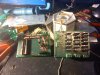
motor control board on top of motor:
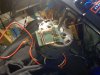
motor is a converted HVAC induction motor. it has worked with prior less powerful drivers, but the hope is to be able to get decent power out of it (higher voltage, more current, and more RPM, ex, maybe run it with 90Hz and get 5000 RPM or so).
as-is, the motor is 2-pole wye wound. internally, there are 6 coils, and opposing coils are wired in parallel. the coils are then wired in Wye configuration. the coils use 22AWG windings (*).
it appears giving it 60Hz can sustain a coil voltage of around 20v.
theory goes I can run about 12 amps per phase or so.
*: the motor had multiple sets of coils, but the bigger/heavier-gauge coil was used for the 3ph conversion. the other set of coils is offset and uses thinner wire. thus far it had been ignored.
I am not actually sure how much output power I can expect from a motor like this, it is all a bit hit or miss. how much would be possible with a good motor driver?... (past tests basically gave results about like an oversized power-drill).
power-source is generally using multiple lead-acid UPS batteries.
also, suggestions for large/cheap motors and batteries would be nice (for motors well into the kW range, and battery packs in the range of maybe 100V 200Ah or so). best I have seen thus far has been random stuff on Alibaba, but still pretty expensive... (main thing I had seen in this are was 440v oil-cooled induction motors). this would be for someone casually building a full-sized EV or similar.
this will not happen anytime soon though, because, money...
any thoughts?...
one is a triple half-bridge, with 12x MJE3055Ts, in turn driven with 3x TIP122 or TIP127 transistors.
two 3055Ts are naively wired in parallel, which is theoretically a terrible way to do it, but in past tests it doesn't seem to blow up. this is to stretch the current-handling limits a little beyond what 3055Ts can do normally.
the thinking is that this board will be cooled by submerging it in vegetable oil (this is what I have on hand). it will probably be run between 24 and 36 volts. the hope is that the board can stay cool enough to keep the motor running.
a few past air-cooled drivers would overheat, and periodically the transistors would get "stuck" in an on state until the board could cool off (but generally recover normal behavior if given a chance to cool off). this limited most tests to only running the motor briefly and at low power.
there is another control board, which contains the logic, and will run an MSP430 and send control signals to the H-bridge, which generally lacks its own control electronics.
it uses a series of 220ohm 1W resistors and some zener diodes to try to generate the 3.3v voltage (as-is, getting closer to 3.7v). in retrospect I may have been better off using a zener and a transistor. at 36v, these resistors still get rather hot. an issue though is that 3 fully-charged batteries will go out of spec for some of the components on the control board, which is less clear how to best address (left to wonder about using a 3906 as a 40v zener, but no idea how reliable this would be).
though, I have noted in past tests, that the breakdown voltage seems to be around 50% over the rated absolute maximum, which means ~ 60v before C/E breakdown is likely.
some pull-ups/downs use 10k 1/4W resistors, with the higher resistance needed because of the voltage (for 12v, would have used 1k resistors, but a 1k resistor is not happy at 36v).
motor control (L) and driver (R) boards:
motor control board on top of motor:
motor is a converted HVAC induction motor. it has worked with prior less powerful drivers, but the hope is to be able to get decent power out of it (higher voltage, more current, and more RPM, ex, maybe run it with 90Hz and get 5000 RPM or so).
as-is, the motor is 2-pole wye wound. internally, there are 6 coils, and opposing coils are wired in parallel. the coils are then wired in Wye configuration. the coils use 22AWG windings (*).
it appears giving it 60Hz can sustain a coil voltage of around 20v.
theory goes I can run about 12 amps per phase or so.
*: the motor had multiple sets of coils, but the bigger/heavier-gauge coil was used for the 3ph conversion. the other set of coils is offset and uses thinner wire. thus far it had been ignored.
I am not actually sure how much output power I can expect from a motor like this, it is all a bit hit or miss. how much would be possible with a good motor driver?... (past tests basically gave results about like an oversized power-drill).
power-source is generally using multiple lead-acid UPS batteries.
also, suggestions for large/cheap motors and batteries would be nice (for motors well into the kW range, and battery packs in the range of maybe 100V 200Ah or so). best I have seen thus far has been random stuff on Alibaba, but still pretty expensive... (main thing I had seen in this are was 440v oil-cooled induction motors). this would be for someone casually building a full-sized EV or similar.
this will not happen anytime soon though, because, money...
any thoughts?...