2 transistor circuit input output question.

Tha fios agaibh

Aug 11, 2014
2,253
Joined
Aug 11, 2014
Messages
2,253
A voltage source set to zero output and connected between two points in a circuit effectively shorts out the two points. That is the basis for finding the Thevenin resistance, right?
Set to zero output? I assume you mean the load removed? I realize it's insignificant but, What about the current drawn by the biasing resistors?
 

Tha fios agaibh

Aug 11, 2014
2,253
Joined
Aug 11, 2014
Messages
2,253
if I look just at the part of the circuit we are trying to find the Thevenin equivalent for (the 10V source, the 20k and the 5k, removing everything else) and I tried to measure the resistance between the two points A and B, what would I find? And if I tried to calculate that resistance, how would I do it? (For the moment forgetting about Thevenin's theorem.)
A false reading since there is current flowing through the resistors and your dc meter applies its own to it.
Just knowing its a voltage divider, you can calculate that 8v is dropped across the 20k and 2v across the 5k. Totaling the 10v supply.
 

Tha fios agaibh

Aug 11, 2014
2,253
Joined
Aug 11, 2014
Messages
2,253
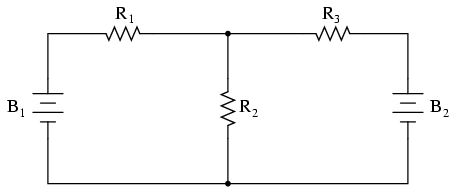
Well, folks, Thevenin Equivalent Circuit is supposed to simplify things... I recall the classic problem of two voltage sources of arbitrary value and polarity, each connected to a series resistor, with the other end of each of those two resistors connected to a third resistor and thence to common of the two power supplies. Calculate current and voltage drop across all three resistors. Ain't superposition wunnerful?
Indeed, and what a great tool it is.
This is way up there with ohms law.
I appreciate everyone steering me around my mental road blocks.

Ps; "Thence"... Thoust fanciful words. Lol
 

dorke

Jun 20, 2015
2,342
Joined
Jun 20, 2015
Messages
2,342
Well John,
If it makes life easier for you here is another aspect of the same thing.
Think about the AC equivalent circuit,same thing, replacing the PS with it's internal resistance (=zero).
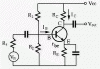
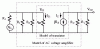
Look at the pics below ,in the AC equivalent circuit ==>
R1 is in parallel with R2 and appear between Base and GND.
Rc is connected between Collector and GND(not VCC).

Like I said before, we do that all the time...
assuming that the power supply is an ideal one,thus it's resistance is zero;)
ACamplification1.gif
ACamplification2a.gif
 

dorke

Jun 20, 2015
2,342
Joined
Jun 20, 2015
Messages
2,342
Or even 8V / 2mA is 4kΩ
But I do like this idea, as it seems to fit with the Thevenin model.

I wonder whether it might help to ask oneself, if I look just at the part of the circuit we are trying to find the Thevenin equivalent for (the 10V source, the 20k and the 5k, removing everything else) and I tried to measure the resistance between the two points A and B, what would I find? And if I tried to calculate that resistance, how would I do it? (For the moment forgetting about Thevenin's theorem.)

Measuring the equivalent resistance,like that:
Since there is a voltage source involved you can not do a direct resistance measurement,thus:
Measure the open circuit voltage.(Voc)
Measure the short circuit current (Isc).
From the two calculate Req=Voc/Isc
Note:There is never a problem with measuring Voc,
but measuring Isc may not be possible in some cases where a short circuit may blow up devices/fuses or cause the power supply to enter into "current limit protection".(not in this case though).

Calculating can be done in the same way as the measurement by calculating Voc and Isc.
Or by the replacement of the 10V PS with zero ohm and calculating the resistance directly.
 
Last edited:

dorke

Jun 20, 2015
2,342
Joined
Jun 20, 2015
Messages
2,342
Well, folks, Thevenin Equivalent Circuit is supposed to simplify things... I recall the classic problem of two voltage sources of arbitrary value and polarity, each connected to a series resistor, with the other end of each of those two resistors connected to a third resistor and thence to common of the two power supplies. Calculate current and voltage drop across all three resistors. Ain't superposition wunnerful?

Hop,
I think the Classic Case should be the " Loaded Wheatstone Bridge".
Solving it with Thvenin's equivalent simplifies life a lot.

Wheatstone bridge.jpg
 

hevans1944

Hop - AC8NS
Jun 21, 2012
4,968
Joined
Jun 21, 2012
Messages
4,968
Hop,
I think the Classic Case should be the " Loaded Wheatstone Bridge".
Solving it with Thvenin's equivalent simplifies life a lot. ...
Yes, it sure does. But the "Two Sources with Shared Load" problem is the one I most vividly remember:
00207.png

A good tutorial that analyzes both circuits using a variety of methods can be found here.
 
Last edited:

Ratch

Mar 10, 2013
1,102
Joined
Mar 10, 2013
Messages
1,102
I think of a parallel as physically connected at both ends, not having a battery in series with it.
In this example the 5k hooks to +, and the 20k hooks to - (neg). To me that's not the same node.
I guess I'm thinking of the battery as a component.
Being in parallel does not require a battery or voltage source. I carefully explained in post #32 that the current splits into two paths, the 2k0 resistor and the transistor base. Throw away the battery and the parallel topology is still the same. Both those paths are physically connected at both ends. What don't you understand about that?

Ratch
 

Ratch

Mar 10, 2013
1,102
Joined
Mar 10, 2013
Messages
1,102
Set to zero output? I assume you mean the load removed? I realize it's insignificant but, What about the current drawn by the biasing resistors?

Perhaps this will illustrate better what I am saying. It is the Norton equivalent circuit. It shows that if the resistance looking into the transistor base is many times larger than the Norton resistance, then the base voltage is stabilized close to 8 volts.

Tha.JPG

Ratch
 

Tha fios agaibh

Aug 11, 2014
2,253
Joined
Aug 11, 2014
Messages
2,253
Both those paths are physically connected at both ends. What don't you understand about that?
I don't understand how you can say that they are "physically connected".

You could say; Using thevenin or Norton's theory it is considered connected. Or, as far as the circuit is evaluated, they are essentially connected together.
I don't mean to nit pick here, I just want to be clear.
If I have two parallel resistors soldered together and I snip apart at one end and solder in a battery to them, I no longer have parallel resistors. I have a series circuit in my eyes.

Would it be more accurate to say;
A step required to calculate Rth is to consider the power source as zero volts and zero ohms?
 

Ratch

Mar 10, 2013
1,102
Joined
Mar 10, 2013
Messages
1,102
I don't understand how you can say that they are "physically connected".

You could say; Using thevenin or Norton's theory it is considered connected. Or, as far as the circuit is evaluated, they are essentially connected together.
I don't mean to nit pick here, I just want to be clear.
If I have two parallel resistors soldered together and I snip apart at one end and solder in a battery to them, I no longer have parallel resistors. I have a series circuit in my eyes.

Would it be more accurate to say;
A step required to calculate Rth is to consider the power source as zero volts and zero ohms?

It becomes a series circuit after it is Theveninized. The two base resistors are folded into the Thevenin resistance. You don't need to apply the Thevenin or Norton method to see what is happening to the base circuit. Just keep the bottom base resistor less than 1/10 of the transistor base resistance (Re*(beta+1)) and everything will be fine.

Ratch
 

Tha fios agaibh

Aug 11, 2014
2,253
Joined
Aug 11, 2014
Messages
2,253
It becomes a series circuit after it is Theveninized. The two base resistors are folded into the Thevenin resistance. You don't need to apply the Thevenin or Norton method to see what is happening to the base circuit. Just keep the bottom base resistor less than 1/10 of the transistor base resistance (Re*(beta+1)) and everything will be fine.

Ratch
Thank you, your clarity is appreciated.
 

dorke

Jun 20, 2015
2,342
Joined
Jun 20, 2015
Messages
2,342
I don't understand how you can say that they are "physically connected".

You could say; Using thevenin or Norton's theory it is considered connected. Or, as far as the circuit is evaluated, they are essentially connected together.
I don't mean to nit pick here, I just want to be clear.
If I have two parallel resistors soldered together and I snip apart at one end and solder in a battery to them, I no longer have parallel resistors. I have a series circuit in my eyes.

Would it be more accurate to say;
A step required to calculate Rth is to consider the power source as zero volts and zero ohms?


I would put it this way:
A step required to calculate Rth is :
Independent Voltage or Current Sources are replaced by their internal resistances.
For an Ideal Voltage source
(like we assume normally) the internal resistance is zero
For an Ideal Current source
(like we assume normally) the internal resistance is infinite.
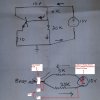
Look at the 10V P.S in the re-posted drawing below,
it is still there but replaced by a short (it's internal resistance, as an ideal voltage source).

Note that we do the exact same thing when we draw the AC equivalent circuit like in #44. and that has nothing to do with the Thevenin Theorem !

1454022469929.jpg
 

dorke

Jun 20, 2015
2,342
Joined
Jun 20, 2015
Messages
2,342
Let us do a demonstration of how the Thevenin Theorem simplifies the calculation of the classical
Loaded Wheatstone bridge(an important "tool" in many areas).
We want to know all aspects of the Load and "Driving Network" and the relationship between them.
Here is the circuit:
Wheatstone bridge.jpg

We could do that in the traditional Loop method or Node method .
In either case there would be 3 equations with 3 unknowns to solve.
Complicated, and a lot of potential for errors...
Like so:
Wheatstone bridge-I.JPG

Solving it with Thevenin:
1) First step, we disconnect the Load and calculate the open circuit voltage that is Vab.

Wheatstone bridge-Vth.JPG

That is immediate and intuitive.
we have two parallel branches:
one consists of R1 and R2 in series and the other of R3 and R4 in series.
Voltages are relative to "GND"(the negative of Vs,our reference point).
The simplest voltage divider yields:
Va=VR2= Vs*[R2/(R1+R2)]
Vb=VR4= Vs*[R4/(R3+R4)]
Vab=Va-Vb=Vs*[R2/(R1+R2)]-Vs*[R4/(R3+R4)]

Vth=Vab=Vs*[R2/(R1+R2) - R4/(R3+R4)]
That is kids stuff easy,isn't it?;)
Not only that ,
there is great insight here(very often overlooked):
Vth is the maximum absolute possible voltage on any RL connected
i.e for a given bridge and Vs values we can't get above Vth volts on any RL!

Next we calculate Rth (in next post)
 
Last edited:
Top