
Calculating Rth.
We replace the voltage source Vs with it's internal resistance
Like so:

for simplicity and demonstration we redraw the circuit like so:
Rs is moved ,the connection is the same.

Again for demonstration we redraw like so: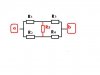
Now we note that Vs is an ideal voltage source thus Rs=0
and we get the following circuit:
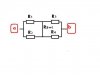 Thus we have
Rth= (R1||R2) + (R3||R4)
again kids stuff easy,isn't it
That's it falks,done.
We can calculate any RL related issues:
VL,IL,PLmax,etc.
As well as the bridge issues:
what is the maximum voltage and current it can supply,
what is it's "output resistance",when is it "balanced" etc.
For example:what is the maximum current possible
Imax=Vth/Rth
no surprises here:
Imax=iN i.e Northon current
Thevenin equivalent circuit:
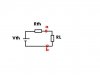
We replace the voltage source Vs with it's internal resistance
Like so:
for simplicity and demonstration we redraw the circuit like so:
Rs is moved ,the connection is the same.
Again for demonstration we redraw like so:
Now we note that Vs is an ideal voltage source thus Rs=0
and we get the following circuit:
Thus we haveRth= (R1||R2) + (R3||R4)
again kids stuff easy,isn't it
That's it falks,done.
We can calculate any RL related issues:
VL,IL,PLmax,etc.
As well as the bridge issues:
what is the maximum voltage and current it can supply,
what is it's "output resistance",when is it "balanced" etc.
For example:what is the maximum current possible
Imax=Vth/Rth
no surprises here:
Imax=iN i.e Northon current
Thevenin equivalent circuit:
Last edited:


