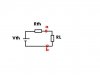
2 transistor circuit input output question.

dorke

Jun 20, 2015
2,342
Joined
Jun 20, 2015
Messages
2,342
Calculating Rth.
We replace the voltage source Vs with it's internal resistance
Like so:

Wheatstone bridge-Rth.JPG

for simplicity and demonstration we redraw the circuit like so:
Rs is moved ,the connection is the same.

Wheatstone bridge-Rth moved.JPG

Again for demonstration we redraw like so:Wheatstone bridge-Rth sqr.JPG
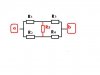
Now we note that Vs is an ideal voltage source thus Rs=0
and we get the following circuit:
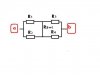
Wheatstone bridge-Rs 0.JPG Thus we have
Rth= (R1||R2) + (R3||R4)
again kids stuff easy,isn't it;)
That's it falks,done.

We can calculate any RL related issues:
VL,IL,PLmax,etc.
As well as the bridge issues:
what is the maximum voltage and current it can supply,
what is it's "output resistance",when is it "balanced" etc.

For example:what is the maximum current possible
Imax=Vth/Rth
no surprises here:
Imax=iN i.e Northon current;)

Thevenin equivalent circuit:

Wheatstone bridge-th.JPG
 
Last edited:

Ratch

Mar 10, 2013
1,102
Joined
Mar 10, 2013
Messages
1,102
Let us do a demonstration of how the Thevenin Theorem simplifies the calculation of the classical
Loaded Wheatstone bridge(an important "tool" in many areas).
We want to know all aspects of the Load and "Driving Network" and the relationship between them.
Here is the circuit:
View attachment 24773

We could do that in the traditional Loop method or Node method .
In either case there would be 3 equations with 3 unknowns to solve.
Complicated, and a lot of potential for errors...
Like so:
View attachment 24774

Solving it with Thevenin:
1) First step, we disconnect the Load and calculate the open circuit voltage that is Vab.

View attachment 24775

That is immediate and intuitive.
we have two parallel branches:
one consists of R1 and R2 in series and the other of R3 and R4 in series.
Voltages are relative to "GND"(the negative of Vs,our reference point).
The simplest voltage divider yields:
Va=VR2= Vs*[R2/(R1+R2)]
Vb=VR4= Vs*[R4/(R3+R4)]
Vab=Va-Vb=Vs*[R2/(R1+R2)]-Vs*[R4/(R3+R4)]

Vth=Vab=Vs*[R2/(R1+R2) - R4/(R3+R4)]
That is kids stuff easy,isn't it?;)
Not only that ,there is great insight here(very often overlooked)
Vth is the maximum absolute possible voltage on any RL connected
i.e for a given bridge and Vs values we can't get above Vth volts on any RL!

Yes, but what values can Vth be? If just R1 & R4 both equal zero, then Vth = Vs. If just R2 & R3 both equal zero, then Vth = -Vs . So Vth can be ±Vs , which is the voltage limit of RL .

Ratch
 

Ratch

Mar 10, 2013
1,102
Joined
Mar 10, 2013
Messages
1,102
Calculating Rth.
We replace the voltage source Vs with it's internal resistance
Like so:

View attachment 24778

for simplicity and demonstration we redraw the circuit like so:
Rs is moved ,the connection is the same.

View attachment 24780

Again for demonstration we redraw like so:View attachment 24781
Now we note that Vs is an ideal voltage source thus Rs=0
and we get the following circuit:

View attachment 24782 Thus we have
Rth= (R1||R2) + (R3||R4)
again kids stuff easy,isn't it;)
That's it falks,done.

We can calculate any RL related issues:
VL,IL,PLmax,etc.
As well as the bridge issues:
what is the maximum voltage and current it can supply,
what is it's "output resistance",when is it "balanced" etc.

For example:what is the maximum current possible
Imax=Vth/Rth
no surprises here:
Imax=iN i.e Northon current;)

Thevenin equivalent circuit:

View attachment 24783

What do you do when Vs contains a finite Rs? According to the schematic, you will have another bridge circuit.
 

hevans1944

Hop - AC8NS
Jun 21, 2012
4,968
Joined
Jun 21, 2012
Messages
4,968
From a practical point of view, Wheatstone bridges are usually used in a nearly balanced configuration (four strain gauges for instance) with a constant-voltage excitation, or an excitation that is sensed at the bridge and used as a reference for the circuitry that processes the bridge differential output, for example an analog-to-digital converter whose output ratios the bridge output to the excitation. The current loop equations are easily solved, but the Thevinin Equivalent Circuit provides a quick answer if the source impedance can be neglected. The effect of finite source impedance (long lead wires from source to bridge for example) is to lower the bridge excitation at the bridge, thus decreasing sensitivity to bridge unbalance which is important if that unbalance is what you are trying to measure. Many ways to solve this problem, but another pair of wires to measure the voltage at the bridge excitation terminals is probably the most common. Most Wheatstone bridge configurations have a very limited range in the active resistance variation and use a high-impedance load, so analytical calculations get lost in the noise (literally) while you try to figure out how to recover the bridge signal in the presence of common-mode voltages and other disturbances from nearby electrical sources. But good hopelessly pedantic points, @Ratch!
 

dorke

Jun 20, 2015
2,342
Joined
Jun 20, 2015
Messages
2,342
Yes, but what values can Vth be? If just R1 & R4 both equal zero, then Vth = Vs. If just R2 & R3 both equal zero, then Vth = -Vs . So Vth can be ±Vs , which is the voltage limit of RL .

Ratch

Of course ±Vs is the trivial case for a maximum.
But it is also a non-interesting one since this isn't a bridge any more just 2 resistors in parallel connected across Vs .

The interesting case is R1~=R2 and R3~=R4.
i.e. "almost or about" a balanced bridge.
 

dorke

Jun 20, 2015
2,342
Joined
Jun 20, 2015
Messages
2,342
What do you do when Vs contains a finite Rs? According to the schematic, you will have another bridge circuit.

Yes that is correct.
But still ,being a Voltage Source the internal resistance should be very low relative to the "load" connected to the power supply.
In any case we can do a transformation from delta to Y and do an accurate calculation like so:
Delta to Y.jpg
for "small" Rs :
For Ra,Rb we can chose any pair R1,R2 or R3,R4.
RC=Rs.
Choosing arbitrarily RA=R1 and RB=R2.
Lets assume R1>>Rs and R2>>Rs
and show that we get the case of Rs=0.

Now lets evaluate the denominator RA+RB+RC.
since R1+R2 >>Rs we get R1+R2 .
So R'3= R1*R2/[R1+R2]= R1||R2 .
and
R'1=RB*(RA/RC +RB/RC) =R2*(R1/RS+R2/Rs) -->0
R'2=RA*(RA/RC +RB/RC) =R1*(R1/RS+R2/Rs) -->0

And we get the same result like the case when Rs=0 :)
 
Last edited:

Ratch

Mar 10, 2013
1,102
Joined
Mar 10, 2013
Messages
1,102
Of course ±Vs is the trivial case for a maximum.
But it is also a non-interesting one since this isn't a bridge any more just 2 resistors in parallel connected across Vs .

The interesting case is R1~=R2 and R3~=R4.
i.e. "almost or about" a balanced bridge.

My observation was not about how interesting it was. It was about what the range of Vth was. You stated that the voltage across RL could never be greater than Vth, but you never said what Vth could be.

Ratch
 

dorke

Jun 20, 2015
2,342
Joined
Jun 20, 2015
Messages
2,342
Of course I said...it is in the formula in #60.

Your observation is trivial ,not interesting,
and more than that meaningless.
 

Ratch

Mar 10, 2013
1,102
Joined
Mar 10, 2013
Messages
1,102
Calculating Rth.
We replace the voltage source Vs with it's internal resistance
Like so:

View attachment 24778

for simplicity and demonstration we redraw the circuit like so:
Rs is moved ,the connection is the same.

View attachment 24780

Again for demonstration we redraw like so:View attachment 24781
Now we note that Vs is an ideal voltage source thus Rs=0
and we get the following circuit:

View attachment 24782 Thus we have
Rth= (R1||R2) + (R3||R4)
again kids stuff easy,isn't it;)
That's it falks,done.

We can calculate any RL related issues:
VL,IL,PLmax,etc.
As well as the bridge issues:
what is the maximum voltage and current it can supply,
what is it's "output resistance",when is it "balanced" etc.

For example:what is the maximum current possible
Imax=Vth/Rth
no surprises here:
Imax=iN i.e Northon current;)

Thevenin equivalent circuit:

View attachment 24783
I think you forget to calculate the Thevenin open circuit voltage. It is Vs * Rbridge/(Rs+Rbridge) where Rbridge is the resistance from the top of the bridge to the bottom.

I would attack that problem a different way. I would divide the open V_ab by the short current I_ab.

Ratch
 

dorke

Jun 20, 2015
2,342
Joined
Jun 20, 2015
Messages
2,342
I think you forget to calculate the Thevenin open circuit voltage. It is Vs * Rbridge/(Rs+Rbridge) where Rbridge is the resistance from the top of the bridge to the bottom.

I would attack that problem a different way. I would divide the open V_ab by the short current I_ab.

Ratch

??? go a head,show it .
 

Ratch

Mar 10, 2013
1,102
Joined
Mar 10, 2013
Messages
1,102
Of course I said...it is in the formula in #60.

Your observation is trivial ,not interesting,
and more than that meaningless.
Isn't it more concise to say that the range of Vth is between -Vs to +Vs instead of a formula that has to be evaluated?

Ratch
 

Ratch

Mar 10, 2013
1,102
Joined
Mar 10, 2013
Messages
1,102
??? go a head,show it .
OK, the derivation is shown below. The Thevenin resistance is shown with Rs taken into consideration. If Rs is zero, then the expression equals what you derived.
Dorke.JPG
Ratch
 

dorke

Jun 20, 2015
2,342
Joined
Jun 20, 2015
Messages
2,342
Isn't it more concise to say that the range of Vth is between -Vs to +Vs instead of a formula that has to be evaluated?

Ratch

Obviously that is true but,
surly you can see it is absolutely trivial.

I copy from #60:

Vth=Vab=Vs*[R2/(R1+R2) - R4/(R3+R4)]

That is the general case,
including the Trivial("extreme") case you talk about,
which isn't actually a bridge anymore.

The "Formula" enables us to find the Max Voltage(Design if that is a requirement) a given bridge can "output".
That is Insight/"design power" to me...

e.g.
Say you are asked to design a bridge that will deliver a max voltage of |3V| while being driven by a 5V P.S and have an output resistance of 1k.
Or the other way around ,for that given(known) bridge.
What would the max voltage the bridge can output to any load.
 

dorke

Jun 20, 2015
2,342
Joined
Jun 20, 2015
Messages
2,342
OK, the derivation is shown below. The Thevenin resistance is shown with Rs taken into consideration. If Rs is zero, then the expression equals what you derived.
View attachment 24805
Ratch

It looks so much more complicated this way.

a note:
You use the notation Vab ,it is a bit confusing,since that notation normally means the voltage between a and b.
I think you should have used Vb instead.
I didn't check the Zth expression...too long;)

And,
Yes, for Rs not zero we have to take that into account while calculating Vth.
But If "Rbridge" >> Rs ,we can neglect it .
that is for (R1+R2)||(R3+R4) >>Rs we can neglect the effect of Rs on Vth.

Again,
we have to keep in mind that we are talking about a Power Supply "feeding" a circuit thus
"Rbridge" >> Rs is a given!
 
Last edited:

hevans1944

Hop - AC8NS
Jun 21, 2012
4,968
Joined
Jun 21, 2012
Messages
4,968
I want to amend my post #64: both of you are hopelessly pedantic. That's a good thing, right?:D
 

Ratch

Mar 10, 2013
1,102
Joined
Mar 10, 2013
Messages
1,102
It looks so much more complicated this way.

Which does? The derivation or the result? No one can truthfully change the result. Show me a shorter derivation that takes Rs into consideration.

a note:
You use the notation Vab ,it is a bit confusing,since that notation normally means the voltage between a and b.
I think you should have used Vb instead.
Look again. I annotated that on the same line as the equation. I said Va or Vb.

I didn't check the Zth expression...too long;)
Yes, it is a complicated expression. Can't help that. It is what it is. Notice that it reduces to the correct expression when Rs-->0. That is a good indication of its correctness.

And,
Yes, for Rs not zero we have to take that into account while calculating Vth.
But If "Rbridge" >> Rs ,we can neglect it .
that is for (R1+R2)||(R3+R4) >>Rs we can neglect the effect of Rs on Vth.

Again,
we have to keep in mind that we are talking about a Power Supply "feeding" a circuit thus
"Rbridge" >> Rs is a given!
For practical purposes, Rs can be ignored. For theoretical and pendantical purposes, it can be calculated.

Ratch
 

dorke

Jun 20, 2015
2,342
Joined
Jun 20, 2015
Messages
2,342
I want to amend my post #64: both of you are hopelessly pedantic. That's a good thing, right?:D

Not necessarily so...;)
As we say in my places(translated)
Be careful, You may not see the forest for the trees...:rolleyes:
 

Martaine2005

May 12, 2015
5,276
Joined
May 12, 2015
Messages
5,276
@Tha fios agaibh
Thanks John for asking the same questions that I would! Without your/my questioning, I wouldn't be any closer to understanding..
That was a great discussion and the different examples helped me a lot.
So thanks guys..

Martin
 
Top