Capacitor question

HellasTechn

Apr 14, 2013
1,579
Joined
Apr 14, 2013
Messages
1,579
Hello friends !

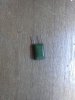
I would like to ask about this capacitor. I have seen such in old telephone sets and in switching PSU's. What kind of caps are they and what are they mainly used for (audio applications?) ? Also how can we read it's value ? Is it the same way we read ceramics ?

Thank you !
 

Attachments

  • IMG20161012_002.jpg
    IMG20161012_002.jpg
    184.3 KB · Views: 102

davenn

Moderator
Sep 5, 2009
14,470
Joined
Sep 5, 2009
Messages
14,470
Is there some guide about which kind of capacitor is better for a cpecific application ?

For example, which is better for audio filtering, which is better for decoupling etc.

the basics of that is answered in the link you gave .... keep reading :)

Dave
 

HellasTechn

Apr 14, 2013
1,579
Joined
Apr 14, 2013
Messages
1,579
So 1 cap lead to the Mains ac socket (line) and the other lead to say red probe of DMM and then the black of the DMM to neutral of the Mains socket ? and then reverse the cap and read again ?
 
Last edited by a moderator:

HellasTechn

Apr 14, 2013
1,579
Joined
Apr 14, 2013
Messages
1,579
the basics of that is answered in the link you gave .... keep reading :)

I have. For theese specific caps they say this
"These are also very popular for high-frequency circuits,"

so ? what are they good for ? Serving as HF filters ?
 

davenn

Moderator
Sep 5, 2009
14,470
Joined
Sep 5, 2009
Messages
14,470
I have. For theese specific caps they say this
"These are also very popular for high-frequency circuits,"

so ? what are they good for ? Serving as HF filters ?


for those "greencaps" their common nickname for obvious reasons, audio use, definitely wouldn't use them for RF
 

davenn

Moderator
Sep 5, 2009
14,470
Joined
Sep 5, 2009
Messages
14,470
So 1 cap lead to the Mains ac socket (line) and the other lead to say red probe of DMM and then the black of the DMM to neutral of the Mains socket ? and then reverse the cap and read again ?

NO, NO, NOOOOOOOOOO

Edd did say gnd socket ................... but still very dangerous advice, I have deleted his post and edit it out of your post
don't ever go near trying
 

HellasTechn

Apr 14, 2013
1,579
Joined
Apr 14, 2013
Messages
1,579
Please go ahead and delete my post #4 and this one. Better be on the safe side.
 

HellasTechn

Apr 14, 2013
1,579
Joined
Apr 14, 2013
Messages
1,579
for those "greencaps" their common nickname for obvious reasons, audio use, definitely wouldn't use them for RF

See ?
This is what i am talking about, while this site states they are popular at high freq circuits, you say not for RF.

While i have very limited gnowledge on electronics it is not easy for me to understand what they are best used for.
And then i ask is there something like a guide thet someone like me can look and quickly figure out what kind of cap to use in some circuit ?

For example i know that for smoothing we use electrolytics.
 

HellasTechn

Apr 14, 2013
1,579
Joined
Apr 14, 2013
Messages
1,579
for those "greencaps" their common nickname for obvious reasons,
Is "Greencap" their nickname ? i dont know how that relates to audio but please, please don't take me wrong it may very well be my poor skill in english (some idiom i am not aware of).
 

Arouse1973

Adam
Dec 18, 2013
5,178
Joined
Dec 18, 2013
Messages
5,178
It looks like a Mylar film cap to me, might be wrong. If it is then they are classed as general purpose caps normally for DC and can be made to withstand very high voltages. They can have large losses in AC circuits at high temperatures.
Thanks
Adam
 

davenn

Moderator
Sep 5, 2009
14,470
Joined
Sep 5, 2009
Messages
14,470
Is "Greencap" their nickname ?

for those "greencaps" their common nickname for obvious reasons,


This is what i am talking about, while this site states they are popular at high freq circuits, you say not for RF.

I wouldn't use them (and you will never see them in signal paths of HF (high freq and up) circuits) in RF circuits over a MHz or two, they are not stable enough


For example i know that for smoothing we use electrolytics.

yes and also commonly used in audio circuits as interstage coupling of the signal ... between inputs and preamps, then between preamp and power amp stages


Also how can we read it's value ? Is it the same way we read ceramics ?


That was sorta answered in that link.....

capacitors are marked in 5 common ways

1) the direct uF value 100uF, 1uF, 0.1 uF etc

2) indirect uF way, by showing a decimal value, .1, .001 etc ( the leading zero is commonly dropped to save space
if you see a cap with .1 on it, IT WILL be 0.1 uF

3) the 3 digit code, saves lots of space, 106, 104, 103, 102, 683 etc = 10uF, 0.1uF, 0.01uF, 0.001uF, 0.068uF = (68nF / 68000pF)

4) any ceramic, mylar, polyprop, polyester cap marked in whole numbers eg 10, 1000, 2200 is a pF value eg 2200 = 2200pF

5) not really seen any more but really old tubular caps and some very small caps during 70's and '80's used colour banding like resistors

an example was in another thread over the last couple of days .....
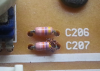
upload_2016-10-28_8-25-13.png

you can see the lower one has spewed its guts and let out the "magic smoke"


Dave
 

davenn

Moderator
Sep 5, 2009
14,470
Joined
Sep 5, 2009
Messages
14,470
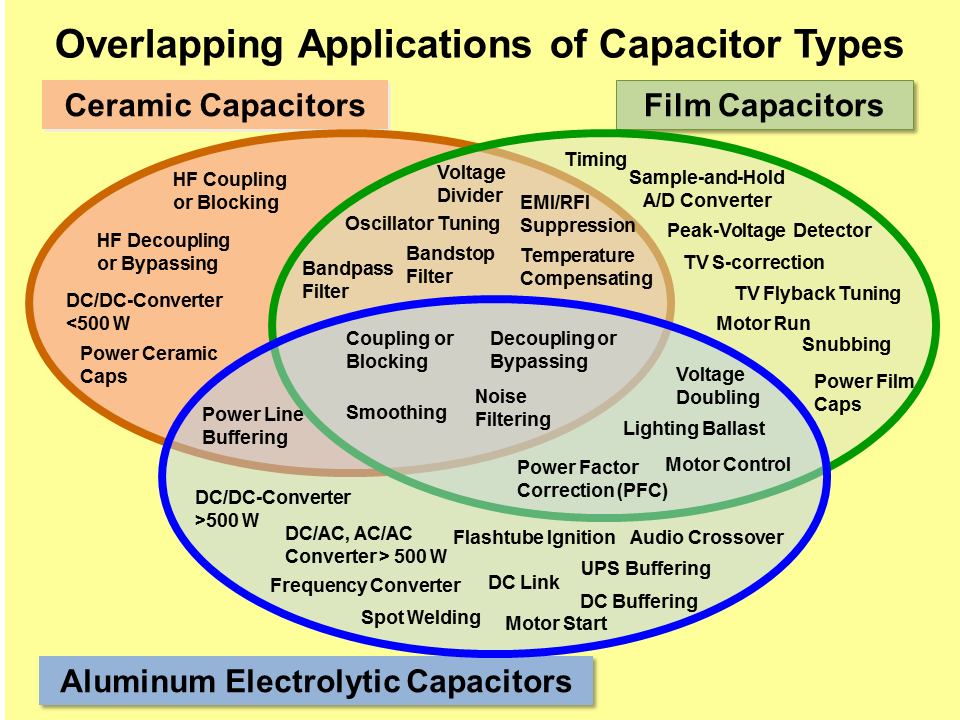
a nice chart I just found

Capacitors-Overlapping-Applications.png


Dave
 

davenn

Moderator
Sep 5, 2009
14,470
Joined
Sep 5, 2009
Messages
14,470
While i have very limited gnowledge on electronics it is not easy for me to understand what they are best used for.
And then i ask is there something like a guide thet someone like me can look and quickly figure out what kind of cap to use in some circuit ?

you would do well to read the section in the wiki entry, about 1/2 way down the page

https://en.wikipedia.org/wiki/Capacitor_types

Comparison of types an extensive table of types, their make up, uses and disadvantages
 

Arouse1973

Adam
Dec 18, 2013
5,178
Joined
Dec 18, 2013
Messages
5,178
Further investigation reveals that Mylar is a trade name and is in fact PET a form of polyester, but there are more than one type of polyester :)
Adam
 
Top