Which resistor values are we talking about?The mosfets need to be quite similar, but not actually matched (in most cases where you are switching).
The important thing is that the mosfets have separate gate resistors to allow both of the mosfets to switch simultaneously even if they have slightly different Vgs(th) or Vgs/Id curves.
They are matched. What is your opinion on how many can I put in parallel? Will they than share the load? I need it to make a control for a wiper motor and I was thinking to use this circuit.They must be matched or the more sensitive one will do all the work and maybe burn out.
Not good in terms of efficiency. Using a switching controller as in your example reduces the thermal load on the driving transistor(s) considerably. Also note that many power MOSFETs are specifically designed for switching applications but are not well suited to linear operation (again an app-note by NXP).I was thinking to make a linear PSU
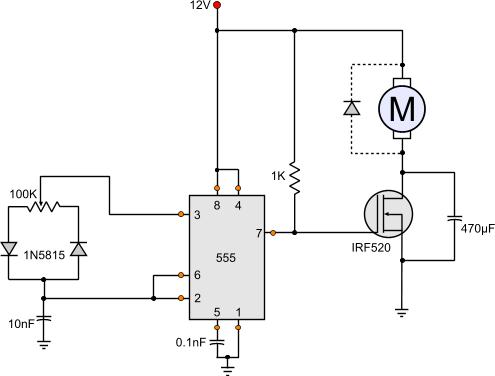
This circuit is basically correct, but has (imho) a few deficiencies for a practical application:I was thinking to use this circuit.
Ty for all the info. For the LC filter can I just put Electrolytic capacitor and one inductor. Could I use one stronger inductor from a broken pc psu?Paralleling of MOSFETs can be done comparatively easy in switching applications, but not so easily in linear applications. This application note gives lots of detailed information. Luckily your application is switching
Not good in terms of efficiency. Using a switching controller as in your example reduces the thermal load on the driving transistor(s) considerably. Also note that many power MOSFETs are specifically designed for switching applications but are not well suited to linear operation (again an app-note by NXP).
This circuit is basically correct, but has (imho) a few deficiencies for a practical application:
- The 12 V power supply will be very much distorted by the pulsed currrent through the motor and possibly high frequency noiuse from the commutator. I suggest you put an additional LC filter between the 12V supply and the motor.
- The 555 likes to have the power supply bufffered (as does most any IC), therefore place a 100 nF capacitor across the 555 from pin 8 to 1.
- The control signal from the 555's pin 7 to the gate of the MOSFET should have a series resistor to limit the gate current during switching. As you are going to have multiple MOSFETS, use separate resistors for each MOSFET.
- The 555 has a totem pole output. Therefore the 1k Pull up is not required.
However, as you are going to have multiple MOSFETS, the drive current from the 555 may be insufficient to ensure fast turn-on/turn-off of the MOSFETs. An additional driver circuit may be required.
The issue is described e.g. here. Figures 14 and 15 respectively show simple discrete transistorized driver circuits.
That's true for the static case. When switching, however, you have to take into account the gate-source capacitance. The IRF520 has a typical Cgs = 360 pF. When charged with 200 mA from a 555 the rise time of the gate voltage is ~21 ns. Or, in other words, if the rise time is faster, the current needs to be higher. As the typical output rise time or fall time of a 555 is on the order of 100 ns, this should not be the issue here for a single IRF520.The '555 has plenty of power to turn on the MOSFET, they need almost no power, they are voltage driven.
I dont know really, i just found this schematicThe '555 has plenty of power to turn on the MOSFET, they need almost no power, they are voltage driven.
But in the circuit you are using, it is the 1K resistor that supplies a positive voltage to the MOSFET. Depending on the frequency the '555 is running at, this might be too high.
Why are you not using the output pin (pin 3) to drive the MOSFET gate?
Bob
Yea but I'm using a HRF3205That's true for the static case. When switching, however, you have to take into account the gate-source capacitance. The IRF520 has a typical Cgs = 360 pF. When charged with 200 mA from a 555 the rise time of the gate voltage is ~21 ns. Or, in other words, if the rise time is faster, the current needs to be higher. As the typical output rise time or fall time of a 555 is on the order of 100 ns, this should not be the issue here for a single IRF520.
With multiple MOSFETS plus wiring capacitance it may become critical.
Sorry, I went by the schematic in post #3.Yea but I'm using a HRF3205
I see. I made another circuit based on ne555 and it works. I'm going to post schematic soon.Sorry, I went by the schematic in post #3.
With an HRS3205 matters get worse as Cgs = 4 nF, 10 times that of the IRF520. With the 200 mA from the 555 the rise time will be accordingly 10 times as long on the order of 200 ns. This may lead to local thermal overload of the MOSFET's internal structure. A faster driver is realy advised then.
I'm sorry, I forgot to mention that I sill used HRF3205 for testing purposes.With 2 nF Cgs max. and ~3 V Vgs(th) this BUZ111 will be turned on in ~30ns, faster if the real world transistor and NE555 have better parameters than the max. values from the datasheet. The limiting factor here is the output slew rate of the 555 (~100 ns). The gate-source voltage will follow this output voltage slope. As this is on the same order as the rise time and fall time of the BUZ11, it's imho quite o.k.,