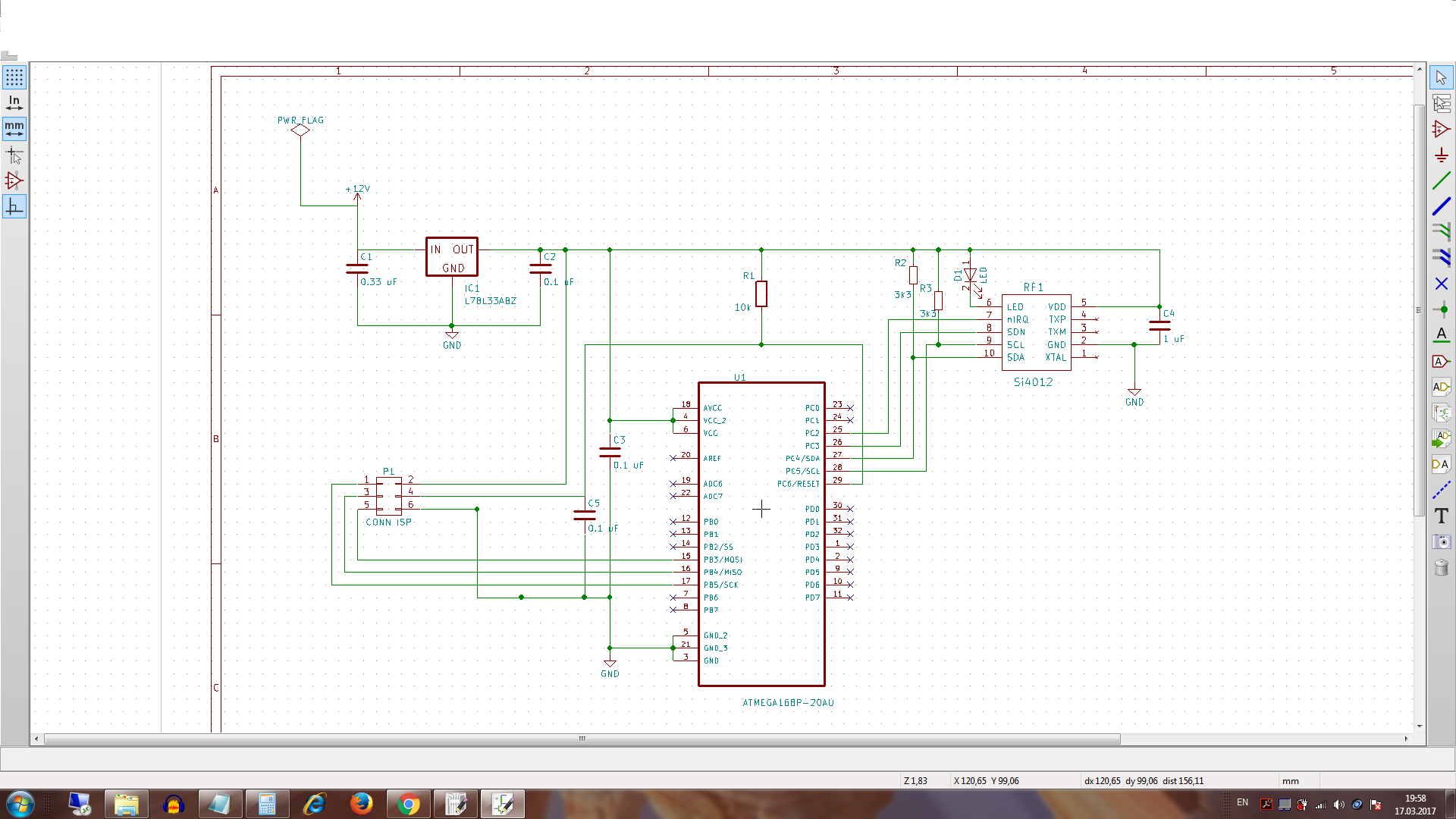
Made my first PCB, yay! a MCU and a RF transmitter mainly. Programmed it OK through the SPI interface (which has a power pin feeding it stable 3.3V). All worked fine.
The circuit is intended to run off its currents at 12V obtained from a car lighter socket. So I have soldered the car plug, plugged it in and within 2-3 seconds there was smoke coming out. Pulled it off and visually inspected. Nothing gave any clues as being fried. Done this a second time with brand new PCB and parts, same deal.
A multimeter verification revealed that Vcc and GND were shorted. Took out everything except the MCU and RF transmitter - the board was still shorted.
My voltage regulator is a good old TO-92 L78L33AB which I have used just like in the datasheet example: one 0.33 uF capacitor on the 12 V rail and another 0.1 uF capactior on the Vout = 3.3V rail,
My first thoughts were heat dissipation problems, but after doing the maths it doesn't seem like this would be the case. Got about 25 mA drawn by the circuit and the car socket reads 12.3 V. Let's round it to 30 mA. With a thermal junction-ambient coefficient of 200 deg_C/W this would give:
(12-3 - 3.3) * 0.03 * 200 = 54 degrees rise.
Not that much to cause the failure I have witnessed twice. And it has worked fine if stable 3.3V was fed to it through the programming interface... Any pointers ?
Thanks!
The circuit is intended to run off its currents at 12V obtained from a car lighter socket. So I have soldered the car plug, plugged it in and within 2-3 seconds there was smoke coming out. Pulled it off and visually inspected. Nothing gave any clues as being fried. Done this a second time with brand new PCB and parts, same deal.
A multimeter verification revealed that Vcc and GND were shorted. Took out everything except the MCU and RF transmitter - the board was still shorted.
My voltage regulator is a good old TO-92 L78L33AB which I have used just like in the datasheet example: one 0.33 uF capacitor on the 12 V rail and another 0.1 uF capactior on the Vout = 3.3V rail,
My first thoughts were heat dissipation problems, but after doing the maths it doesn't seem like this would be the case. Got about 25 mA drawn by the circuit and the car socket reads 12.3 V. Let's round it to 30 mA. With a thermal junction-ambient coefficient of 200 deg_C/W this would give:
(12-3 - 3.3) * 0.03 * 200 = 54 degrees rise.
Not that much to cause the failure I have witnessed twice. And it has worked fine if stable 3.3V was fed to it through the programming interface... Any pointers ?
Thanks!