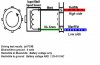
The Trans harness pic shows the Input Shaft Speed Sensor as a variable reluctance type with a coil resistance of around 1kΩ. So that's what you've got if that pic indeed relates to your car model.From what I've read, it is a Hall sensor
If the sensor is a 'coil' pickup of a rotating magnetic slotted disk then you'll have an AC signal output. If the sensor is a hall effect device then it MUST have a supply voltage to one side of it ergo one of the wires will have a fixed DC voltage on it.
The 13V (battery) you measured fits with my previous assumption - the other wire will have the return (speed) signal that is only present when the gearbox input shaft is rotating. That signal being a squarewave with a frequency proportional to the rotation speed of the shaft.
The comparator circuit I showed above would therefore accept the 'signal' (the NON 13V wire) on pin 6 and R2/R3 could be replaced with a preset potentiometer (wiper to pin 7).
You then take the output signal from the comparator at pin 1 and feed it back into the ECU, adjusting the preset so the circuit switches at the level of the input signal.
The Trans harness pic shows the Input Shaft Speed Sensor as a variable reluctance type with a coil resistance of around 1kΩ. So that's what you've got if that pic indeed relates to your car model.
Yes.Since it only has two wires, could it be that both wires are AC self generating output, with no need for a voltage supply signal from the car's battery?
A typical Hall sensor has a +ve supply wire, a ground wire and a signal output wire.I read that 3 wire Hall sensor needs a reference voltage signal.
Both of those understadings are wrong.Excellent. Thank you for your patience and explanation. I had some general ideas, but nothing specific. So in a nutshell, if I understand correctly, the 13 volt DC signal will be the Vin and the comparator can be adjusted for the desired output with potentiometer? If I can simply adjust for 7,8, 10 VAC output, I have achieved what I need. Thanks.
Both of those understadings are wrong.
If it is a hall effect sensor, one wire must be to the 12V power, and the other is the signal out.
If it is a coil, it is truly putting out AC , and , to duplicate the original signal exactly, you would need an isolated, bipolar supply. But, based on the results others have seen, this should not be necessary.
To know exactly what would and would not work, we need to know what each wire is connected to in the ECU. For example, one of the two connections at the ECU is ground or 12V, we would need to design the circuit with that constraint.
Bob
You can have a voltage that is the sum of a DC component and an AC component (see e.g. here).How can I simultaneously get AC and DC?
You can use a series capacitor to block the DC component, then use an ordinary amplifier to boost the remaining AC to the desired level.Any way I can boost this 4.0 VAC
Do they only do a visual test in the US? In Europe the test involves exhaust gas analysis at different rpms, so the error light would promptly come on again and the test would fail. A certain European car manufacturer fell foul of trying to cheat the emissions test.thus turning off the check engine light, and passing the visual test at the smog station.
Do they only do a visual test in the US? In Europe the test involves exhaust gas analysis at different rpms, so the error light would promptly come on again and the test would fail. A certain European car manufacturer fell foul of trying to cheat the emissions test.
Can you explain a few things in your pic:
1) What is 'PCM' in this context?
2) Is Red/Blk the same as Red/Wht?
3) If Blue to Ground is 0V, why is Red to Blue different from Red to Ground?
These questions have not been answered. Until they are this thread is going to be tantamount to a fishing expedition.What is the box with the S and V in it?
Bob
You can have a voltage that is the sum of a DC component and an AC component (see e.g. here).
With an ordinary multimeter:
When the meter is in DC setting, it will average the AC component if the frequency is more than a very few Hz. The average of an AC component is 0 V, so the meter displays the DC component only.
When the meter is in AC setting, typically a capacitor blocks any DC component. The remaining AC component is rectified, measured and displayed.
Og course, there exist advanced meters that perform so called RMS metering. These meters will calculate the RMS of the combined voltage and will in the case of a mixed waveform thus display a different value than an ordinary multimeter.
You can use a series capacitor to block the DC component, then use an ordinary amplifier to boost the remaining AC to the desired level.