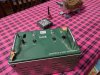
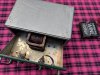
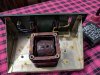
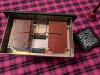
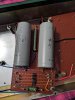
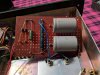
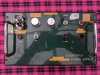
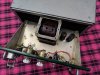
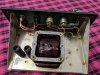
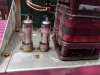
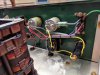
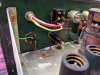
Can anyone ID this transformer?

(*steve*)

¡sǝpodᴉʇuɐ ǝɥʇ ɹɐǝɥd
Moderator
Jan 21, 2010
25,510
Joined
Jan 21, 2010
Messages
25,510
I have two of these transformers and I'm after some further information if anyone has anything.

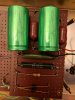
IMG_20171117_204257.jpg
IMG_20171117_204329.jpg

The high voltage secondary is marked as 250-0-250 and 60mA DC.

There are three other secondary windings, 0-4-6.3 2A, 0-4-6.3 3A, and 0-4-5 3A.

I'm curious about how to understand the rating for the high voltage secondary. And some documentation...
 

Minder

Apr 24, 2015
3,561
Joined
Apr 24, 2015
Messages
3,561
What else is there to know? The ratings are on it?
The 60ma rating will be for 250v, the L.V. secondaries will be at the highest value in each case.
The VA at each tap setting can be extrapolated.
Including the total VA for the transformer.
M.
 

(*steve*)

¡sǝpodᴉʇuɐ ǝɥʇ ɹɐǝɥd
Moderator
Jan 21, 2010
25,510
Joined
Jan 21, 2010
Messages
25,510
The problem is that one can rectify the output of this transformer in multiple ways. To which configuration would the 60mA refer?

I'm intending to full wage rectify the 500V to get approx 700V DC.

The circuit it was in half wave rectified the secondary (with semiconductor diodes) and regulated the output with OA2 tubes. The OA2 tubes have a max current of 30mA, so I guess the max output was no more than 25mA to 30mA (since the power supply could be operated unloaded)

It would be a lot easier if they gave the max continuous AC current for the high voltage secondary.
 

Minder

Apr 24, 2015
3,561
Joined
Apr 24, 2015
Messages
3,561
If not loading it up to the full Va via the other secondaries, you could go a little higher on the 250 sec. the limiting factor is the wire gauge but you would see this with a volt drop if exceeded too much.
M.
 

73's de Edd

Aug 21, 2015
3,730
Joined
Aug 21, 2015
Messages
3,730
Sir Steve . . . . .

In referencing the wiring hookup, that the LAST person used:

On the transformer primary looks like they could have used O as AC low and an optional 200 or 220 or 240, for AC HI, but instead, he opted for using that far left offset of 10VAC and the 220 to get himself a 230VAC input.

On that next row up, the BROWN wire was his OVAC and then he took off 6.3 VAC at up to a 2 amp capacity with the YELLOW wire and then he used the GREEN wire along with the The BROWN OVAC common wire already established , to get 30 or 70 VAC . . . (its being obscured, what it is ?) . . .for a SCR supply voltage that the unit was intended to be used with. *********

Then move to the top row where you have the two RED wire AC voltages either side of their central C common centertap. Figure on that AC voltage rectifying via fullwave rectification to end up with a DC supply of ~250VDC a ~ 60 ma capability.
On the final bottom row looks like he shared / established that AC supply common starting at the left BLUE and GREEN wire pair with the GREEN joining to the B+ supply common ground.
Then he joins the bottom of that 6.3 VAC tap to the O of the common like supply to the right to make it series aiding output and finally takes off 6.3VAC + 5VAC at the far right BLUE wire.

********** All of your voltage and current specs are being given excepting that "SCR" winding.
Sooooooo power up and measure that summed AC voltage from the left "0" to the GREEN wires as the summed up AC SCR voltage.
Take that AC voltage just being measured . . .as unloaded . . . across that path just given, and load it down with combinational power resistors until you have dropped it 10% and then compute the volt and current specs for that degree of loading upon that SCR winding.

Thassssit . . .

73's de Edd

.
 

73's de Edd

Aug 21, 2015
3,730
Joined
Aug 21, 2015
Messages
3,730
Yep . . . . . that is beeing one cojoined parental effort . . . . . Mom worked in a molasses factory and Pop worked at an arsenal as a hand grenade assembler.
 

Minder

Apr 24, 2015
3,561
Joined
Apr 24, 2015
Messages
3,561
I took SCR to mean Screen, IOW electrostatic shield??
Also has a connection to the frame bolt.
M.
 

kellys_eye

Jun 25, 2010
6,512
Joined
Jun 25, 2010
Messages
6,512
Yeah, the DC designation is a funny one..... but given it's a centre-tapped secondary we can assume a fullwave rectifier feeding either a capacitive smoothing circuit in which case the DC load capacity is going to be the stated 60mA and 350V DC out.

With a choke input filter your DC will fall to around 250V DC but the current will be 50% higher.

Gardiner transformers are a real work of art - very sought-after in the valve (tube) communities - I sold one recently for well below what could have got (as I subsequently found out :rolleyes: )
 

(*steve*)

¡sǝpodᴉʇuɐ ǝɥʇ ɹɐǝɥd
Moderator
Jan 21, 2010
25,510
Joined
Jan 21, 2010
Messages
25,510
It looks like a reverse engineering of the circuit may be in order.

I have 2 of these from 2 different power supplies. I'll reverse engineer the simpler one first :)
 

(*steve*)

¡sǝpodᴉʇuɐ ǝɥʇ ɹɐǝɥd
Moderator
Jan 21, 2010
25,510
Joined
Jan 21, 2010
Messages
25,510
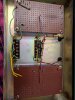
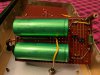
Some photos of the simpler of the two units:

IMG_20171118_093340.jpg

IMG_20171118_094009.jpg

IMG_20171118_094058.jpg

IMG_20171118_094131.jpg

IMG_20171118_094406.jpg

IMG_20171118_094554.jpg
 

73's de Edd

Aug 21, 2015
3,730
Joined
Aug 21, 2015
Messages
3,730
On that board portion that you show . . . . .indeed a B+ supply, with a full wave rectifier pair to get initial B+ then an inline HF inductor to an initial 22 ufd of filtering into a 7K filter resistor with a possible like 22 ufd of final filtering.
That developed B+ then regulated via a series pair of stud mount zener diodes.
Confirmation of that ' SCR ' as electrostatic shield to chasis ground.
FIO . . .But what was that number value beside it.
Unit visualises as 1961'ish design and construction.
NOW the other board half ? to see how the lower voltage aspect was treated.
 

(*steve*)

¡sǝpodᴉʇuɐ ǝɥʇ ɹɐǝɥd
Moderator
Jan 21, 2010
25,510
Joined
Jan 21, 2010
Messages
25,510
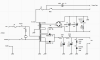
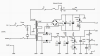
Here is the reverse engineered schematic.

upload_2017-11-18_12-7-28.png

I'm pretty sure it's accurate (it's not, see below).

The device was last "checked" in 1990, and so was probably scrapped within 5 years of that (assuming a 5 year cycle for electrical safety checks which is about what I've seen in this environment).

The other (more complex) unit is significantly different, but getting the schematic for it might have to wait a while...

(I apparently have jobs to do)

And here is the corrected version:

upload_2017-11-19_12-34-0.png
 
Last edited:

kellys_eye

Jun 25, 2010
6,512
Joined
Jun 25, 2010
Messages
6,512
Got to love the 'space optimisation' they employed in those days!

Schematic seems just fine - is there a particular issue with it or was your query just about the 'DC' spec of the secondary winding?
 

(*steve*)

¡sǝpodᴉʇuɐ ǝɥʇ ɹɐǝɥd
Moderator
Jan 21, 2010
25,510
Joined
Jan 21, 2010
Messages
25,510
No, just about the meaning of the DC spec.

I'll reverse engineer the other box tomorrow. Same transformer, but significantly different circuit.
 

hevans1944

Hop - AC8NS
Jun 21, 2012
4,968
Joined
Jun 21, 2012
Messages
4,968
Amazing find! It is clear from the low-voltage secondary windings that this high-quality transformer was intended to power vacuum tubes in its original incarnation. The 5R4-GYB full-wave duo-diode rectifier was the usual choice for DC rectification, but it required 5 VAC for its filaments. Almost every other tube required 6.3 VAC, but I have no idea what the 4 VAC tap powered. Maybe some "old timer" here will remember and fill us in on that.

The very first "serious" power supply I built, circa 1964, used a 5R4 rectifier and two power transformers salvaged from defunct television sets. My rectifier was a "military surplus" version of the 5R4, easily identified by its cylindrical bottle with the flat-top end. IIRC, I later substituted silicon diodes for this vacuum tube rectifier, but that was pretty much my last adventure with vacuum tube home projects. The power supply was connected to my home-brew, crystal-controlled, 3 MHz, CW (80m Novice band) transmitter, providing a variable, regulated, positive plate voltage up to about 400 V DC at 250 mA or about 100 watts to an RCA 6146B final amplifier operating in Class C bias. Novice amateur radio licenses in 1964 required somewhat less power input to the "final," 75 watts (maximum), hence the need for an adjustable plate voltage.

So, Steve, what are your plans for your two treasures?
 

(*steve*)

¡sǝpodᴉʇuɐ ǝɥʇ ɹɐǝɥd
Moderator
Jan 21, 2010
25,510
Joined
Jan 21, 2010
Messages
25,510

Nothing really exciting. I have some dekatron and some nixie tubes and I plan on making a clock. I plan on doing the division and digit driving using the dekatrons rather than logic.

I could use a DC to DC converter to create the high voltage, but these transformers look a lot better :)
 

(*steve*)

¡sǝpodᴉʇuɐ ǝɥʇ ɹɐǝɥd
Moderator
Jan 21, 2010
25,510
Joined
Jan 21, 2010
Messages
25,510
Here is the other unit:

IMG_20171119_103135.jpg

IMG_20171119_103154.jpg

IMG_20171119_103227.jpg

IMG_20171119_103254.jpg

IMG_20171119_103323.jpg

IMG_20171119_103339.jpg

IMG_20171119_103419.jpg

IMG_20171119_103715.jpg

IMG_20171119_104606.jpg

IMG_20171119_104622.jpg
 

(*steve*)

¡sǝpodᴉʇuɐ ǝɥʇ ɹɐǝɥd
Moderator
Jan 21, 2010
25,510
Joined
Jan 21, 2010
Messages
25,510
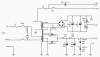
And the schematic for the other unit:

upload_2017-11-19_12-25-24.png

I don't have a symbol for the tubes, but they're just big zeners, so that's OK.

Note the -6.2V output. I rechecked and that;s the same on the other box... I got that part of the previous schematic wrong (I may update it later).

I'm pleased that both circuits rectify the high voltage in the same manner. If I assume that's what the 60mA is based on, I can do some calculations to figure out what I can get for other configurations (and that was my goal).
 
Top