Op Amp with a/c output

Alec_t

Jul 7, 2015
3,817
Joined
Jul 7, 2015
Messages
3,817
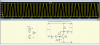
Here's a simpler circuit which amplifies a sine input from a sensor at terminals 1,2. The output at S,V, is a similar shape with a peak-to-peak voltage clamped at 12V (the assumed supply voltage). Note that the voltage difference between S and V has both negative and positive peaks. The polarity of both capacitors needs to be correct.
This circuit will not work as hoped if the TCU checks for a DC sensor resistance, but may work if it is looking for an input which goes above and below S.
A sensor signal of 10Hz or more and an amplitude of 0.5V or more is enough to raise the output to clipping level.
SensorAdapter13.PNG
 

HomerDodd

Sep 6, 2017
53
Joined
Sep 6, 2017
Messages
53
Here's a simpler circuit which amplifies a sine input from a sensor at terminals 1,2. The output at S,V, is a similar shape with a peak-to-peak voltage clamped at 12V (the assumed supply voltage). Note that the voltage difference between S and V has both negative and positive peaks. The polarity of both capacitors needs to be correct.
This circuit will not work as hoped if the TCU checks for a DC sensor resistance, but may work if it is looking for an input which goes above and below S.
A sensor signal of 10Hz or more and an amplitude of 0.5V or more is enough to raise the output to clipping level.
View attachment 41613

My older multimeter actually measures frequency, but does not tell me if sine, square or triangle wave. I will check frequency today. The other Cadillac guys said in a very old post that a known good sensor was measuring approx. 530 Hz at idle speed and rising with speed increases. It stands to reason that at one point during my test drive the other day, that I reached that since the light cleared for awhile, then came back on. Do you agree (voltage met, frequency not met ?). Thanks again Alec, we are making a difference.
 

Alec_t

Jul 7, 2015
3,817
Joined
Jul 7, 2015
Messages
3,817
If we take idle speed as, say, 600rpm then that's 10rps. The reluctor wheel would need 53 teeth to generate 530Hz at that speed. I believe wheels with 51 teeth or 40 teeth are common. Sounds like the Caddy's is a 51 teeth type, or could be a 40 teeth one with a higher idle speed.
My circuit was designed to work down to ~10Hz (in connection with a VSS thread on another forum), but simulation says it should cope with anything up to 100kHz at least! If your lowest sensor frequency really is ~500Hz, then you could reduce the values of both caps to 1uF each.
 

HomerDodd

Sep 6, 2017
53
Joined
Sep 6, 2017
Messages
53
If the car computer only really needs to see a frequency, but not necessarily a sine wave, then any square wave oscillator circuit will work. Opamp, 555, 1/6 of a CMOS Schmitt trigger hex inverter, 1/4 of a CMOS quad NAND gate, two transistors - lotsa options.

What is your experience level with any of these technologies, and building a small circuit on perf board?

ak

I have assembled small circuit boards before, I'm OK with it. I'm thinking the cars computer needs an ac sine wave with a minimum of 500hz. I have made one amp that was recommended, and I achieved the voltage. However, the Check Engine light stays on. I'm thinking it is more of a frequency issue (too low). Can you give me a schematic of some of these circuits you recommend? There is a well stocked electronic supply about 20 minute away, so getting the items is not a problem. Thanks.
 

HomerDodd

Sep 6, 2017
53
Joined
Sep 6, 2017
Messages
53
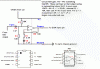
Update: the attached picture, with notes in it, worked for the voltage. Output is now between 5.5 and 6.5 VAC. However, the check engine light came back on. I then measured the frequency. This may be the culprit. it only measured 200-300 Hz. I think the computer needs a minimum of 530 Hz. Any suggestions, or any way to "tweek" this circuit? We made real progress with all of your help. I built another circuit that actually turned the Check Engine light off for a few minutes during hard acceleration, even with the voltage over 5 VAC. So I'm really leaning toward a frequency issue. Thanks again.
 

Attachments

  • OpAmp 12 volt assist.GIF
    OpAmp 12 volt assist.GIF
    21.8 KB · Views: 58

HomerDodd

Sep 6, 2017
53
Joined
Sep 6, 2017
Messages
53
I've commented on your frequency concern over at AAC.

Again, thanks for everything Alec. Hey, just a thought. You think it would be possible to just completely forget the sensor, and simply build and independent DC powered sine wave generator instead ? They look very easy to assembly, and obtaining frequency seems as easy as changes the RC make up. Do you think the correct frequency wave is REALLY what the computer is looking for?
 

HomerDodd

Sep 6, 2017
53
Joined
Sep 6, 2017
Messages
53
After test driving and measuring, we are close. I am beginning to think the ECM (cars computer) is more concerned with frequency, as I have achieved the voltage amplification with the recommendations by you guys. I am now wondering if it is a better option to complete eliminate the sensor itself from any part of the circuit, and simply go with a basic sine wave generator (oscillator ?) circuit. This one below caguth my attention. What do you think ? http://www.learningaboutelectronics.com/Articles/Sine-wave-generator-circuit-with-a-transistor.php
 
Top