240VAC Power Output on Circuit Board

Powertrain

Jun 23, 2023
6
Joined
Jun 23, 2023
Messages
6
Need help... I have a main control board with 240VAC coming in. It is supposed to output 240VAC to a heating element. There is a connector from the board that runs two wires to each side of the heating element. I get 120VAC coming out of both legs at the connector and at the contact of the heating element, but when I measure across them, I get 0VAC. I replaced two relays on this board that allows power to the heating element, but I show zero voltage when I measure across the element and across the connector. I have checked across the 2 legs coming into the board and I get 240VAC. Thoughts on what might be happening would be greatly appreciated.
 

kellys_eye

Jun 25, 2010
6,512
Joined
Jun 25, 2010
Messages
6,512
If the power goes through the relay contacts then I suspect the relays are dud or the contacts therein are severely corroded/pitted.
 

Powertrain

Jun 23, 2023
6
Joined
Jun 23, 2023
Messages
6
Thank Kellys_Eye... I just don't understand having 120VAC at each leg of the connector, and at the heating element connection, but no voltage when I test across them. Could the phasing be off somewhere and canceling each other out? Again I have 240VAC coming into the board so I know it's board related.
 

Delta Prime

Jul 29, 2020
2,987
Joined
Jul 29, 2020
Messages
2,987
Thoughts on what might be happening would be greatly appreciated.
I thought you would never ask!
Where in the world are you located?
You see saying you have "240VAC coming in" and trying to describe your dilemma means nothing to me. Could you possibly take some photos where you're taking your measurements. They're just too many variables. We must narrow them down.
Others here may know off the top of their heads but I frown upon speculation and I do wish to help you.
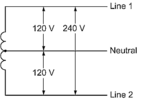
In the US,1P(single phase) 240V Power is provided to homes and small buildings as a 120/240V 1P3W(single phase 3 wire) power circuit. It provides 120V for light loads (lights, TV, etc.) and 240V for medium loads (Water Heaters, AC Compressors, etc.).


photo_1687761089159.png


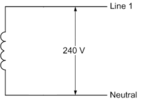
In some countries, 240V Power is provided to homes and small buildings as a 2 Wire 240V Single Phase power circuit.


photo_1687761678088.png


240V Power is provided to small buildings with large loads as 240V,
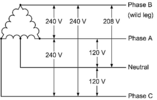
3 Phase Open Delta. It’s like 120 / 240V but also provides 240V 3 Phase for large loads (Machinery, etc.). It’s often called “Wild Leg” of “High Leg” Delta because one leg (Phase B) is different.
The “Wild Leg” or “High Leg” (Phase B) can cause problems if you’re not aware it’s different. How is it different?The “Wild Leg” or “High Leg” (Phase B) is 208V to Neutral, so it’s different than the then the other legs or phase.


photo_1687759692870.png


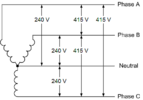
In some countries, 240V Power is provided to buildings with large loads as a 415Y/240V 3P4W power circuit.


photo_1687760298658.png


Last edited:

Powertrain

Jun 23, 2023
6
Joined
Jun 23, 2023
Messages
6
I thought you would never ask!
Where in the world are you located?
You see saying you have "240VAC coming in" and trying to describe your dilemma means nothing to me. Could you possibly take some photos where you're taking your measurements. They're just too many variables. We must narrow them down.
Others here may know off the top of their heads but I frown upon speculation and I do wish to help you.
In the US,1P(single phase) 240V Power is provided to homes and small buildings as a 120/240V 1P3W(single phase 3 wire) power circuit. It provides 120V for light loads (lights, TV, etc.) and 240V for medium loads (Water Heaters, AC Compressors, etc.).


View attachment 59610


In some countries, 240V Power is provided to homes and small buildings as a 2 Wire 240V Single Phase power circuit.


View attachment 59615


240V Power is provided to small buildings with large loads as 240V,
3 Phase Open Delta. It’s like 120 / 240V but also provides 240V 3 Phase for large loads (Machinery, etc.). It’s often called “Wild Leg” of “High Leg” Delta because one leg (Phase B) is different.
The “Wild Leg” or “High Leg” (Phase B) can cause problems if you’re not aware it’s different. How is it different?The “Wild Leg” or “High Leg” (Phase B) is 208V to Neutral, so it’s different than the then the other legs or phase.


View attachment 59612


In some countries, 240V Power is provided to buildings with large loads as a 415Y/240V 3P4W power circuit.


View attachment 59614


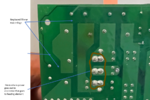
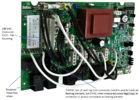
Thank you so much for the response. I am in the US. This board is used in a hot tub and it's the power going to the heating element that is the issue. This would be a single phase application. I replaced 2 relays that did get me power to the connector going to the heating element, with 120vac on each leg, but 0 when measured across the legs. My soldering skills are not great, so I'm concerned I might have damaged the board somehow. Everything else continues to work as it should after I reinstalled the board. Please see photos below. I've tried to outline the power in and where it comes out. I used a stock photo for the front of the board, and my own photo I took of the actual board prior to replacing the two relays. Any thoughts or ideas?
 

Attachments

  • Back of board Pic1.PNG
    Back of board Pic1.PNG
    965.5 KB · Views: 8
  • Circuit Board Pic 1.PNG
    Circuit Board Pic 1.PNG
    1.5 MB · Views: 7

Delta Prime

Jul 29, 2020
2,987
Joined
Jul 29, 2020
Messages
2,987
120VAC with reference to neutral. On both legs.
If you measure a cross
Leg to leg or hot to hot
On the input then yes 240 vac.
Now you're measuring on the heating elements expecting to see 240 vac leg to leg and you're measuring 0 volts then your circuit is open. Your concerns are valid you have damaging the board somehow. Make and model
Of your hot tub. Please. It's a long shot but perhaps I can dig up a schematic for you. Or find a replacement board. And be careful when probing don't fry yourself.
 

Delta Prime

Jul 29, 2020
2,987
Joined
Jul 29, 2020
Messages
2,987
This may sound silly but did you check the fuse?
I see two of them.
Also you my have damaged the traces on the PCB itself perhaps flexing it.
 

Delta Prime

Jul 29, 2020
2,987
Joined
Jul 29, 2020
Messages
2,987
Do you have the old relays?
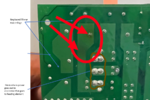
Your solder connections look tip top. Reference the red circle with red arrows
Looks like excessive heat what's on the other side?
photo_1687792565075.png
 

Powertrain

Jun 23, 2023
6
Joined
Jun 23, 2023
Messages
6
Do you have the old relays?
Your solder connections look tip top. Reference the red circle with red arrows
Looks like excessive heat what's on the other side?
View attachment 59620
Thank you Delta! I do have the old relays. The photo above is the board prior to me changing the relays. I did apply a lot of heat to the board to get the solder to flow unfortunately. I don't have a pic of the board after I soldered, but it wasn't pretty. If I measure from one leg to ground, I get 120VAC. This is true for leg 1 and leg 2 at both the connector on the board and at the heating element connection. When I measure across those same legs, I should get 240VAC, but instead I get 0. I know the heating element is good..I've checked it following the manfucturers steps. Below is a link to the board,
 

Delta Prime

Jul 29, 2020
2,987
Joined
Jul 29, 2020
Messages
2,987
Well I'm going to have to take your word about the heating element because everything points towards the heating element itself. And that board is rather robust nice thick traces solder pads.
If it was me I would look into the return policy if you were to purchase a board and plug it in see if it fires right up then of course you know for sure but that is dependent upon the return policy
 

Delta Prime

Jul 29, 2020
2,987
Joined
Jul 29, 2020
Messages
2,987
I don't have a pic of the board after I soldered, but it wasn't pretty.
Well I'm glad to hear you are your own worst critic is the only thing I could think of that could be the fault. Sorry buddy that's all I could think of.
Except check the wiring again there could be a jumper that you have forgotten to replace comparing your board to the stock photo. Or lug nut that attaches to the chassis of your unit check for rust,corrosion things of that nature.
 
Last edited:

Powertrain

Jun 23, 2023
6
Joined
Jun 23, 2023
Messages
6
Well I'm glad to hear you are your own worst critic is the only thing I could think of that could be the fault. Sorry buddy that's all I could think of.
Except check the wiring again there could be a jumper that you have forgotten to replace comparing your board to the stock photo. Or lug nut that attaches to the chassis of your unit check for rust,corrosion things of that nature.
I greatly appreciate your feedback and will check the items you mentioned! I will let you know if I have any success. Regards, Phil
 

Bluejets

Oct 5, 2014
7,374
Joined
Oct 5, 2014
Messages
7,374
I have a main control board with 240VAC coming in. It is supposed to output 240VAC to a heating element.
Show where you have power in and out on the board or better still, a hand drawn circuit of what connections you have and where you are measuring to obtain your readings. i.e. show what you connect both meter probes to...... almost impossible to follow your description as it has become just a rant.
 

Powertrain

Jun 23, 2023
6
Joined
Jun 23, 2023
Messages
6
Show where you have power in and out on the board or better still, a hand drawn circuit of what connections you have and where you are measuring to obtain your readings. i.e. show what you connect both meter probes to...... almost impossible to follow your description as it has become just a rant.
Thanks for the review Bluejets and my apologies for the rant. Did you see the photos that were previously added showing the 240VAC incoming and the power out to heating element? I have 240 across L1/L2 so I know the power coming into the board is good. There are three relays on the board in the picture that when all closed, allow the power to leave the board and go to the heater element. I have 120vac on each leg leaving the board to the connector for element (checking from L1 to ground and L2 to ground, as well as at the connection to the heating element), but when I check across L1/L2 both at the connector and at the heating element, my voltage shows zero. I'm just a DIY'er, not an EE. Hope this clarifies but if not thanks for reviewing my post.
 
Top