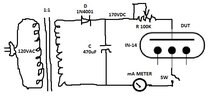
I hope there are some members with grey hairs here. This question involves 1950s-1970s tech.
I'm exploring ways of driving a Nixie Tube (basically a neon lamp that displays numeric digits). The Nixie (IN-14) I'm trying to drive has a running current of 2mA. Since it's a gas discharge lamp, the resistance is high when off then quickly goes low once lit (struck). For this reason some sort of external ballast current limiting circuitry is necessary.
Most schematics I've found online simply use a fixed anode resistor to regulate the current. While I'm sure that's probably adequate, I was looking for a more precise way of controlling and minimizing the current through the Nixie to maximize it's life (Nixie's cathodes get damaged if overdriven even slightly).
So I am trying to design a active constant current source / current limiter circuit to use with Nixie tubes. Your insight and comments would be greatly appreciated.
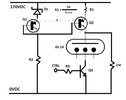
SCHEMATIC (Rough Draft):
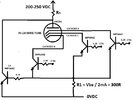
DESCRIPTION:
The way I'm hoping this works is when one of the cathodes is turned on by saturating one of the cathode transistors through its CTRL line, the Nixie strikes and current starts flowing through the anode resistor, through the Nixie, then through the saturated transistor and finally through R1.
Once the current through R1 rises above one Vbe drop (~0.6V) Q1 will begin to turn on, shunting current away from the Nixie tube (and associated cathode circuit) until the voltage at R1 is at or below Vbe again. This (I think) will have the effect of establishing a negative feedback loop and thus keeping the voltage across R1 at Vbe, and keeping the current through the cathode circuit at ~2ma.
This is advantageous over a fixed resistor IMO because different cathodes in the Nixie can have slightly different electrical properties and this circuit tailors each cathode to the specified 2ma instead of the one-size-fits-all approach of a fixed anode resistor.
Or is this overkill and I'm missing something? I've obviously never worked with Nixie tubes before.
All replies welcome, thank you.
I'm exploring ways of driving a Nixie Tube (basically a neon lamp that displays numeric digits). The Nixie (IN-14) I'm trying to drive has a running current of 2mA. Since it's a gas discharge lamp, the resistance is high when off then quickly goes low once lit (struck). For this reason some sort of external ballast current limiting circuitry is necessary.
Most schematics I've found online simply use a fixed anode resistor to regulate the current. While I'm sure that's probably adequate, I was looking for a more precise way of controlling and minimizing the current through the Nixie to maximize it's life (Nixie's cathodes get damaged if overdriven even slightly).
So I am trying to design a active constant current source / current limiter circuit to use with Nixie tubes. Your insight and comments would be greatly appreciated.
SCHEMATIC (Rough Draft):
DESCRIPTION:
The way I'm hoping this works is when one of the cathodes is turned on by saturating one of the cathode transistors through its CTRL line, the Nixie strikes and current starts flowing through the anode resistor, through the Nixie, then through the saturated transistor and finally through R1.
Once the current through R1 rises above one Vbe drop (~0.6V) Q1 will begin to turn on, shunting current away from the Nixie tube (and associated cathode circuit) until the voltage at R1 is at or below Vbe again. This (I think) will have the effect of establishing a negative feedback loop and thus keeping the voltage across R1 at Vbe, and keeping the current through the cathode circuit at ~2ma.
This is advantageous over a fixed resistor IMO because different cathodes in the Nixie can have slightly different electrical properties and this circuit tailors each cathode to the specified 2ma instead of the one-size-fits-all approach of a fixed anode resistor.
Or is this overkill and I'm missing something? I've obviously never worked with Nixie tubes before.
All replies welcome, thank you.