Switching direction of a 12V motor with two push-to-make switches

Gary-Clifford

Sep 19, 2024
8
Joined
Sep 19, 2024
Messages
8
I need to build a 12V circuit that will switch the direction of a motor when a push-to-make switch is pressed. There are two switches; one to make the motor go in one direction and another to reverse the motor direction. I would prefer a circuit design using relays and diodes as my electronics knowledge is poor. Please can anyone help with suitable circuit diagram?
For information, the motor is going to be geared down to about 50rpm.
 

crutschow

May 7, 2021
984
Joined
May 7, 2021
Messages
984
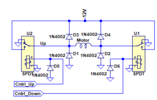
Below is a circuit using two SPDT relays controlled by two switches that should do what you want:
The diodes are to protect the contacts from inductive arcing.
1726849461010.png
 

Bluejets

Oct 5, 2014
7,374
Joined
Oct 5, 2014
Messages
7,374
If it's only small hobby motor, a couple of c/o switches would suffice, such as microswitches.
 

crutschow

May 7, 2021
984
Joined
May 7, 2021
Messages
984
As Bluejets noted, if the switch can handle the motor current, then a couple of SPDT switches would work without the relay.
 

Harald Kapp

Moderator
Moderator
Nov 17, 2011
14,271
Joined
Nov 17, 2011
Messages
14,271
@Gary-Clifford : note that this circuit requires the button to be pressed for the motor to run. When you release the button, the motor will stop.
If that is what you want, then this circuit is entirely o.k.
Should you want to use momentary pushbuttons, i.e. one short press sends the motor in one direction, a short press on the other button reverses the direction, this circuit needs a modification. In that case a pair of "radio buttons" could do the trick, bute this kind of hardware today is hard to find (today you'll find "radio buttons" galore in graphical user interfaces of software). Plus you will need a separate on/off switch to stop the motor completely.
A pushbutton solution using dual coil bistable relays is also possible, but a tad more complex than the circuit from post #2. Plus it willalso require a separate on/off switch.

What is it you need?
 

Gary-Clifford

Sep 19, 2024
8
Joined
Sep 19, 2024
Messages
8
@Gary-Clifford : note that this circuit requires the button to be pressed for the motor to run. When you release the button, the motor will stop.
If that is what you want, then this circuit is entirely o.k.
Should you want to use momentary pushbuttons, i.e. one short press sends the motor in one direction, a short press on the other button reverses the direction, this circuit needs a modification. In that case a pair of "radio buttons" could do the trick, bute this kind of hardware today is hard to find (today you'll find "radio buttons" galore in graphical user interfaces of software). Plus you will need a separate on/off switch to stop the motor completely.
A pushbutton solution using dual coil bistable relays is also possible, but a tad more complex than the circuit from post #2. Plus it willalso require a separate on/off switch.

What is it you need?
Hi Harald, many thanks for your feedback. You are correct that the push-to-make buttons will only be pressed momentarily. The purpose is for a Halloween charity event at my school. I have a large papier mache spider, that I want to cycle up and down on a string 'web'. When the spider touches the top or bottom switch, the motor direction changes and sends it in the opposite direction. I am ready to try and build a circuit with dual coil bistable relays, if you would be able to post a circuit diagram.
 

crutschow

May 7, 2021
984
Joined
May 7, 2021
Messages
984
Hi Harald, many thanks for your feedback. You are correct that the push-to-make buttons will only be pressed momentarily. The purpose is for a Halloween charity event at my school. I have a large papier mache spider, that I want to cycle up and down on a string 'web'. When the spider touches the top or bottom switch, the motor direction changes and sends it in the opposite direction. I am ready to try and build a circuit with dual coil bistable relays, if you would be able to post a circuit diagram.
I'm a little confused.
What will the buttons do if the spider goes up and down the "web" by itself with the bistable relays?
Or what is the expected sequence of operation using the buttons?
 

Martaine2005

May 12, 2015
5,276
Joined
May 12, 2015
Messages
5,276
Sounds like the op wants to use push to make switches as limit switches.
Hobby train set enthusiasts have been doing this for decades using only diodes. The train goes along the track, stops, then reverses to the beginning again. This repeats for as long as power is present.
 

Gary-Clifford

Sep 19, 2024
8
Joined
Sep 19, 2024
Messages
8
I'm a little confused.
What will the buttons do if the spider goes up and down the "web" by itself with the bistable relays?
Or what is the expected sequence of operation using the buttons?
Hello Crutschow,
Thanks for your continued interest in my project. The objective is to have the spider momentarily touch a push-to-make switch, which will reverse the direction of the motor. When the motor direction is sending the spider upwards, it will touch the upper push-to-make switch, which will reverse the motor direction and the spider will now go down and touch the lower push-to-make switch and the motor direction changes again and the spider goes back up. My electronics knowledge is enough that I could connect transistors, diodes and capacitors, but I have no experience of using items like Arduino modules. I would really appreciate a circuit design that achieves my objective with discrete electrical/electronic items.
Thanks,
Gary
 

crutschow

May 7, 2021
984
Joined
May 7, 2021
Messages
984
So the switches are controlled by the spider movement, not by a person pressing the switch?
So the switch is really a limit-switch, not a push-to-make switch which, to me, implies someone "pushing" the switch.
 

Gary-Clifford

Sep 19, 2024
8
Joined
Sep 19, 2024
Messages
8
So the switches are controlled by the spider movement, not by a person pressing the switch?
So the switch is really a limit-switch, not a push-to-make switch which, to me, implies someone "pushing" the switch.
Hello Crutschow,
Sorry for using the wrong terminology for the switches. Yes, the spider is controlling the motor direction.
 

crutschow

May 7, 2021
984
Joined
May 7, 2021
Messages
984
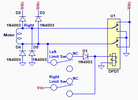
Below is a simple circuit that should do what you want.
It consists of a standard DPDT relay (not latching), two SPDT limit switches, and 5 diodes.

  • The motor runs to the right with the relay de-energized as shown.
  • When the Right Limit Sw is activated, the relay coil is energized, reversing the motor direction to the left. This also latches the relay through the Left Limit Sw NC contacts and diode D1 to keep the motor running to the left after the Right Limit Sw is deactivated.
  • When the Left Limit Sw is activiated, the voltage to the relay coil is removed, de-energizing the relay and reversing the motor back to the right.
D1 keeps the Right Limit Sw voltage from being shorted through the Left Limit Sw and the relay contacts to ground.
D2 through D5 suppress the motor voltage transients to protect the relay contacts.

Note that the limit switches carry only the relay coil current, not the motor current.

1728050342515.png
 

Harald Kapp

Moderator
Moderator
Nov 17, 2011
14,271
Joined
Nov 17, 2011
Messages
14,271
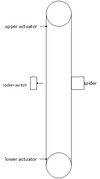
Thinking a bit out of the box, here's an idea for a much simpler construction:
1728300837476.png
A looped string around the upper and lower wheel, one of whicih is powered by the motor. The box to the right symbolizes the spider ;).
On the looped string are 2 actuators (actually these can be as simple as knots in the string. The actuators pass (or are fed trough) the lever of a dpdt rocker switch (left side).
  • spider moves up, upper actuator moves down. When the spider reaches the top, the upper actuator throws the rocker switch which in turn (pun intended) reverses the motor direction.
  • spider reverses, moves down. When the spider reaches the bottom, the lower actuator throws the rocker switch in the other position, again reversing the motor direction.
No fancy relay or electronic circuit required, only a piece of string which you have anyway to move the spider.
 

Gary-Clifford

Sep 19, 2024
8
Joined
Sep 19, 2024
Messages
8
Thinking a bit out of the box, here's an idea for a much simpler construction:
View attachment 64867
A looped string around the upper and lower whell, one of whcih is powered by the motor. The box to the right symbolizes the spider ;).
on the looped string are 2 actuators (actually these can be as simple as knots in the string. The actuators pass (or are fed trough) the lever of a dpdt rocker switch (left side).
  • spider moves up, upper actuator moves down. When the spider reaches the top, the upper actuator throws the rocker switch which in turn (pun intended) reverses the motor direction.
  • spider reverses, moves down. When the spider reaches the bottom, the lower actuator throws the rocker switch in the other position, again reversing the motor direction.
No fancy relay or electronic circuit required, only a piece of string whcih you have anyway to move the spider.
Harald,
That is brilliant! Much as I was keen to start soldering up a circuit, this is definitely a simpler solution. I'll attach a photo of the spider in full operation, once it is ready.
 

crutschow

May 7, 2021
984
Joined
May 7, 2021
Messages
984
Harald,
That is brilliant!
You could use a 4-way DPDT light switch for that purpose.

Note that you likely want to add 4 diodes across the switch contacts, similar to that shown in my post #15, to protect them from arcing due to the motor inductance.
 

Gary-Clifford

Sep 19, 2024
8
Joined
Sep 19, 2024
Messages
8
Conclusion of the circuit to raise and lower a spider for a Halloween event.
I just wanted to let you know that I used Crutschow's circuit to operate my spider. It performed very successfully for the 3 and a half hour event. I was going to load a video of it moving but the file size is 100MB, so will just go with a photo. We had the spider lit up so once it got dark, it was ready to (slightly) scare and thrill the 300+ kids who came to the event. Thanks again for all your advice and help.
 

Attachments

  • Halloween spider.JPG
    Halloween spider.JPG
    639.9 KB · Views: 3
Top