Designing Active Cell Balancer using STM-32

Hamza44447

Nov 17, 2024
4
Joined
Nov 17, 2024
Messages
4
1000064763.png
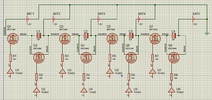
What I'm trying to make is an active cell Balancer using STM32. I have a BATT pack of 5 Cells and above is the balancing circuit part that will get GPIO Output signal from STM32. For voltage read I'm thinking of ADC channels of stm32. Moreover, the STM32 will decide which cell to be balanced and provide signal via GPIO output to MOSFET. Hope this explains what I am trying to achieve. Since I'm new into this stuff, I'm really lost
 

Delta Prime

Jul 29, 2020
2,987
Joined
Jul 29, 2020
Messages
2,987
What I'm trying to make is an active cell Balancer using STM32
why? Take a look at the data sheet below for the STM 32 bit micro controller, using a STM32 wouldn’t even be my fourth choice to use.
Voltage,current,temperature; all these parameters must be given.
For voltage read I'm thinking of ADC channels of stm32. Moreover, the STM32 will decide which cell to be balanced and provide signal via GPIO output to MOSFET
All that you would be doing with that schematic is blowing up your chosen MOSFET’s.
Since I'm new into this stuff, I'm really lost
Sorry, kiddo more reading is necessary.
 

Attachments

  • cd00237391.pdf
    2.8 MB · Views: 10

Bluejets

Oct 5, 2014
7,374
Joined
Oct 5, 2014
Messages
7,374
View attachment 65205
What I'm trying to make is an active cell Balancer using STM32. I have a BATT pack of 5 Cells and above is the balancing circuit part that will get GPIO Output signal from STM32. For voltage read I'm thinking of ADC channels of stm32. Moreover, the STM32 will decide which cell to be balanced and provide signal via GPIO output to MOSFET. Hope this explains what I am trying to achieve. Since I'm new into this stuff, I'm really lost
Question is, just what type of cells are you trying to balance @ 1.5v?
Apart from that, normal to load a cell to some degree on testing.
 

Hamza44447

Nov 17, 2024
4
Joined
Nov 17, 2024
Messages
4
Question is, just what type of cells are you trying to balance @ 1.5v?
Apart from that, normal to load a cell to some degree on testing.
Actually I'm asked to make a prototype of active cell balancing using stm32. And to check that balancer that I'll be making, we have a Battery Pack made of Super Capacitors 400F 2.7V (a total of 5). I thought of using Voltage Divider Rule while using ADC pins for voltage. And as for balancing them, I thought of making above circuit. Kindly let me know if this is possible?
 

Hamza44447

Nov 17, 2024
4
Joined
Nov 17, 2024
Messages
4
why? Take a look at the data sheet below for the STM 32 bit micro controller, using a STM32 wouldn’t even be my fourth choice to use.
Voltage,current,temperature; all these parameters must be given.

All that you would be doing with that schematic is blowing up your chosen MOSFET’s.

Sorry, kiddo more reading is necessary.
But I have to use STM 32. That thing is fixed by our supervisor. What are possible ways to accomplish this.
 

Hamza44447

Nov 17, 2024
4
Joined
Nov 17, 2024
Messages
4
why? Take a look at the data sheet below for the STM 32 bit micro controller, using a STM32 wouldn’t even be my fourth choice to use.
Voltage,current,temperature; all these parameters must be given.

All that you would be doing with that schematic is blowing up your chosen MOSFET’s.

Sorry, kiddo more reading is necessary.
But I have to use STM 32. That thing is fixed by our supervisor. What are possible ways to accomplish this
why? Take a look at the data sheet below for the STM 32 bit micro controller, using a STM32 wouldn’t even be my fourth choice to use.
Voltage,current,temperature; all these parameters must be given.

All that you would be doing with that schematic is blowing up your chosen MOSFET’s.

Sorry, kiddo more reading is necessary.
While using stm32, measuring parameters like voltage, current, temp, would these methods be feasible?

1. Using the ADCs available in the STM32 to measure cell voltages through voltage divider circuits.

2. Measuring the balancing current using a low-value shunt resistor and an operational amplifier to amplify the voltage drop.

3. Using temperature sensors (e.g., NTC thermistors) to monitor overheating of the MOSFETs or batteries.

Also to protect MOSFETs using flyback diodes across drain-source terminals to handle voltage spikes ?
 

Harald Kapp

Moderator
Moderator
Nov 17, 2011
14,273
Joined
Nov 17, 2011
Messages
14,273
Since all of the batteries have a common ground, they can't be in series, but in parallel. You don't use a cell balancer for cells in parallel. They're kind of self balancing.
A cell balancer is used to ensure (more or less) equal charge state of batteries in series. Your circuit is not suitable.

Read e.g. here or here on active cell balancing. You're welcome to come back with specific questions once you have designed a basic functional circuit.

I will also move this thread to the homework section. Our responses will be linmited as it is our policy not to give away complete solutions to homework or similar assignments.
 

Kohei

Mar 27, 2025
2
Joined
Mar 27, 2025
Messages
2
View attachment 65205
What I'm trying to make is an active cell Balancer using STM32. I have a BATT pack of 5 Cells and above is the balancing circuit part that will get GPIO Output signal from STM32. For voltage read I'm thinking of ADC channels of stm32. Moreover, the STM32 will decide which cell to be balanced and provide signal via GPIO output to MOSFET. Hope this explains what I am trying to achieve. Since I'm new into this stuff, I'm really lost
 

Kohei

Mar 27, 2025
2
Joined
Mar 27, 2025
Messages
2
Designing an active cell balancer using an STM32 microcontroller is a smart approach for improving battery performance and longevity. Unlike passive balancing, which wastes excess energy as heat, active balancing redistributes charge efficiently between cells, making it ideal for high-capacity battery packs, such as those in EVs and energy storage systems. The STM32’s powerful ADCs and PWM capabilities allow precise monitoring and control of balancing circuits. Has anyone here implemented a similar design? I’d love to hear about your choice of balancing topology (capacitive, inductive, or transformer-based) and your experience with firmware optimization!
 

poormystic

Jul 23, 2023
187
Joined
Jul 23, 2023
Messages
187
Hi :) ... I'm just curious -
It sounds as though these "active cell balancers" have a separate charge circuit for each cell, while the cells can also be connected into a higher voltage series arrangement. Is that about right?
 
Top