Powering soundbar with 18650

ShadeTreeAudio

Dec 3, 2024
2
Joined
Dec 3, 2024
Messages
2
I have a soundbar that I'm going to put into a smaller form box. I move it around my apartment a lot and just have the wireless subwoofer in a centralized spot. The long box has unnecessary space and it'd be easier to put on any of my shelves if it was smaller.

I have noticed the soundbar takes a 25v dc input. Why not also power it by battery? I have made a crude image of how I think this would be done. Any input is appreciated.
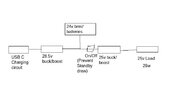
soundbar.jpg
 
Last edited:

Delta Prime

Jul 29, 2020
2,987
Joined
Jul 29, 2020
Messages
2,987
You are risking acoustic wave interference, by reducing the size of the enclosure or sound baffle, you have changed the resonant frequency that the enclosure naturally tends to vibrate, be it sealed or ported, resulting in sound waves bouncing around inside and causing interference along with different materials used to make the enclosure will result in absorption or reflection.
 

Harald Kapp

Moderator
Moderator
Nov 17, 2011
14,271
Joined
Nov 17, 2011
Messages
14,271
Have you considered the sheer size of the batteries required to power a 29 W load for a reasonable time (say > 1 hour)?
The long box has unnecessary space
See the previous comment: This space may not be "unnecessary" but required for good sound quality.
 

ShadeTreeAudio

Dec 3, 2024
2
Joined
Dec 3, 2024
Messages
2
You are risking acoustic wave interference, by reducing the size of the enclosure or sound baffle, you have changed the resonant frequency that the enclosure naturally tends to vibrate, be it sealed or ported, resulting in sound waves bouncing around inside and causing interference along with different materials used to make the enclosure will result in absorption or reflection.
Lol. These speakers are set inside a box inside the case for one. For two, we're not asking for perfection. I'm quite aware of the math involved with speaker enclosures.
Have you considered the sheer size of the batteries required to power a 29 W load for a reasonable time (say > 1 hour)?

See the previous comment: This space may not be "unnecessary" but required for good sound quality.
I'm just gonna let chatgpt answer this one.

To calculate the total watt-hours (Wh) of six 2500mAh, 3.7V batteries, follow these steps:

Convert milliampere-hours (mAh) to ampere-hours (Ah):

2500 mAh=2.5 Ah2500mAh=2.5Ah.

Calculate watt-hours for one battery:

Watt-hours = Voltage × Ampere-hours

3.7 V×2.5 Ah=9.25 Wh3.7V×2.5Ah=9.25Wh per battery.

Multiply by the number of batteries (6):

9.25 Wh×6=55.5 Wh9.25Wh×6=55.5Wh.

Total Energy:
The total capacity of the six batteries is 55.5 watt-hours (Wh).
 

Harald Kapp

Moderator
Moderator
Nov 17, 2011
14,271
Joined
Nov 17, 2011
Messages
14,271
The total capacity of the six batteries is 55.5 watt-hours (Wh).
Less than 2 hours uptime at 29 W load. Is that what you want?
On the other hand your load (speakers) may typically require much less than 29 W, so the batteries will last accordingly longer.

Let's look at your scheme:
  1. I don't know what "USB chargimng circuit" you plan to use, but typically the batteries will be connected directly to the charging circuit. Putting a buck/boots converter between charger and batteries nullifies the effect of the charger as the charging circuit has no longer a way to determine the charge state of the battery.
    You will need a charger that directly connects to the batteries without the in-between buck/boost converter.
  2. The 2nd buck/boost converter may be entirely unnecessary. The speaker circuit typically has its own internal voltage regulatio. It may as well run perfectly directly from the batteries, even down to say e.g. 20 V when the batteries are no longer at full charge. Give it a try before adding that probably unnecessary converter.
 
Top