You are using an out of date browser. It may not display this or other websites correctly.
You should upgrade or use an alternative browser.
You should upgrade or use an alternative browser.
Electronics Knowledge and Skill Level of This Forum
- Thread starter John R Retired
- Start date
Scroll to continue with content

By the way, some say that a person is a "Professional" in any field or operation if they are making money at it and are expert in their
understanding of said endeavor.
yes, that is true, but it's a mis-use of the term professional

That would make you a professional even if you don't have a uuniversity degree.
By their low description standard of the use of professional, that would be true.
BUT, I know I am not a professional electronics technician using the correct meaning of the word. I, also, cannot use the description
of electronics engineer for the same reason. I havent done that degree.
I'm just your basic underpaid and overworked electronics technician who has been doing this for more years than I care to remember.
I would rather have been out in the field doing geology, specifically, volcanics and seismology, for which I did do a university BSc in geology.
Dave

John R Retired
- Mar 13, 2022
- 155
- Joined
- Mar 13, 2022
- Messages
- 155
That's one thing about factory E.Tech is the sitting all day at the bench. I've worked in factories at most as an assembleryes, that is true, but it's a mis-use of the term professional
By their low description standard of the use of professional, that would be true.
BUT, I know I am not a professional electronics technician using the correct meaning of the word. I, also, cannot use the description
of electronics engineer for the same reason. I havent done that degree.
I'm just your basic underpaid and overworked electronics technician who has been doing this for more years than I care to remember.
I would rather have been out in the field doing geology, specifically, volcanics and seismology, for which I did do a university BSc in geology.
Dave
or non-electronics positions, where ETs were also employed and seen them work.
Too much of that sitting all day long for years and you coud develop physical illnness but there is always some price to pay.
Being outside working in the fresh air is definitely healthier, especially nice if you have a technical mind and a degree
in somewhat outdoors natural science.
But back to my inquiry: What do you think is the minimum level of theory and hands on skill in electronics to be the "real deal" and marketable ET for repairing and-or designing electronics gear or circuits? That would be some kind of a contrast to being a hobbyist
I think, who works at any level for their own enjoyment, with no pressure to produce for the factory bottom line, even though some here have said that a hobbyist might be more skilled than some industry ETs.
That's one thing about factory E.Tech is the sitting all day at the bench.
I couldnt handle doing that .... sitting on an assembly line or similar ... NO No no hahaha would drive me crazy
part of my workshop -- I am ( for the last 13 years) a high precision GPS and survey equipment tech.
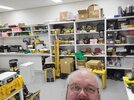
But back to my inquiry: What do you think is the minimum level of theory and hands on skill in electronics to be the "real deal" and marketable ET for repairing and-or designing electronics gear or circuits?
A very good knowledge of basic and applied electronics, a good understanding of Ohms law, AC impedances and the like.
An excellent understanding of all main components, except any form of processor or other complex IC
But really, most decent hobbyist person would probably know all that as well
I openly admit, I am not a deep theory person, there are several on this site that blow me out of the water when it comes to
deeper electronics theory @bertus and @Harald Kapp
Dave
John R Retired
- Mar 13, 2022
- 155
- Joined
- Mar 13, 2022
- Messages
- 155
ThanksI couldnt handle doing that .... sitting on an assembly line or similar ... NO No no hahaha would drive me crazy
part of my workshop -- I am ( for the last 13 years) a high precision GPS and survey equipment tech.
View attachment 65302
A very good knowledge of basic and applied electronics, a good understanding of Ohms law, AC impedances and the like.
An excellent understanding of all main components, except any form of processor or other complex IC
But really, most decent hobbyist person would probably know all that as well
I openly admit, I am not a deep theory person, there are several on this site that blow me out of the water when it comes to
deeper electronics theory @bertus and @Harald Kapp
Dave
You learned all that on your own?
Also you said: "except any form of processor or other complex IC"
Could you elaborate on that a little?
You learned all that on your own?
For this current job, the manufacturer runs training courses to teach us the way they want things repaired
But probably around 80% of my electronics knowledge has been self taught
But my long history of RF electronics has helped me greatly in a number of my jobs
Being an amateur radio operator since 1980 and building transceiver radios, antennas etc
Also you said: "except any form of processor or other complex IC"
Could you elaborate on that a little?
Well these things are just little black boxes of "magic" .... noone other than the designer knows, to any depth, what goes on inside them
And, frankly, noone needs to know ... All you need to know is.... if you put supply voltages on these pins and signals on those pins,
you get something else out of those other pins.
You have to go back to the old TTL and CMOS logic gate IC's (7400 series and the CD4000 series) to get a easy understanding of what is
going on inside and make good use of that.
Dave
John R Retired
- Mar 13, 2022
- 155
- Joined
- Mar 13, 2022
- Messages
- 155
For this current job, the manufacturer runs training courses to teach us the way they want things repaired
But probably around 80% of my electronics knowledge has been self taught
But my long history of RF electronics has helped me greatly in a number of my jobs
Being an amateur radio operator since 1980 and building transceiver radios, antennas etc
Well these things are just little black boxes of "magic" .... noone other than the designer knows, to any depth, what goes on inside them
And, frankly, noone needs to know ... All you need to know is.... if you put supply voltages on these pins and signals on those pins,
you get something else out of those other pins.
You have to go back to the old TTL and CMOS logic gate IC's (7400 series and the CD4000 series) to get a easy understanding of what is
going on inside and make good use of that.
Dave
You said:
"A very good knowledge of basic and applied electronics"
What would that include?
Also, as being a HAM, would you recomend the ARRL handbook as a clear and systemized learning manual, which goes step by step
from square one and on up the ladder of more and more involved circuits that would be building blocks on top of each other to construct
a solid framework for general all-round electronics?
Having a project book that does the same thing with hands on would also be nice. I already have some books but they jump around
on theory and are not systemized but haphazard in how things are explained and organized.
I am not totally ignorant about electronics and took some college course decades ago but it didn't do me much good in the real world
except for electronics assembly so I had to move to another field to make a living. Now I am hoping I can pull all that I know and maybe it will click and I will grasp the concepts better. I know Ohms law and the basic components but putting them all together to creat a
working practical electronic device or useful circuit of some sort, that has some value, is not my strong point. A positive factor in my
favor is that I like electronics, even though I'm not much good at it.
I'm approaching it 1/2 as a hobby and 1/2 as maybe a part time way to make aome extra retirement money. I know a guy who repairs 80s
audio equipment and he is not a genius or a highly trained E.Tech, and has just a fundamental understanding of electrical theory and electronics at an elementary level, but he is making money at it.
Thanks for your help.
Last edited:
If this bloke can repair audio equipment then he MUST understand how it works to be able to repair it. Guessing or just substituting parts will send you broke quick. You don't have to be a "highly trained Electronic tech" to be able to repair equipment, and just knowing "electronics at an elementary level" won't get you very far. You get an idea of what voltages should be, what waveforms should appear at a certain point in the circuit, etc. All comes with experience= head down, arse up, get stuck into it, make mistakes, learn along the way. If you start out knowing zero and expect to make money quickly without the time honoured method of hard slog, I recommend taking up fishing instead.. I know a guy who repairs 80s
audio equipment and he is not a genius or a highly trained E.Tech, and has just a fundamental understanding of electrical theory and electronics at an elementary level, but he is making money at it.
Thanks for your help.
You said:
"A very good knowledge of basic and applied electronics"
What would that include?
Also, as being a HAM, would you recomend the ARRL handbook as a clear and systemized learning manual, which goes step by step
from square one and on up the ladder of more and more involved circuits that would be building blocks on top of each other to construct
a solid framework for general all-round electronics?
Having a project book that does the same thing with hands on would also be nice. I already have some books but they jump around
on theory and are not systemized but haphazard in how things are explained and organized.
I am not totally ignorant about electronics and took some college course decades ago but it didn't do me much good in the real world
except for electronics assembly so I had to move to another field to make a living. Now I am hoping I can pull all that I know and maybe it will click and I will grasp the concepts better. I know Ohms law and the basic components but putting them all together to creat a
working practical electronic device or useful circuit of some sort, that has some value, is not my strong point. A positive factor in my
favor is that I like electronics, even though I'm not much good at it.
I'm approaching it 1/2 as a hobby and 1/2 as maybe a part time way to make aome extra retirement money. I know a guy who repairs 80s
audio equipment and he is not a genius or a highly trained E.Tech, and has just a fundamental understanding of electrical theory and electronics at an elementary level, but he is making money at it.
Thanks for your help.
The ARRL handbook is a good resource. Also youtube has quite a lot of fixit videos
that can be quite instructive.
There is a ton of magazines / books here, Electronics World, Popular Electronics....
with articles on learning as well as projects.....
HOME PAGE WorldRadioHistory Radio Music Electronics Publications
WorldRadioHistory: Thousands of Radio Music Electronics Publications ALL FREE
www.worldradiohistory.com
Regards, Dana.

Hello,
I have been busy with electronics since my youth.
I have now about 50 years of experience.
An other great source of information is the NEETS series, found in the archive:
https://archive.org/search?query=neets+electronics+module
Bertus
I have been busy with electronics since my youth.
I have now about 50 years of experience.
An other great source of information is the NEETS series, found in the archive:
https://archive.org/search?query=neets+electronics+module
Bertus
John R Retired
- Mar 13, 2022
- 155
- Joined
- Mar 13, 2022
- Messages
- 155
Thanks for the course and book recomendations everyone.
Is there a course that uses hands on, step by step construction from the most basic circuit to more complex circuits
to demonstrate generic general use boilerplate circuits used in most devices, starting with analog?
I imagine it would be breadboard type circuits. I bought some breadboards and various components off Amazon
to learn this stuff. I have some resistors, capacitors, Leds, wires, several multimeters, a cheap 220K Oscilloscope etc.
I'll be getting some inductors and ICs soon. I suppose I shold get some analog ICs and some digital ICs, although
I'm not sure exactly which ones to get. I know everyone mentions the 555 IC for many projects.
Like I said, I'm not totally ignorant about electronics. I was going to get into it in my youth took a few courses, one was on
tubes (valves) and quit, but now I want to see if I can tie together what I know into some useful applications hobby and or
try to experiment on some broken gear. I built a few Heathkits and worked in electronic assembly which didn't require much
theory, just stuffing boards and soldering.
Later I might get a higher level scope. I know Ohms law and some electrical concepts which I don't want to list here
because it's scattered knowledge at different levels. I want to learn the basic general circuits and how they fit together to make
different devices.
Is there a course that uses hands on, step by step construction from the most basic circuit to more complex circuits
to demonstrate generic general use boilerplate circuits used in most devices, starting with analog?
I imagine it would be breadboard type circuits. I bought some breadboards and various components off Amazon
to learn this stuff. I have some resistors, capacitors, Leds, wires, several multimeters, a cheap 220K Oscilloscope etc.
I'll be getting some inductors and ICs soon. I suppose I shold get some analog ICs and some digital ICs, although
I'm not sure exactly which ones to get. I know everyone mentions the 555 IC for many projects.
Like I said, I'm not totally ignorant about electronics. I was going to get into it in my youth took a few courses, one was on
tubes (valves) and quit, but now I want to see if I can tie together what I know into some useful applications hobby and or
try to experiment on some broken gear. I built a few Heathkits and worked in electronic assembly which didn't require much
theory, just stuffing boards and soldering.
Later I might get a higher level scope. I know Ohms law and some electrical concepts which I don't want to list here
because it's scattered knowledge at different levels. I want to learn the basic general circuits and how they fit together to make
different devices.

Delta Prime
- Jul 29, 2020
- 2,993
- Joined
- Jul 29, 2020
- Messages
- 2,993
You should seriously consider maintaining a record of your electronics adventures. It can be as simple as taking photos of your projects with your cell phone. You can also get in the habit of sketching out your circuits and writing down the process you used to get there.I want to learn the basic general circuits and how they fit together to make
different devices.
https://www.nutsvolts.com/magazine/...164&utm_content=336023164&utm_source=hs_emailAttachments

John R Retired
- Mar 13, 2022
- 155
- Joined
- Mar 13, 2022
- Messages
- 155
What I am looking for is some kind of hands on course that takes you step by step from the most elelmentary circuitYou should seriously consider maintaining a record of your electronics adventures. It can be as simple as taking photos of your projects with your cell phone. You can also get in the habit of sketching out your circuits and writing down the process you used to get there.
like battery, resistor, light with fairly detailed relationships of Ohms law, then multiple resistors, mabe multiple lights etc.
(for lack of a better description). Then add a capacitor, then 2 capacitors, with multiple resistors then add inductors,
one, two then more, all with calculations and relationships etc. etc., add a diode, multiple diodes, add a transistor,
2 transistors etc. add different types of transistors on and on up the ladder of "sequenced" universally labled circuits.
Labels of circuits that everyone recognizes in electronics. Later add in ICs, linear, analog then digital until an inventory
of circuits from the most simple, (light, resistor, battery) up to more anc more complex well known and labled circuits
that are used universally in most devices., whether its, audio, RF, switching and decision making circuits (very elementary
computing) then more complex computing. For exmple, I know there are circuits for power supplies called :full rectifiers
with 4 diodes, the 1/2 rectifiers with 2 diodes used in power supplies. I know there are RCL circuits used for different gear
and countless others. "Step by Step" practical instruction thatI I could build on a breadboard, always increasing in complexity
(with calculations and relationships), but not just "theory" but building the circuits on a breadboard (at least at frst on a breadboard).
Is there a book or course that does this? Like I know the Navy course sort of goes in that sequence of learning, but it is only
theory, not actually building the circuits with your hands to get hand and mind coordination and reinforcement. There are some
courses that do have this "hand to mind" coordination, but they are not all encompassing. they just jump over a lot of basic
information and leave big gaps in sequenced "up the ladder step by step" learning of electronics. They are incomplete.
Even a college course I took skipped over some essential information and practical basic circuits just to hit on certain ponts
as an introduction, not as a comprehensive complete course with theory and hands on construction of all possible universal
basic circuits that underly electronics devices.
I hope that makes sense. Thanks for reading.
Hello,
You can also get a log of information of different levels in the resources:
Bertus
You can also get a log of information of different levels in the resources:
Bertus

John, if you want to start experimenting with electronics to learn, then you might start with one of the many electronic kits available for just that purpose.
John R Retired
- Mar 13, 2022
- 155
- Joined
- Mar 13, 2022
- Messages
- 155
Thanks for the advice. Those look like old Radio Shack kits. I have built kits down through my life, Heathkit shortwave receivers,John, if you want to start experimenting with electronics to learn, then you might start with one of the many electronic kits available for just that purpose.
VTVM, a radio in a college class, but those just taught me assembly and soldering, not the combination of theory & circuits needed.
As I said, I'm not totally ignorant about electronics. It's just that I have not had that real world experience of designing or repairing
electronic equipment which gives a person hands on working knowledge that is of use to anyone. The reason is I dropped electronics
and moved into another occupation that offered more money and benefits to support a family and didn't have time to continue
my education and experience needed in electronics. Now that I am retired, I am exploring ways to perhaps tie up some loose ends
and at least try to finish electronics skills and-or explore the possibilities although it's not pressing but more contemplation.
But perhaps like one of the posters said here, I "should take up fishing instead" because it may be too high a hill to climb due to
the years of working experience required.
Perhaps I made a mistake thinking this forum would welcome someone who is exploring such a path.
There seems to be a lot of Paranoia about Trolls if someone does'nt toe the line of whatever protocol is demanded here, although some
people here have given valueable advice and some things to look at concerning this avenue I am contemplating. If exploring such an
endeavor takes away from the purpose and function of this forum, the moderators can tell me this is not the place to ask these
questions and inquiries, lest you be called a Troll or perhaps an idiot.
Last edited:
Note, John, that you were asking very similar questions in January. What changed?I'm not seeking a philosophical answer or revelation so I can accept the reality of the world of electronics (or airline pilots or whatever.
I'm trying to get a handle on what I need to know or practice to be considered competent in electronics, even though I already have some knowledge and experience at some basic level. What the general basic level is in electronics is, I'm not sure. After establishing that fact,
I am trying to grasp what knowledge and skill I should move on to. I'm talking about "general electronics" that could be applied in any area
of electronics, whether it's audio, RF, consumer devices around the house, TV, satellites, industrial control, aircraft electronics, digital and computers or ANY type or genre of electronics that exists currently----"general competent knowledge and practical (hands on) real world
electronics. Or is electronics so wide and differentiated that a general theoretcal working understanding of electronics does not exist and
each genre is so completely different that "general electronics" does not exist at some level?
And then this one also sounds oddly similar:
Last edited:
John R Retired
- Mar 13, 2022
- 155
- Joined
- Mar 13, 2022
- Messages
- 155
Note, John, that you were asking very similar questions in January. What changed?Note, John, that you were asking very similar questions in January. What changed?
And then this one also sounds oddly similar:
I'm slow & cautious although, believe it or not I have pretty high IQ. and my situation is in flux. Also some health issues surfaced.
I was pursuing another retirement possibility that seemed viable but it has not panned out the way I thought it would so I have to
shift gears again.
Also AI has thrown a wrench into the gears, as it has in many fields, so I come back to electronics as I am somewhat
familiar with it from youth, and have an interest, even though I did not complete the requirements, including practical experience.
Also, I don't have contacts with anyone in the ET trade so the only place I know to ask these questions is on a place like this
which seems reasonable since it is worldwide and I can get global opinions and insight into the electronics field.
Do you look around the forum to find Trolls under every rock? Did you ever think there might be some other reason or reasons
a person might be repetitive? From what I understand a Troll is motivated by some nefarious motivation.. I don't think any of my posts
indicate any nefarious intentions. If anything, I am guitly of mulling over ideas for too long and not resolving the issues.
If I am wasting peoples time here, the moderators can tell me and I'll stop asking these types of questions. Is there a restriction on repetitive questions in the forum guidelines and rules? There are some good answers in the other thread so I'll look at those again.
Like I said, I don't have any business or work contacts out in the world concerning the electronics trade so I come to a place like this
which may be the wrong place to go for questions like the ones I ask. One other thing, the "Throw Away" phenomena in society
especially with electronics and black box devices, makes me wonder if it is a "beating a dead horse" so I am unsure about that.
Also U.S. farming out electronics work to India and other countries makes me wonder if it is even worth it except for just a hobby
and I really don't have time for hobbies.
I hope that explains why I am here and am repetitive in my posts.
Last edited:
True, those kits are mainly just to assemble a useful device.I have built kits down through my life, Heathkit shortwave receivers,
VTVM, a radio in a college class, but those just taught me assembly and soldering,
Those kits I referenced are for learning, not making a permanent product.
Look for advanced kits for adults or engineering students.
But you remark about a "Throw away" society is a caution, since there is not a lot of electronic consumer electronic repair done anymore.
There is still repair done for industrial electronics, since many of those devices are too expensive to trash.
Last edited:
Similar threads

- Replies
- 3
- Views
- 1K


- Replies
- 19
- Views
- 2K

- Replies
- 6
- Views
- 3K

- Replies
- 1
- Views
- 2K
