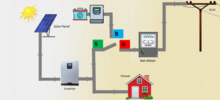
I have been pondering this question for quite some time now. Our grid-tied solar system is directly connected to our 200A distribution panel through a disconnect switch. That switch can be used by our electric utility, Florida Power & Light (FPL), to disconnect, and lock out, the solar array from the power grid to prevent electrocution of their linemen. This switch, when opened, prevents "backfeeding" through our bi-directional net-zero meter solar-generated power to the pole-mounted line transformer (pole pig) that converts high-line 7kV to 120-0-120 vac. However, our Enphase microinverters automatically shut down to prevent such backfeeding if utility power isn't available. The disconnect switch is just a CYA feature, probably required by law.
Because our 200A distribution panel is connected directly to the net-zero meter, in parallel with the solar-generated electricity through the disconnect switch, it is impossible to open the disconnect switch and still have solar power to the distribution panel. I have considered several workaound solutions, all of which involve doing exactly what
@MrNams, the original poster, suggested: use an auxilliary power oscillator to "trick" the microinverters into producing 120 vac. The problem to be solved is how to do this without backfeeding power through the "net-zero" meter between my house and the power grid.
The "easiest" solution is to remove the meter, thereby isolating the house from the grid. That is very problamatical since the meter belongs to FPL. Also, our solar installation includes a pair of current transformers at the inputs to the 200A distribution panel. It would be desirable to retain this feature by removing the meter. I'm not sure the the Enphase control box would appreciate not having a signal available from the current transformers because it uses them to report solar array performance over the Internet.
The only other solution I have thought of is to open the solar panel disconnect switch and extend the solar panel wiring to a second distribution panel ahead of the disconnect switch. There are several purposes for this second panel. First, it extends solar power inside the house, by-passing the FPL wiring. Second, it provides a means to connect the second panel to the original 200A distribution panel through a pair of unused circuit breakers in the original panel. Third, it provides an access point for a transformer with a low-voltage primary and 240 vac center-tapped secondary. The primary of this small transformer is driven by a 60Hz battery-powered oscillator and the center-tapped 120-0-120 vac secondary provides excitation to the microinverters, tricking them into believing that FPL grid power is available.
The main 200A circit breaker in the original panel would have to be opened to prevent backfeeding power into the FPL meter. I would have to remember to do this before opening the solar panel disconnect switch and turning on two dedicated circuit breakers feeding solar power into the 200A panel. Also, since the solar power is feeding into the original panel through two of its circuit breakers, it may not be possible to use all the current capability produced by the solar panels. I can live with that if I can have some electrical power during the day. It sure beats dragging out the propane-fired motor-generator to run the water-well pump, the water treatment system, and small appliances (including TV and computers and Internet fiberoptics terminal) during the day. Of course, without battery backup, we still need to run the MG set at night.
All thirty-eight of our Enphase microinverters are daisy-chained, on quick-disconnect connectors, whose solar power wiring detours through a control box, so their status can be monitored via the Internet. I suspect this control box is also essential to their proper operation, so an independent power oscillator must also power up this control box. A small sealed lead-acid "motorcycle" battery could be used to run the power oscillator until the microinverters begin producing 120 vac power. Once the solar panels are supplying the electricity, the battery can be re-charged by rectifying the AC from the solar panel microinverters. (Who cares about "efficiency" when the energy is free?)
I haven't tried any of this yet, but power almost always goes out for a few days every time a hurricane hits this area. That's why we keep a motor-generator set ready to go: can't even flush toilets, wash dishes, or take a shower without power to the well pump. This requires 240 vac, which we get with a step-up power tranformer connected to the 120 vac output of the MG set. Our MG only produces 120 vac. It runs 24/7 when FPL grid power goes away, but it would save wear-and-tear and fuel costs if we only had to operate the MG after the sun goes down.
I can't
economically add battery backup storage to our solar array plant either, although battery-operated inverters are available to replace internal combustion engines for the emergency power-generation that is now performed by our propane-fueled MG set. Battery backup (like the Tesla Power Wall) is a possible alternative that I periodically consider, waiting for a reliable battery technology to be produced at an affordable cost. Rectifying solar power to charge the backup battery is a cheap no-brainer.
This is a very old thread, but since
@ahsrabrifat responded last month, I thought I would chime in with my thoughts:
- On-grid inverters are not designed to share power with another inverter; they are designed to push power onto a stiff grid.
- If your loads draw less than the solar generation, the on-grid inverter will backfeed into the battery inverter, potentially damaging it.
I have thirty-eight microinverters, all daisy-chained to produce 120-0-120 vac power without backfeed into any of the microinverters, even at night when FPL power is available but the solar panel output is nil. So I call BS on this opinion.
- Battery inverter must be grid-forming and capable of holding voltage and frequency when being backed.
This assumes the battery inverter is syncing to the grid. The grid is not available when the battery inverter is needed.
- Since you already have a battery bank, a DC-DC solar charge controller (MPPT) would be a safer and more efficient way to use your panels without relying on the grid-tie inverter.
This would be a major modification to a commercial grid-tied solar systen, as I described for my system above. Not sure a DIY grid-tie is even permissable by most utilities, but the original poster said their solar system IS grid-tied. So, given that system is operational when utility power is available, and that a backup battery and inverter is available, it should be possible to disconnect from the grid and use the backup battery and its inverter to "trick" the solar panel inverters into "firing up" and producing power. You can then recharge the backup battery after rectifying the AC power from the solar panel microinverters.
My LG panels have the Enphase microinverter permanently attached to each panel with NO provision for accessing the solar cell direct-current output. If an auxilliary oscillator can be used to "trick" the microinverters into believing that utility power is available, the 120 vac from each microinverter becomes available, after DC rectification, for charging a backup battery during the day. At night, a larger backup battery could power a larger inverter, but probably not a "whole house" inverter like a commercial (Generac?) plant would.
Here in Florida most of our electrical load is from the HVAC system. Our 38 panels are more than sufficient to run our home HVAC system because we "sell" power back to FPL every month, even in the summer. In return for the "privalege" of doing "net-zero" metering, we pay a minimum fee of about $25 per month to help support the FPL distribution infrastructure.
That's an interesting DIY link if you can get by with 50 volts of direct current to satisfy your electrical power needs. I think most folks who have already installed grid-tied solar could use, perhaps even need, a "fake-grid" solution similar to what I described above.
...
Buying a new hybrid inverter is quite expensive and would make my existing on-grid inverter a waste, which I want to avoid.
Keep your existing grid-tie inverter(s) and use your backup battery and its inverter to "trick" your solar inverters into working. You will have to somehow disconnect the grid-tie inverter(s) from the net-zero meter to prevent backfeeding into the grid.
Here's what I’m thinking:
1) I have a 12V 150Ah battery bank connected to a pure sine wave inverter, which generates a stable 230V AC output.
Great! Use this to energize a power oscillator capable of "firing up" your solar array inverter(s).
2) I'm considering disconnecting my solar inverter from the actual grid and connecting it instead to the output of the battery inverter.( In image connecting Point S-B)
Definitely disconnect the solar inverter from the grid. Most of the problem involves how to do this.
3) This would act as a “fake grid” to simulate grid presence, tricking the on-grid inverter into syncing and starting solar power production.
I do believe your scheme will work, and it only requires enough power to get the solar inverter(s) believing they are connected to the grid.
4) Then I would run my AC loads using the combined output from both the solar inverter and the battery inverter.
You can probably disconnect the battery inverter after the solar panels are producing usable power again. The battery doesn't have enough ampere-hour capacity to support a continuous load without recharging.
My questions:
1) Is this approach safe and practical?
Everything electrical is safe when you know what you are doing. I think "faking out" the solar inverters is safe. Not sure if it's practical.
2) What are the risks of backfeeding from the on-grid inverter into the battery inverter?
You should not backfeed the on-grid inverter while it is connected to the grid. Disconnect from the grid. I doubt the solar inverter(s) will be affected by the battery inverter turning them on. After all, the battery inverter is providing the voltage and frequency to which the solar inverter(s) synchronize their output. But I would also test to make sure.
3) How can I protect the battery inverter from overcurrent or overvoltage due to solar surplus?
Don't leave the battery inverter connected in parallel with the solar panel inverters after the solar panels begin producing usable power, if this is a real problem. I doubt that it is, since the battery inverter is in effect providing oscillator power (voltage and frequency) to which the solar inverter(s) synchronize. I doubt that leaving it on will cause a problem, as long as all connections to the grid are removed.
4) Are there proven dump load controller circuits or open-source solutions to balance this kind of setup?
Yes, load-dump controllers are proven technology. But why would a dump load controller be necessary? The solar panels produce a DC voltage when sunlight hits them. The microinverter(s) convert this to AC and automatically adjust to meet the current demand of the load. If the electrical load is removed, the solar panels still continue to generate DC voltage but zero current is drawn from the microinverter(s), hence no need for a load dump.
It's not like you have a power source (the Sun) that is constantly delivering power and you must somehow "get rid of the excess". A fossil-fuel powered generator without a governor might go into a runaway condition with the sudden removal of load. Or a water turbine generator that produces power, whether you need it or not, could need a load dump or load control to maintain frequency and volltage output. No load balancing necessary when the output power delivered to the load is variable and controllable by the microinverter(s).
That's my two cents, adjusted for inflation.