Superposition circuits principal?

russwr1

May 13, 2024
27
Joined
May 13, 2024
Messages
27
Can a high internal resistance 9v battery be applied in parallel to 3vDC battery D cell amps pack to run a 10 amp 6V DC headlight bub at full brightness? Neither source power by itself can run bulb. Superimposed 2 sources to operate load bulb resistance? 9 volts DC added to separate power pack. A variable power resistor + amp meter can substitute for bulb, as a higher current reading obtained.


IsaiSporer

Feb 19, 2025
2
Joined
Feb 19, 2025
Messages
2
Hello Geometry Dash!

I think a 9V battery with high internal resistance can be used in parallel with a 3VDC D portable amp pack to run the 10 amp 6V DC headlight BUB at full brightness. Why not? More convincing reasons.

 
Last edited by a moderator:

jameserik

Oct 14, 2025
1
Joined
Oct 14, 2025
Messages
1
Hello Geometry Dash!

I think a 9V battery with high internal resistance can be used in parallel with a 3VDC D portable amp pack to run the 10 amp 6V DC headlight BUB at full brightness. blooket all answers correct Why not? More convincing reasons. face rater.
Hello! That setup sounds interesting, but using a 9V battery in parallel with a 3VDC pack could cause voltage imbalance and possible damage to your circuit. It’s better to match voltages or use a regulator for safety. face rater sometimes testing the balance first can save your components from burning out.
 

danadak

Feb 19, 2021
1,063
Joined
Feb 19, 2021
Messages
1,063
Boost the LV supply, boost switching regulator.

Then implement current sharing on outputs ?

Or implement outputs as current sources, scaling each source for its appropriate
current manageable load ?

When you say 9V battery what is its current rating ? Same for D cell pack ? How long
you want to run headlight off these batteries ?
 
Last edited:

AnalogKid

Jun 10, 2015
3,045
Joined
Jun 10, 2015
Messages
3,045
Can a high internal resistance 9v battery be applied in parallel to 3vDC battery D cell amps pack to run a 10 amp 6V DC headlight bub at full brightness?
Asmost certainly not. Assuming the 3 V battery has a low ESR, it will "short out" the 9 V source, holding its output (and the voltage across the lamp) to 3 V.

You don't way what the "high internal resistance" is. If you assign values to the two battery's output resistances, such as 1 ohm and 10 ohms, you can draw the complete circuit and solve for the lamp voltage with Ohm's Law.

Also, it's gonna take a lot of D cells to source 10 A.

ak
 

eithernebulous

Nov 12, 2025
2
Joined
Nov 12, 2025
Messages
2
Hello golf hit!

I think a 9V battery with high internal resistance can be used in parallel with a 3VDC D portable amp pack to run the 10 amp 6V DC headlight BUB at full brightness. Why not? More convincing reasons.
No — that won’t work. Paralleling a 9V and a 3V source to try to make a 6V, 10 A supply is asking them to do something they weren’t designed for: their voltages don’t match, so they’ll fight each other and dump current into one another; a typical 9V or small 3V pack can’t supply anywhere near 10 A without huge voltage sag or overheating; internal resistance will collapse the voltage under load so the headlight won’t reach full brightness; and you risk damaging the batteries or causing heat/fire. If you need 6 V at 10 A, use a proper low-impedance 6 V power source or a correctly rated battery pack or converter instead.
 

Sunnysky

Jul 15, 2016
573
Joined
Jul 15, 2016
Messages
573
Can a high internal resistance 9v battery be applied in parallel to 3vDC battery D cell amps pack to run a 10 amp 6V DC headlight bub at full brightness? Neither source power by itself can run bulb. Superimposed 2 sources to operate load bulb resistance? 9 volts DC added to separate power pack. A variable power resistor + amp meter can substitute for bulb, as a higher current reading obtained.

No. That is like shorting out the weaker cell. (weak = high Rs)

Parallel voltage sources that differ in voltage will result in circulating currents where the source with the lower impedance dominates the superimposed parallel voltage in cells.

I made a simulation with my estimate of the series resistance by recalling from memory the short circuit current of an example of random 9V cell and two D cells and chose the series resistance.

Using Kirchoff's Laws the voltage & current can be computed just as performed in this simulation.
Press the dummy remote switch so you don't mess up the connections for a momentary connection between cells and see the effects of the "Superposition Principal". Just like jump starting a car unless the voltages are close you get a big spark on connection.

I used an ideal voltage source and added R to make a simple battery models. They are actually a little more like complex Supercaps with an activation voltage with thousands of Farads.
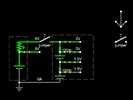
1762923511962.png
 
Top