Symbol I have found

Chrisraven4321

Jan 1, 2026
15
Joined
Jan 1, 2026
Messages
15
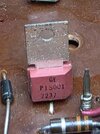
I have gotten myself into a 1975 Cordovox accordion with a separate amplifier and Tone cabinet. Fortunately I have finally acquired the complete schematics, unfortunately they have just the part numbers from Cordovox. I am trying to find out how to decipher, what a current or substitute part number would be from what is written on the part. An example is a transistor from GE and the number on it is P15000 with another number under it 7225, another one beside it has the number P15001 and the number under it is 7237. I believe it is in a regulator circuit. I can forward the schematics to anyone that is willing to give me a hand with this. I have an image of a component that looks like it is 4 diodes attached end to end, I am not familiar with this item unless it is just a stacked diode to give a certain voltage drop over the item??, I do have some decent test gear that is on my bench so I should be able to get readings and voltages that may be asked. (I have a 4 trace Teck Scope). I have attached one schematic which shows the power supply and I believe the transistors I referred to earlier are Q112 and Q114. I checked the voltages initially and it is saying I should have +and - 35 volts and I have + and - 40 volts. Q112 has a 20 volt zener at it's base and Q114 has a 22v zener at it's base. The output of Q114 is supposed to be -20 volts and I have -19 volts. The output of Q113 has an output of + 19 volts which is what it should be. Z4 is supposedly a 11 volt zener. I know I have a bunch of capacitors that are going to be replaced, in fact I think I will recap the whole project just to be safe. Looks like I have lots of leakers...lol. Looking forward to some help on my endeavor.
Thanks
Chris
 

Attachments

  • Cordovox CXA-CXG Service Manual-014.pdf
    40.1 KB · Views: 7

Delta Prime

Jul 29, 2020
2,987
Joined
Jul 29, 2020
Messages
2,987
Your Electrolytic capacitors are probably dried up, rather than leaking, either way, must be replaced.
Can you take a photo of the transistors in question, please? I need to see the “style package”. Thank you.
 
Last edited:

Chrisraven4321

Jan 1, 2026
15
Joined
Jan 1, 2026
Messages
15
I am going to replace all the caps in the system. There are a few hundred...lol.. The tone generator is full of them. They all have some kind of leakage so will probably replace them with the orange style. They are not electrolytic, just regular radial caps, with lots of white dust and stains on them. I have a couple of large filter caps that are a little difficult to find so I am going to open the can and put modern ones inside and keep the original look.
 

Harald Kapp

Moderator
Moderator
Nov 17, 2011
14,273
Joined
Nov 17, 2011
Messages
14,273
They all have some kind of leakage so will probably replace them with the orange style. They are not electrolytic
What makes you think these are not electrolytic? The schematic you provide shows a lot of electrolytic capacitors, e.g. such as this one:
1767259635489.png
The electrolytic nature is clearly indicated by the clearly marked polarity.
If they aren't electrolytic, they can't leak. The "leakage" you see may simply be glue that is often used to fix comparatively heavy components in place. Can you provide a sample picture for us to see? You shouldn't have to replace these. Only replace the electrolytics.

I can't find any reference to a P15001 transistor.
The last numbers on the "transistors" could be a datecode yyww, so both would have been made in (19)72, weeks 25 and 37, respectively. (I know, this doesn't help here :( ).
What makes you think you need to replace these?

checked the voltages initially and it is saying I should have +and - 35 volts and I have + and - 40 volts.
This sounds o.k. At the time of manufacturing of this accordion mains voltage could have been at a nominal 110 V. Today it's to my knowledge 120 V (+- tolerance). This change alone would be responsible for an increase from 25 V to 38 V on the secondary side of the power supply. Plus the 35 V is an unregulated voltage. It will drop considerably if the power supply is loaded by the full output power of the amplifier section.
Also having -19 V instead of -20 V is probably of no concern considering the usual tolerances of zener diodes and transistor parameters. A 22 V zener diode with 5 % tolerance (which is already one of the better ones), for example, can vary between 20.9 V ... 23.1 V. So your measured values are well within spec for this simple voltage regulator circuit.
Your measurements may well be a bit off as a consequence of the residual ripple on top of the DC output due to the electrolytic capacitors which may no longer work well. Which brings us back to the first part of this answer.

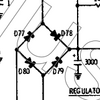
a component that looks like it is 4 diodes attached end to end
This one?: 1767259274007.png
That would be a bridge rectifier also called a diode bridge.


My suggestion: replace the electrolytics first, then measure again before you start replacing other componnets.
 

Chrisraven4321

Jan 1, 2026
15
Joined
Jan 1, 2026
Messages
15
That was my thoughts also. Going to replace all the Electrolytic caps and then work my way into the Tone Generator. The diode's I was referring to is on another sheet. It looks like 2 diodes that are fastened together in series. I am familiar with the diode bridge configuration so thanks for that comment. I thought perhaps it was done that way to get a certain voltage drop. I have attached the other schematic the double diode is D81 in the middle of the drawing. There is another one that has 4 in a row like that but I have not found it yet. Could have seen it on the earlier schematics that I located for an earlier model. I was only looking at those two transistors as examples of trying to find a replacement part. I have not yet removed the transistor and tested them but will do as I work my way through the project. I will take a few pictures of the inside of the tone generator and attach them here so you can have a look at what it looks like in real life.
Thanks for your input I do appreciate it a lot.
Chris
 

Attachments

  • Cordovox CXA-CXG Service Manual-015.pdf
    26.1 KB · Views: 3

Harald Kapp

Moderator
Moderator
Nov 17, 2011
14,273
Joined
Nov 17, 2011
Messages
14,273
It looks like 2 diodes that are fastened together in series.
That's 2 diodes in series, obviously in a single package, to bias the transistors Q22 and Q123. These transistors are in the class B amplifier configuration and the double diode provides a bias voltage to the bases of the transistors to minimize crossover distortion.
 

Chrisraven4321

Jan 1, 2026
15
Joined
Jan 1, 2026
Messages
15
That's kind of what I thought it might be. I will get into it and actually measure it when I get to that portion. Still going through the schematics and finding where all the parts are located. Lots of wires...lol... Reminds me of a hammond organ I tried to fix back in the mid 70's
 

olivia_49

Dec 26, 2025
24
Joined
Dec 26, 2025
Messages
24
I have gotten myself into a 1975 Cordovox accordion with a separate amplifier and Tone cabinet. Fortunately I have finally acquired the complete schematics, unfortunately they have just the part numbers from Cordovox. I am trying to find out how to decipher, what a current or substitute part number would be from what is written on the part. An example is a transistor from GE and the number on it is P15000 with another number under it 7225, another one beside it has the number P15001 and the number under it is 7237. I believe it is in a regulator circuit. I can forward the schematics to anyone that is willing to give me a hand with this. I have an image of a component that looks like it is 4 diodes attached end to end, I am not familiar with this item unless it is just a stacked diode to give a certain voltage drop over the item??, I do have some decent test gear that is on my bench so I should be able to get readings and voltages that may be asked. (I have a 4 trace Teck Scope). I have attached one schematic which shows the power supply and I believe the transistors I referred to earlier are Q112 and Q114. I checked the voltages initially and it is saying I should have +and - 35 volts and I have + and - 40 volts. Q112 has a 20 volt zener at it's base and Q114 has a 22v zener at it's base. The output of Q114 is supposed to be -20 volts and I have -19 volts. The output of Q113 has an output of + 19 volts which is what it should be. Z4 is supposedly a 11 volt zener. I know I have a bunch of capacitors that are going to be replaced, in fact I think I will recap the whole project just to be safe. Looks like I have lots of leakers...lol. Looking forward to some help on my endeavor.
Thanks
Yeah, those Cordovox part numbers are house codes, so you’ll need to identify the parts by their role and ratings in the circuit and then cross-reference modern equivalents. The diode stack is likely just a series voltage reference, and recapping is definitely a good move on gear that old.
 

Chrisraven4321

Jan 1, 2026
15
Joined
Jan 1, 2026
Messages
15
I can give you two examples of the power transistors I am currently looking to find a replacement/substitution for: Following is the numbers and symbols both in TOS cases: 1) the symbol is a sprawled out M, the number is MJ2955 and under that is the number 8026 which I think may be some kind of date code. I need one of these. 2) first line is the number: 480058A, the next line says RCA, and the next line is 8102. These are basically power transistors. I need three of these. I have attached the schematic of the amplifier that these are in to help with the task. Thanks in advance for any help.
 

Attachments

  • Schematic 8 Amplifier Page 13.pdf
    25.5 KB · Views: 1

Harald Kapp

Moderator
Moderator
Nov 17, 2011
14,273
Joined
Nov 17, 2011
Messages
14,273
MJ2955
480058A is supposed to be a 2N3055, see this discussion.
I have attached the schematic of the amplifier that these are in to help with the task.
Please supply also the information which reference designators (Qxx) refer to which type of transistor (MJ..., 480...). Otherwise we can't know where these transistors are being used in the circuit.
 

Chrisraven4321

Jan 1, 2026
15
Joined
Jan 1, 2026
Messages
15
OK: Firstly the transistor that is listed as Q22 is actually Q122, along with Q 124 and Q125 are all 3 Numbered RCA 489958A, Transistor Q123 is the only MJ2955. Q119 and Q 121 are both 135 on the top line and underneath says 44H, Q120 has numbers: TI 7315 and EP1125 underneath the first line.
 

Chrisraven4321

Jan 1, 2026
15
Joined
Jan 1, 2026
Messages
15
Still trying to find out what MJ2955 is or a substitute number. It is a Motorola Transistor but have not made any headway in finding a replacement.
Anyone out there can can shed so light on this for me by chance?? Schematic is attached above
Thanks
 

Chrisraven4321

Jan 1, 2026
15
Joined
Jan 1, 2026
Messages
15
Sorry I do not understand your response. You had given the transistor number for the one. (480058A is supposed to be a 2N3055) but I did not see a link for the MJ2955. Did I miss something?
 

Harald Kapp

Moderator
Moderator
Nov 17, 2011
14,273
Joined
Nov 17, 2011
Messages
14,273
When you follow the link to MJ2955 there is a link to replacement parts on that website.
 

Chrisraven4321

Jan 1, 2026
15
Joined
Jan 1, 2026
Messages
15
OK thanks for that I did not realize that could click on the number and it would give me the link. Thanks for that, I appreciate the help.
 
Top