Which MCU do you prefer — ESP32 / STM32 / RP2040 / Arduino?

Joined
Apr 2, 2025
Messages
2
Hey folks,

Just read this short comparison of ESP32, STM32, RP2040, and Arduino:

Curious about your real-world experience:

• ESP32 — great wireless + FreeRTOS, but still too power-hungry for battery stuff?
• STM32 — still the “safe” choice for industrial? Any toolchain pain lately?
• RP2040 — do you pair it w/ external Wi-Fi, or just go ESP32 instead?
• Arduino — still good enough for quick builds, or mostly replaced by the others?

Which one do you use most these days, and why?
Any surprises (good or bad) in long-term projects?

Interested to hear what people here think.
Thanks!
 

Harald Kapp

Moderator
Moderator
Nov 17, 2011
14,270
Joined
Nov 17, 2011
Messages
14,270
Whatever fits the need most: features, price, WiFi, price, availability, price
 

TechDoc

Mar 19, 2025
1
Joined
Mar 19, 2025
Messages
1
Arduino/ATMega328 for the little devices, today I use the RP-PICO/RP2040 for the current developments for the high speed (up to 300MHz) and very large Ram memory. Actually I use the Arduino + C++ (not microPython) for all my softwares. I also develop for STM32/bluepill and ESP32 using ESPNow.
 

danadak

Feb 19, 2021
1,062
Joined
Feb 19, 2021
Messages
1,062
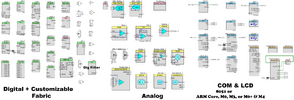
PSOC ARM SOC, all the mixed signal + ARM + on and off chip routability + fabric to
create your own specialized HW + wizards, state machine, DMA, Ohmmeter to manage
high precision analog paths +....

Whats on chip, multiple copies in most cases :

1762304687089.png

IDE and Compiler (PSOC Creator) free. Users creating more components (a component in PSOC language is an onchip
resource) to add to its lib, DDS, Cordic, 74HC logic, .......
 
Last edited:

rachna062

Jul 4, 2024
1
Joined
Jul 4, 2024
Messages
1
I don’t think there’s a single “best” MCU — it really depends on what stage you’re at and what you’re building. For basic projects or beginners Arduino is a great option to start with. For IoT projects, especially where Wi-Fi or Bluetooth is involved, ESP32 is my default. Built-in connectivity, decent performance, and huge community support make it very practical. I use STM32 when I need more control, reliability, and performance — especially in motor control, power electronics, or real life applications.
 

Delta Prime

Jul 29, 2020
2,987
Joined
Jul 29, 2020
Messages
2,987
Curious about your real-world experience:
I am more into neural networks, Machine Learning(TinyML) for kicks and giggles. I have used all of these microcontrollers with my choices depending on processingpower(RP2040/ESP32/STM32 strong, Arduino basic, don’t like it…(yuck), as said before “built in features” (ESP32 for Wi-Fi & BT), & for so called; ultra-low power needs (STM32L/NRF52), using tools like (TensorFlow Lite) as it pertains to my amateur hobbyist approach to “Modeling” of Neural Networks Research.
 
Last edited:

Minder

Apr 24, 2015
3,561
Joined
Apr 24, 2015
Messages
3,561
@maker_o9scok4l_1743564570 For a very long while I have used Picmicro products using assembly.
But recently have developed an interest in the Raspberry Pi v5. might be an avenue to explore, especially if one is a beginner as you claim to be.
 

Dollyartasia772

Feb 23, 2026
1
Joined
Feb 23, 2026
Messages
1
Hey folks,

Just read this short comparison of ESP32, STM32, RP2040, and Arduino:

Curious about your real-world experience:

• ESP32 — great wireless + FreeRTOS, but still too power-hungry for battery stuff?
• STM32 — still the “safe” choice for industrial? Any toolchain pain lately?
• RP2040 — do you pair it w/ external Wi-Fi, or just go ESP32 instead?
• Arduino — still good enough for quick builds, or mostly replaced by the others?

Which one do you use most these days, and why?
Any surprises (good or bad) in long-term projects?

Interested to hear what people here think.
Thanks!
What a fascinating question that is.
I generally use ESP32 these days. Projects get easier when Wi-Fi and Bluetooth are integrated, especially for internet-connected devices. Although it is more practical for general use, its higher power consumption makes it less suitable for tiny battery projects.

I still like STM32 for longer-term or more serious projects. It has a sturdy, dependable feel. It may take a little longer to set up, but once everything is set up, everything works perfectly.
RP2040 is enjoyable and adaptable, particularly for bespoke configurations or learning. However, I typically choose the ESP32 rather than installing additional modules if I need wireless.
Arduino is still a fantastic tool for rapid prototyping. When you simply want something to operate quickly, it's straightforward, uncomplicated, and ideal.
 

bidrohini

Feb 1, 2023
213
Joined
Feb 1, 2023
Messages
213
ESP32 always, cheapest wifi board .... stm32 is difficult and costly ....
 

superuser726

Mar 8, 2026
9
Joined
Mar 8, 2026
Messages
9
RP2040 comes in nice form-factor boards from ST electronics, so I prefer that for the compactness. It's very helpful cause I usually am using it in small model rockets where the payload space is really tiny.
 

Krishna Sankhyan

Apr 15, 2026
7
Joined
Apr 15, 2026
Messages
7
Depends on the project 🙂
For me, I’d go with something that has built-in connectivity and good performance it just makes things easier.
 

jonas123

Apr 13, 2026
6
Joined
Apr 13, 2026
Messages
6
My quick pick by use case are:
  • IoT & Wireless → ESP32
  • Industrial Embedded → STM32
  • Learning & Creativity → RP2040
  • Fast DIY Prototypes → Arduino
 

VictorZhang_PCB

May 3, 2026
4
Joined
May 3, 2026
Messages
4
I don’t think there’s a single “best” MCU — it really depends on what stage you’re at and what you’re building. For basic projects or beginners Arduino is a great option to start with. For IoT projects, especially where Wi-Fi or Bluetooth is involved, ESP32 is my default. Built-in connectivity, decent performance, and huge community support make it very practical. I use STM32 when I need more control, reliability, and performance — especially in motor control, power electronics, or real life applications.
I agree with your point of view, especially since ESP32 and STM32 have obvious differences in their intended use.
 
Top