0-30 Vdc Stabilized Power Supply

audioguru2

Apr 6, 2004
12,026
Joined
Apr 6, 2004
Messages
12,026
You can use two 1 ohm/5W resistors in parallel, or two 0.22 ohm/5W resistors in series. Ten 4.7 ohm/1W resistors in parallel and many other combinations.


Gruber

Oct 22, 2005
11
Joined
Oct 22, 2005
Messages
11
audioguru said:
Connect your voltmeter directly to the output terminals because the internal wiring has some voltage loss.
A current meter in series with the load has a resistance that ruins the fabulous voltage regulation of this project.
This is very good advice by the way  ;D I blow around 10 or more fuses when tried to connect a good ampermeter in series with the load.
When me and my friend tried the PSU it worked good except when we tried to test its current limit with a low resistence ampermeter we got one big problem - the main fuse at transformer's input was unusable anymore.We thought the PSU doesnt have working current limiter because the ampermeter showed current above 3A and then the fuse blew,but it seems that was the problem - the ampermeter in series with the load.
I was going to ask about this "bug" but after some time i got the answer myself.The strange thing is that with some no-name chinese ampermeter it showed some results and the current protection/regulation was OK.But when tried to connect a better device the fuse blew.Which i guess means the first "noname" ampermeter has higher resistance and therefore the results were wrong.
Anyway,the PSU is somehow working and did the job it was supposed to do  ;D
 

audioguru2

Apr 6, 2004
12,026
Joined
Apr 6, 2004
Messages
12,026
Hi Gruber,
The current-setting pot in this project has a tolerance of 20% and the values of the resistors were chosen so it provides 3A if the pot's resistance is 20% high. If your pot's resistance is 20% low then with it set to max, the project will try to produce 4.2A.
Such a high current will overload the transformer and cause its core to saturate. A transformer with a saturated core isn't a transformer anymore, it is a piece of wire across the mains, blowing fuses.

You should add a trimpot in series with the current-setting pot. Adjust the trimpot so the project supplies a max of exactly 3A when the current-setting pot is at max.


Tedy1

Feb 20, 2005
29
Joined
Feb 20, 2005
Messages
29
Hi,
I have built this PSU few months ago with modified parts (with no casing). :p
Few hours ago I have plugged it and spark came out near C1.
Now output is ~0.42V and I cannot set any voltage. :'(
I Have done few measurments:

Q4:
Ucb = 39.5V
Uce = 39.5V
Ube = 0V

U1 (pin4-6) = 11.35V
U2 (pin4-6) = -0.5V
U3 (pin4-6) = 37.9V

voltage across r7 is few mV

I wonder what could be wrong and if you can help me.
I hope OPamps aren't damaged, because it is really hard to get them ???

Thanks!

(sorry for my bad english)


audioguru2

Apr 6, 2004
12,026
Joined
Apr 6, 2004
Messages
12,026
Hi Tedy,
Maybe the spark was caused by a poor solder joint or fused pcb trace to C1. It has a huge surge of current to charge it.

Doesn't your project use two 2N3055 transistors with emitter resistors as Q4?

Turn off the project quickly if U2 gets hot. Q1 might be turned on all the time shorting its output to ground, because something might not be working in the negative -5.6V supply.
If Q1 is normally turned off, the output of U2 should increase as you adjust the voltage pot.


Tedy1

Feb 20, 2005
29
Joined
Feb 20, 2005
Messages
29
hi again
Yes, I have two 2N3055 with emitter resistors for Q4
U2 gets hot after few minutes. There are no poor solder joints around C1.
It is possible that there was short circuit on one of 2n3055 between emittor and base or collector.
shortcircuit.gif


audioguru2

Apr 6, 2004
12,026
Joined
Apr 6, 2004
Messages
12,026
Hi Tedy,
U2 would get hot if Q1 is conducting when it shouldn't, maybe because the negative -5.6V supply doesn't work. Maybe the spark came from something in the negative supply.


Tedy1

Feb 20, 2005
29
Joined
Feb 20, 2005
Messages
29
Is it possible that that was caused because that short circuit?
Elements on -5.6V are D5, D6, D7, C3, R3, R14?


audioguru2

Apr 6, 2004
12,026
Joined
Apr 6, 2004
Messages
12,026
Yes, but R2 and C2 feed the negative -5.6V supply circuit.
Q1 is designed to short the output of U2 to ground at the moment that the power to the project is turned off, to prevent the output voltage from rising. The negative supply has a small filter cap that discharges much quicker than the main positive filter cap when the power is turned off. When the negative -5.6V disappears, Q1 turns on.


Tedy1

Feb 20, 2005
29
Joined
Feb 20, 2005
Messages
29
I have desoldered -5.6V elements and measured them, but they are working properly.
Im not sure for D7 zener, because I don't know how to measure reverse voltage (5.6V).


audioguru2

Apr 6, 2004
12,026
Joined
Apr 6, 2004
Messages
12,026
Did the circuit make about -5.6V? If it was much less then Q1 will turn on when it shouldn't.


Tedy1

Feb 20, 2005
29
Joined
Feb 20, 2005
Messages
29
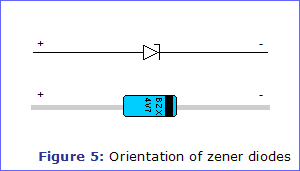
029_05.gif

that colored ring is pointing to ground (0V)
???

Here are some more measurments on -5.6V elements:

Ud5=266mV
Ur2=0V
Ud6=420mV
Ur3=5mV

Ur14=-220mV (common of instrument was on Q1 base)
Uc2=40V (common of instrument was on negative of cap.)
Uc3=650mV (common of instrument was on negative of cap.)
 

audioguru2

Apr 6, 2004
12,026
Joined
Apr 6, 2004
Messages
12,026
Hi Tedy,
Your Zener dagram is confusing. It shows the polarity of ordinary diodes, not zener diodes.

Your D7 is installed correctly. D5 also has its cathode to ground.
Your lowest voltage is at C3, maybe it is shorted.
Do you have a 4-diode full-wave-bridge rectifier for D1 to D4?
Is the transformer's terminal #2 on my sketch accidently grounded?

View attachment 38269

 
Last edited by a moderator:

Tedy1

Feb 20, 2005
29
Joined
Feb 20, 2005
Messages
29
Hi
I have checked C3 and it is not shorted, yes I have 4 rectifier diodes.
My D5 is also installed corectly.
Transformers terminal #2 is not grounded.


audioguru2

Apr 6, 2004
12,026
Joined
Apr 6, 2004
Messages
12,026
Well, there isn't much remaining:
R2 or C2 are open or the wrong value.
D5 or D6 not working or backwards.
Shorted diode in the bridge rectifier.
Broken trace or shorted traces on the pcb.
???

 
Top