Hi katsujinsetsunin,
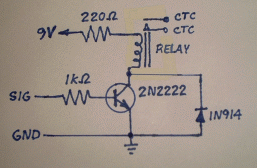
This is the project I thought you might be referring, but I could not find the reference to using 8 volts. I think mixos was talking about the requirements for the 5 volt regulator chip. The mention of 8 volts was so that you had enough voltage for the 7805.
If you are using 4 volt motors and 5 volts for the 5804, you could just use a 5 volt power supply and remove the 7805 from this board. Then drop the supply down by 1 volt for the steppers.
In reference to the current draw and stepping mode:
(Please bear with me as you probably know most of this)
Standard (hybrid) stepping motors have 200 rotor teeth, or 200 full steps per revolution of the motor shaft. Dividing the 200 steps into the 360º's rotation equals a 1.8º full step angle. Normally, full step mode is achieved by energizing "both windings" while reversing the current alternately. Essentially one digital input from the driver is equivalent to one step.
Half step simply means that the motor is rotating at 400 steps per revolution. In this mode, "one winding" is energized and then "two windings" are energized alternately, causing the rotor to rotate at half the distance, or 0.9º's. (The same effect can be achieved by operating in full step mode with a 400 step per revolution motor). Half stepping is a more practical solution in industrial applications. Although it provides slightly "less torque", half step mode reduces the amount of "jumpiness" inherent in running in a full step mode. It does not run faster, just smoother.
So, in conclusion, you will not be using more current in half step mode and you will not have more torque in half step mode. This mode of operation will only smooth out the stepping of the motor.
In regards to the power supply, give yourself some over head. Actually, an old computer power supply is great for running steppers. Linear supplies tend to run warm.
I hope the information is helpful.
MP


 However, using my software of choice (KCAM), attempting to run the motors in one-phase or half-step mode (by changing jumper position) results in a rather jarring back and forth motion (the motor fails to rotate smoothly in one direction, and instead jumps back and forth, several steps forward, several steps backward, with no net movement) - I doublechecked the solder connections on the controller board and they look alright to me - anyone else have difficulty with this or is this a software specific issue?