3-Phase VFD Supply Pre-Filter

Fish4Fun

So long, and Thanks for all the Fish!
Aug 27, 2013
481
Joined
Aug 27, 2013
Messages
481
I am finishing up a CNC router build and have opted to use a "stock" 3-phase spindle rather than a DIY spindle. I have received the spindle and the VFD and am wading through the instruction manual and various forum posts about set-up, problems, etc, etc. This is the VFD: http://www.ebay.com/itm/251681093909?_trksid=p2059210.m2749.l2649&ssPageName=STRK:MEBIDX:IT

The manual states (in Chin-English) that for single phase operation two leads from a 240V breaker can be connected to any two of the R/S/T 3 phase inputs....and that neutral/ground should be connected to some hieroglyph that I assume to be "neutral" or "Supply Ground". Visual inspection inside the VFD reveals what appears to be a standard 3-Phase rectifier, and while I have NOT verified the traces, I ASS-U-ME the hieroglyph/neutral/ground is tied to the negative side of the rectifier (I do NOT have this represented in the schematic because I have NOT verified the connection) ....at the risk of over-complicating things, I thought it might meliorate the ripple on the VFD's filter capacitors to "pre-rectify" the two 120V legs of the 240V supply and add some filtering capacitors as demonstrated in the following schematic:
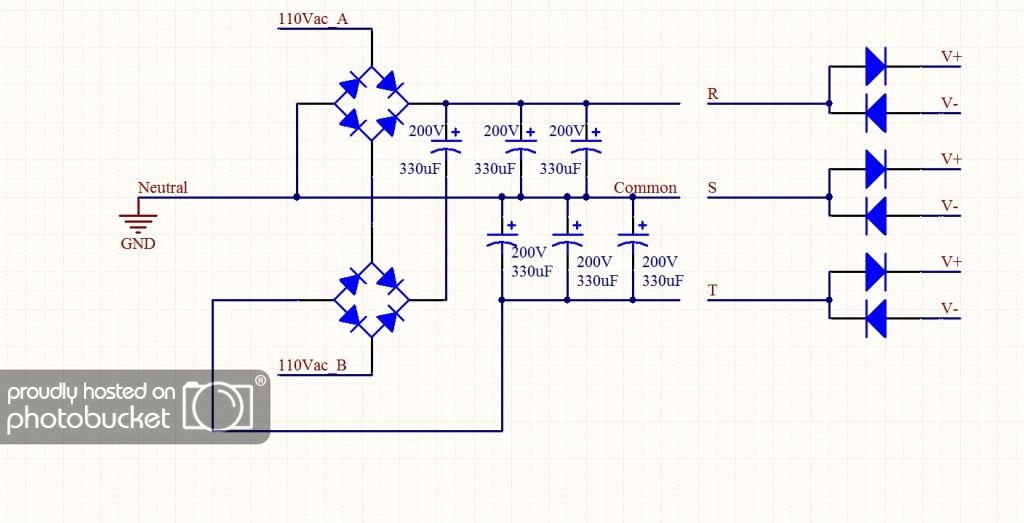


Everything to the right of the R/S/T labels is located inside the VFD, there are also filter capacitors inside the VFD, but I have not disassembled the VFD enough to read the values....Everything to the left of the R/S/T labels is the "proposed supply circuit" to help provide a more stable source for the VFD.

I would love some thoughts on the addition of the proposed circuit....ESPECIALLY any reasons for NOT employing it.

The Drive/VFD are rated @ 2.2kW which implies a current of slightly less than 10A under full load....I am concerned that the capacitors in the VFD simply are not large enough to "fill the valley" during the "low voltage" portion of the 60hz supply....I don't know that 6 * 330uF capacitors in series/parallel (Total effective capacitance ~495uF) are up to the job either, but I figured that was a good starting place....assuming an actual peak voltage of 339V (240V * 2^0.5) to keep the supply voltage above the 220V output voltage for 8mS @ a constant 10A drain would require a capacitor bank of at least 2000uF....and I KNOW the VFD rectifier capacitors are not that large, heck, the entire VFD isn't that large, lol.

I know for a fact that there are thousands of these VFDs working from single phase supplies with these exact spindles and NO pre-rectifier or filter Capacitors....but it seems like "an ounce of prevention" might ease some of the stresses on the VFD and the spindle....but I am more than a little out of my comfort zone here and I would love some thoughts//suggestions.

Fish
 

Harald Kapp

Moderator
Moderator
Nov 17, 2011
14,271
Joined
Nov 17, 2011
Messages
14,271
Fish,
I'm not sure I understand what your pre-rectifier+capacitor circuit is supposed to do.

I'd assume that the input circuit of the vfd has a built-in rectifier and smoothing filter. Otherwise it couldn't be operated off an AC mains. The issue here is that the inverter probably is designed to operate off a 240V mains, not 2*110V. Could you post a scan or photo of the "hieroglyph", please? It may mean ground, but we'd need to see it.
 

Fish4Fun

So long, and Thanks for all the Fish!
Aug 27, 2013
481
Joined
Aug 27, 2013
Messages
481
Hey Harald, Thanks for the quick response! YES the VFD has a built in rectifier/filter.....designed for 3 phase input, but the manual states it will **work** with a single phase input.....but I am concerned that the filter capacitors in the built-in rectifier circuit are NOT large enough....So, by providing 339Vdc (+169.5Vdc/-169.5Vdc) that is "pre filtered" my intent is to prevent such extreme ripple on the built-in rectifier filter capacitors....The only reason I am rectifying the two 120Vac legs separately is to allow the use of 200V capacitors I have on hand....Electrically I could have just as easily rectified the two 120Vac legs and referenced them as 240Vac and specified 3 * 165uF 400V capacitors....

(In the US, our residential mains voltage is supplied by a center-tapped transformer with two 110Vac to 120Vac legs and a "neutral" center, if you connect across both legs and do not reference "neutral", you have a single 220V to 240V supply....)

...I will see if I can find a digital copy of the Chinese character used to reference the "Supply nuetral/ground", but unless you read Chinese, I cannot see how that is going to help.

Thanks!

Fish
 

Harald Kapp

Moderator
Moderator
Nov 17, 2011
14,271
Joined
Nov 17, 2011
Messages
14,271
...I will see if I can find a digital copy of the Chinese character
Photo?

but I am concerned that the filter capacitors in the built-in rectifier circuit are NOT large enough
Why are you concerned? Do you have negative experience? For starters, I'd use the VFD without any additional circuitry. See how it performs and whether there is any uncommon behavior (noise, het, smoke...). If it does what it is suposed to do, there's no need for additional circuitry, which, being connected to mains, will require special consideration and safety measures.
 

Fish4Fun

So long, and Thanks for all the Fish!
Aug 27, 2013
481
Joined
Aug 27, 2013
Messages
481
Thanks Harald.....my "CNC Buddy" gave me exactly the same advice, LOL! But we have had company @ the house since my Spindle & VFD arrived, I had to work all weekend...blah, blah, blah, and so I have not been able to actually do anything except "create problems" and attempt to solve them.....Perhaps I will call off work today and just focus on setting the VFD up like the manual suggests w/o attempting to implement solutions to problems I haven't had yet......**Note to Self: "Take a deep breath......AND your ADD meds...."** LOL!

Thanks Again!

Fish
 

hevans1944

Hop - AC8NS
Jun 21, 2012
4,968
Joined
Jun 21, 2012
Messages
4,968
There are several forums on the Web that cater to Chinese VFD three-phase inverters and Chinese air-cooled and water-cooled three-phase spindles. Here is one that you might find interesting. I find it even more interesting that the price on E-bay for what appear to be identical VFD drives ranges from US$123.00 to US$1116.50! These must all be brute-force DC rectifier/filters, operating directly off the line voltage, driving a three-phase inverter of some ilk. They probably do not produce very good sine-wave outputs, but maybe the spindle motor doesn't care.

One poster on one of the forums I visited had nothing good to say about Huanyang VFD, calling them a POS VFD. But they do seem to be popular with others. Others have had problems with the spindle overheating and smoking because of incorrect setup parameters, related to setting a minimum frequency that will allow the cooling fan (on air-cooled spindles) to work, while others have problems with an error code popping up after weeks of apparently successful operation. It appears to me that there are plenty of problems just getting the Huanyang VFD programmed to operate without adding an external rectifier/filter to the mix.

Maybe after you get yours working you can consider adding a pre-rectifier/filter to improve performance. Make sure your electrolytic capacitors have a working-voltage specification well above the peak line voltage if you go that route. I would be conservative and use 400 WVDC or more; 200 WVDC is within the peak voltage of 110 VAC, but dangerously close to the minumum necessary if the line voltage surges to 130 VAC. And isn't there a connection "dot" missing on your schematic to connect the lower bridge rectifier cathodes to "common"?
 

Fish4Fun

So long, and Thanks for all the Fish!
Aug 27, 2013
481
Joined
Aug 27, 2013
Messages
481
@Heavans1944....

Thanks for the reply!

Yes, I have read many, many of the horror-stories on various forums....but MOST of those are in the 2008-2010 era...I haven't found many recent posts about "smoking failures....doesn't mean there haven't been any....perhaps Huanyang fixed the issues before they went to the 2-year warranty....OR....maybe the two year warranty is only for units that still have all of the magic smoke in them...lol.....In any case mine currently works and I have NOT added any "pre rectifier" circuit to it.

As to the "dot" in question....as stated above, the capacitors, as drawn in the schematic, are connected to the "Center" of a "Center Tapped" AC supply...so with reference to ground (the center) there are essentially two 120Vac Rectifiers and the 200V capacitors from the "top half" are essentially connected in "series" with the 200v Capacitors in the "bottom half"....From one perspective each rail of the supply is filtered with respect to AC ground which is also referenced as 0Vdc....the top rail would then be +170Vdc and the bottom rail would be -170Vdc....If connected to two of the VFD Line inputs these rails would feed directly to a three phase rectifier, one rail would conduct through one diode in the 3-phase rectifier and the other rail would connect through an opposing diode in the three phase rectifier and the 0Vdc//AC Ground would still be connected to the "Earth/Ground" terminal of the VFD....

EDIT: Just looked at the schematic again.....the "missing DOT" is a quirk in the schematic capture software.....it won't let me add or delete "DOTs"...it makes the decision and stands steadfastly by it!

....Anyway all of this is really kind of moot at this juncture....it seems the VFD does, in fact, have enough capacitance in the input rectifier to source the output with a reasonable facsimile of a three-phase sine-wave output....I would think the motor's inductance would help to smooth the waveform toward a sine wave, but I have NOT verified the theory on a scope....I will say that there is certainly a "ringing" noise in the motor that I suspect can be traced back to some harmonic of the PWM frequency.....nothing earplugs won't mute ;-)

Again, Thanks for the reply!

Fish
 

hevans1944

Hop - AC8NS
Jun 21, 2012
4,968
Joined
Jun 21, 2012
Messages
4,968
I am glad you have it working! On my to-do list is a CNC router table for woodworking. I just have to remember where I misplaced my round tuit to get it moving along.

Are you using your spindle for metal working, or something else? Does it have a z-axis drive?

I think probably not so much the inductance as the rotary inertia allows those inexpensive three-phase spindles to operate with less-than-perfect sine waves, although inductance certainly does play a part. Hah! No inductance, no torque. Doh.
 

Fish4Fun

So long, and Thanks for all the Fish!
Aug 27, 2013
481
Joined
Aug 27, 2013
Messages
481
@Heavens1944, Thanks for the kind words! I would strongly encourage you to make the plunge into CNC if you have some "spare time" for a hobby and you have a passion for a challenge with tremendous potential of rewards in satisfaction, DIY CNC is a GREAT choice! Here is a link to my first **real** venture into CNC.....
http://www.cnczone.com/forums/diy-cnc-router-table-machines/109390-newest-desktop-machine-57.html

If you like to read, start at page one of that thread.....I spent an entire day reading from post 1 until I made my first post @ ~page 44.....and by page 57 I was well on my way ;-)

Here is a quick picture of where I am in my new build:


Still have a long way to go, lol, but not nearly as far as I had back in the Spring....I am trying a lot of different things all at once in this new build....some of the ideas have worked really nicely...others have had numerous "revisions"....some still need revising, lol....There are currently still several critical parts "mocked up" in HDPE that will eventually be replaced with machined aluminum....but for now I am focused on moving to the "initial testing phase"....each axis has been carefully tested as a standalone device, but w/o the spindle there just wasn't much else to test....Hopefully some time today I will get an MDF table "mocked up" and attempt some "first cuts"...

DIY CNC Routers are primarily designed for wood and plastics...some machines can make occasional light cuts in aluminum but beyond that, cutting metals requires fundamentally different machines....While the pictured build likely weighs in @ >>300lbs, a machine designed to mill metals with a similar work envelope would likely weigh ~ 2 orders of magnitude more....cutting metal is all about rigidity....and the larger the work envelope the more mass you have to add to achieve rigidity....Even a classic design like the Bridgeport has relatively limited travel in the Y-Axis and Z-Axis to achieve the requisite rigidity and those girls are heavy! (~2500lbs)...to increase the Y-Axis travel on a Bridgeport class machine to 30" of travel would require a completely different design approach that would make that build REALLY HEAVY!

On the list of things that make a CNC router different from a metal cutting machine are travel speed and spindle speed....on the machine pictured above I am currently able to "jog" the X-Axis and Y-Axis @ ~600ipm with anticipated cutting speeds of ~200ipm....the spindle is designed to be effective from 6krpm to 24krpm....obviously these feeds and speeds are not suited for metal cutting...even if the machine had the requisite rigidity....

Anyway, if you decide to "take the plunge" into CNC, by ALL MEANS feel free to seek advice in "how to get started".... One thing that my little desktop CNC router is extremely well suited for is PCB prototyping.....and I use it for that a lot, lol. So if you need a "push" and you like prototyping PCBs then....there ya go:)

Fish
 

hevans1944

Hop - AC8NS
Jun 21, 2012
4,968
Joined
Jun 21, 2012
Messages
4,968
Many years ago my boss decided to purchase a PCB manufacturing device for our electronics lab. I had been making PCBs the traditional way using photo-etching for quite some time, but my boss didn't much care for the messy chemistry. So, he bought this lathe-like contraption that rotated a thin piece of laminate in front of a cutter head at high speed. Both the laminate and the artwork were clamped to two tandem drums on the lathe. As they turned, a photohead scanned the artwork and translated the black-and-white image into in-and-out motion of the voice-coil driven cutter head. I will never forget the sound that made, but Voila! After only a few hours there was an image of the artwork scratched into the laminate, hopefully deep enough to separate the thin copper from the fiberglass backing. Then it was just a matter of gluing the laminate to a thicker piece for mechanical rigidity and drilling holes for parts. Some of the techs even tried to make double-sided boards with this gem, but not I. Eventually boss retired and we placed the "tool" on the shelf in a storage room to gather dust.

I think CNC milling of PC boards is a viable alternative to chemical etching for small prototypes. I have seen such mills offered for that purpose by commercial vendors. Thanks for your reply and the pictures of what you are doing! Makers rock!
 

TarHeelTom

Nov 3, 2014
4
Joined
Nov 3, 2014
Messages
4
I'm running a Bridgeport vertical mill on a VFD and love it. Think it's a GE/Hitachi brand, bought surplus. About $120 for a 3HP VFD to drive a 2 HP motor. (They were out of the 2 HP version, so sent me a 3 HP for the same price.)

The motor doesn't have much of an internal cooling fan, so seldom run it below about 30 Hz, and then only with a light load.

Only problem I've had is trying to wade through the manual. There must be about 100 parameters that can be set, and it takes a while to figure out most of them.

One thing to remember. There is one monster cap in there. They recommend powering up the unit for a couple of days before using it, or if it's been sitting unused for any length of time. I do this often.

Tom
 
Top