4-20mA splitter

cps13

Feb 25, 2013
54
Joined
Feb 25, 2013
Messages
54
Hi,

I need to make a simple 4-20mA splitter to mount on a small PCB.

It needs to accept a 4-20mA input, and then provide 2x 4-20mA outputs which are a mimic of the input.

I have a 24VDC power supply and no current limitations.

The logic to me seems like I would need to amplify my current to double what it is now on the input, and then drop it over two equal resistors on the output afterwards. Is that correct?

This is not a project/homework.

Thanks
 

Alec_t

Jul 7, 2015
3,817
Joined
Jul 7, 2015
Messages
3,817
Will the two slave loops have independent power supplies, or will all three loops share the 24V supply?

Edit: An advantage of a current loop is that several devices can share it. So why do you wish to replicate the loop?
 
Last edited:

Alec_t

Jul 7, 2015
3,817
Joined
Jul 7, 2015
Messages
3,817
Did you see my post #2 edit?
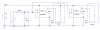
Here's a suggested circuit :-
CurrentLoopReplicator.PNG

Note: emitter resistors R2 and R4 must have the same value as sense resistor R1.
 
Last edited:

cps13

Feb 25, 2013
54
Joined
Feb 25, 2013
Messages
54
@Alec_t

Thanks for the circuit - I have managed to get it working on multisim but not in real life!

I have built the circuit up with only the first amplifier in use, I will add the second one afterwards. I believe the problem I am having is that my 4mA input to the non-inverting A input is not actually present.

I have an instrumentation amplifier (a commercial product not an IC) which outputs 4-20mA. I can read the 4mA output by connecting a multi-meter to this, the mA input on the multi-meter is to the signal output on the amplifier and the common is to the 0V supply of the amplifier.

However when I connect the 4-20mA output from my instrumentation amplifier to the splitter circuit, with a multi-meter in series, I get no input current.

They are both sharing the same power supply, and I have linked the common from the splitter circuit to the inst. amp but I still get no input current.

Can anyone suggest where I am going wrong?

thanks
 

Alec_t

Jul 7, 2015
3,817
Joined
Jul 7, 2015
Messages
3,817
Is the IA 4mA current flowing through R1 with the correct polarity? If so, you should see +0.4V at the non-inverting input. Do you?
 

cps13

Feb 25, 2013
54
Joined
Feb 25, 2013
Messages
54
@Alec_t

No I cannot measure any current flowing through R1 and there is no voltage present at pin 3.

I have also tried a mA injector but this signals a loop error when I connect it.

The mA injector was connected such that the mA output replaces I1 in your circuit, and the common is connected to the 0V supply of the splitter circuit. Does this sound correct? I'm thinking there is an issue with how I am injecting 4mA as there is no "circuit" for the current to flow.

thanks
 

Alec_t

Jul 7, 2015
3,817
Joined
Jul 7, 2015
Messages
3,817
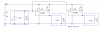
Here's another way of looking at the current loops ....
CurrentLoopReplicator3.PNG
 

Alec_t

Jul 7, 2015
3,817
Joined
Jul 7, 2015
Messages
3,817
Does this sound correct? I'm thinking there is an issue with how I am injecting 4mA as there is no "circuit" for the current to flow.
Sounds correct to me. R1 completes the circuit if you're simply connecting the injector across it. What value R1 are you using? 100Meg won't work :D.
 

cps13

Feb 25, 2013
54
Joined
Feb 25, 2013
Messages
54
@Alec_t

I have replaced R1 for a 100Ohm pot which is set at 50%.
R1 and R2 are 50Ohm.

Very confused! :mad:
 

Alec_t

Jul 7, 2015
3,817
Joined
Jul 7, 2015
Messages
3,817
If the IA is disconnected from the circuit and its output is instead connected to the 0V rail by a 100Ω resistor, what voltage do you read at the IA output?
 

cps13

Feb 25, 2013
54
Joined
Feb 25, 2013
Messages
54
@Alec_t

with the IA disconnected from the splitter circuit entirely, and putting a 100R resistor the output reads 0.4V.

thanks
 

cps13

Feb 25, 2013
54
Joined
Feb 25, 2013
Messages
54
@Alec_t
I have now rebuilt my circuit, before I was using SMD components and the LM358N soldering them onto a dev. board. I have rebuilt the circuit using through hole components (a couple of OPA347PA and 2N222A BJTs) on a bread board and I am now getting the desired outcome.

thanks for your help!!
 

cps13

Feb 25, 2013
54
Joined
Feb 25, 2013
Messages
54
@Alec_t

I noticed whilst soldering some parts on my circuit that when turning the soldering iron on/off there seemed to be some interference with the circuit.

I have added a 100mH inductor in series with the input in loop 1 and a 100uF capacitor with one leg between the inductor and the input to the op amp, and the other going to ground. This has helped massively but there is still some minor interference present.

I know that some of this would be hard to remove as it is on a breadboard, but is there anything else which could be done to help remove this interference?

thanks
 

Alec_t

Jul 7, 2015
3,817
Joined
Jul 7, 2015
Messages
3,817
I have added a 100mH inductor in series with the input in loop 1 and a 100uF capacitor with one leg between the inductor and the input to the op amp, and the other going to ground.
Good move. The cap introduces some delay in the input response, but presumably the loop current isn't meant to change rapidly? If so, might be an idea to add similar filtering to the other loop(s).
 
Top