OK, I had a think about this and here's the circuit I came up with.
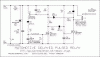
The circuit produces a pulsed closure of the relay contacts after about five seconds of being powered up. The pulse is about half a second long. After power is removed, power must remain OFF for about 30 seconds, otherwise it won't pulse the relay when power is reapplied. This is to prevent nuisance activations.
It uses all standard components except for the following.
RV is a V18AUMLA2220 automotive varistor and is needed to protect the whole circuit from spikes and surges that are present on the automotive supply. Unfortunately this device is only available in SMT, but it shouldn't be hard to solder.
http://www.digikey.com/product-detail/en/V18AUMLA2220H/F3807CT-ND/2627727
CL needs to be a low-leakage electrolytic. I recommend the Nichicon KL series part marked on the schematic. CD and CW can be the same type.
http://www.digikey.com/product-detail/en/UKL1E330MED1TD/493-10492-1-ND/4318106
K1 is a reed relay and must have a maximum coil current of 12 mA or less. Digi-Key's cheapest option is
http://www.digikey.com/product-detail/en/9007-12-00/306-1064-ND/301698 but you can use any of the results from this filter:
http://www.digikey.com/product-search/en?FV=fff40010,fff80368,1140050,1200002,a700009,a7c0019,a7c0027,a7c002b,a7c003f,a7c0054,a8c0007,16040020&ColumnSort=1000011&stock=1&quantity=1&pageSize=250
You can build the circuit on stripboard or any similar prototyping system.
Here's a circuit descripton. Don't worry if you don't understand it fully.
The automotive +12V supply is first clamped to 40V by RV, an automotive varistor, then passed through RS and further clamped by DZ and smoothed by CS.
When power is first applied, CL is fully discharged (by RL) and CD is fully discharged (by RP). Therefore QC and QL are both OFF; this part of the circuit remains in that state initially. As QL is OFF, RP and RK pull its drain up to +12V and DH is reverse-biased, so CW starts to charge through RW. This time period is the "wait" time ("W") before the relay is pulsed.
After about five seconds, with the values given, the voltage on CW reaches about 2V, the typical V
GS(th) voltage for QK, and QK begins to conduct, activating the relay. With QK's drain voltage pulled down near 0V, CD begins to charge through DD and RD. This time delay sets the relay pulse duration ("D").
When the voltage across CD reaches about 0.6V, QC begins to conduct and this starts a latching action between QC and QL. Current through DC and RC rapidly charges CL; this makes QL conduct, and current through RK charges CD further. Once this latching action begins, there is no longer a need for current through RD; the circuit will latch regardless. With QL ON, CW is discharged through RH and DH and the relay is deactivated.
In this state, the circuit node marked +LOCKOUT sits at about 12V. If power is removed, CL discharges slowly through RL; if power is reapplied too soon, QL still has forward bias so the QL/QC circuit latches again, and no relay pulse is generated. Only if power is removed for long enough for +LOCKOUT to drop below QL's gate threshold voltage will the circuit generate a new pulse after power-up.
Because the gate threshold voltages of the MOSFETs are not very tightly controlled, the timings stated here are only approximate. If you have problems with timings being too far out of specification, you can try MOSFETs from a different batch or different manufacturer, or adjust capacitor values to compensate.
When the relay activates, the positive rail drops about 1V due to the relay current causing a drop across RS. This doesn't affect the circuit. After the pulse has been generated, the circuit draws about 1 mA (current through RK).


