70 volt regulator

Kevin Weddle

Feb 23, 2004
1,620
Joined
Feb 23, 2004
Messages
1,620
I have this power supply that I was given that takes the 120vac and converts it to 50vac. The current of the bridge is 1.5A max. The regulator has a control line, input, and output. The output is fed to the base of a darlington and the collector goes to the control. The emitter has a zener diode that gets it's voltage from the ouput. The input to the regulator is 50vac filtered to 70v dc. I suppose the output is approx. 70v dc. What is the voltage of the zener? Is it 70v? I have already taken the circuit apart so that I can reboard it. The circuit has a large capacitor on the output, which in my opinion is negligent design.


ante1

Jan 24, 2004
4,138
Joined
Jan 24, 2004
Messages
4,138
Hi Kevin,

Do you have a multimeter? If so why not measure the voltage over the Zener? Why do you think a large capacitor on the output is negligent design?

Ante ::)


Kevin Weddle

Feb 23, 2004
1,620
Joined
Feb 23, 2004
Messages
1,620
I already took apart the circuit. The large capacitor on the output is open for debate. I have seen smaller capacitors on the output. I think this is correct because the voltage regulator regulates not only the dc, but the fluctuation as well. If you design the voltage regulator to have a small impedance output, then it would be alright. I tend to think it was designed for an impedance equal to the voltage divided by resistance.


ante1

Jan 24, 2004
4,138
Joined
Jan 24, 2004
Messages
4,138
Quite often the things you connect to a PSU are equipped with big capacitors on their input. If you have a big capacitor on the PSU output it reduces the rushin current from the powerstage.
The zener can easily be checked by connecting it in series with a resistor and measure the voltage across.

Ante ::)


Kevin Weddle

Feb 23, 2004
1,620
Joined
Feb 23, 2004
Messages
1,620
What you are saying is that a large capacitor on the output will allow more current when there is a sudden current burst.


Kevin Weddle

Feb 23, 2004
1,620
Joined
Feb 23, 2004
Messages
1,620
I found the zener to be a 8.5v approx 1.5 A . This would make the control voltage approx. 12v because of the transistor. The input voltage is approx. 70v though. This is very high, but there are large divider resistors which means there is not much current from input to the control. The current comes through the collector of the transistor through the control line. Can a regulator accept an input voltage of 70v down to 12v on the output?


ante1

Jan 24, 2004
4,138
Joined
Jan 24, 2004
Messages
4,138
Kevin,

Can you make a drawing of the circuit so I can explore is? It is possible that it is a kind of floating ground circuit.

Ante ::)


Kevin Weddle

Feb 23, 2004
1,620
Joined
Feb 23, 2004
Messages
1,620
I can't find the data sheet on the regulator. I know the circuit was operating at 25vdc with the input, the ouput, and the control all at this voltage. It might be a variable voltage regulator. I must have the data sheet to do anything with it.


ante1

Jan 24, 2004
4,138
Joined
Jan 24, 2004
Messages
4,138
You said earlier it was a transistor / Zener circuit; witch regulator are you trying to find the data sheet for?

Ante ::)


Kevin Weddle

Feb 23, 2004
1,620
Joined
Feb 23, 2004
Messages
1,620
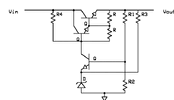
The regulator is a motorola 513 je 800. I think the je800 is the part. The zener is on the emitter of the NPN control transistor. The collector goes to the control of the regulator. The base is connected to the ouput through resistors. The zener gets its voltage this way. I wonder about the zener. Why is it there? Why is it better than a resistor.


ante1

Jan 24, 2004
4,138
Joined
Jan 24, 2004
Messages
4,138
Good question, there are a lot of questions here I guess :-\

Ante ::)


GPG1

May 3, 2004
71
Joined
May 3, 2004
Messages
71
The zener is the reference for the regulator.
MJE800 is a darlington transistor
http://www.fairchildsemi.com/ds/MJ/MJE803.pdf
Does that make it look like the att. The unlabelled resistors are part of the darlington.


GPG1

May 3, 2004
71
Joined
May 3, 2004
Messages
71
Attachment did not attach so its here
http://homepages.slingshot.co.nz/~peg/

reggif.gif


Kevin Weddle

Feb 23, 2004
1,620
Joined
Feb 23, 2004
Messages
1,620
That's the circuit. What does the zener help in that position? Why not use a resistor? Does the zener present a higher impedance to the signal? Also, I am unable to measure the diode of the device, it's just low resistance all the way around.


GPG1

May 3, 2004
71
Joined
May 3, 2004
Messages
71
The zener is the reference for the regulator.
When the voltage on the base of the transistor exceeds
the zener voltage plus Vbe, the transistor conducts
tending to remove base drive from the pass transistor.
So the regulated output is
(Vz + Vbe)*(1+R1/R2)
What are the original values?


audioguru2

Apr 6, 2004
12,026
Joined
Apr 6, 2004
Messages
12,026
That circuit provides a regulated output voltage by this calculation:
Zener voltage plus 0.65V (base-emitter) multiplied by (R1 divided by R2) plus 1.
The zener is the voltage reference that the divided output voltage is compared with. Since a zener is low impedance, changes in current through it does not produce much voltage change across it. If a resistor was used instead, then there would be no reference voltage (it would change with any output change) and the circuit would not regulate.


audioguru2

Apr 6, 2004
12,026
Joined
Apr 6, 2004
Messages
12,026
Sorry for my repeat of GPG's formula. I didn't see page 2 when I replied.


GPG1

May 3, 2004
71
Joined
May 3, 2004
Messages
71
If the zener reads low both ways it is :'(
You say "I found the zener to be a 8.5v approx 1.5 A "
How did you test it?. If it has some writing on it tell us, and the values of the resistors

 
Top