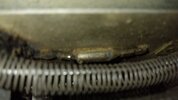
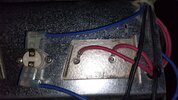
American 220 wall heater problem...

roughshawd

Jul 13, 2020
616
Joined
Jul 13, 2020
Messages
616
The 220v thermostat on my wall heater is obsolete, and I am having problems finding a replacement. I have maybe 5 of these heaters, and they all need the thermostat. Can you help me to diagnose and test these? I checked the resistance, tested the motor, the heating element still has continuity, and everything looks good. The source power was made from 2 separate in 110v sources, instead of a dedicated 220v circuit so the problem might be induced...????
 

Attachments

  • 16774405485443378520387474722632.jpg
    16774405485443378520387474722632.jpg
    308.1 KB · Views: 11
  • 16774405782505051163851289573346.jpg
    16774405782505051163851289573346.jpg
    209.4 KB · Views: 11

Minder

Apr 24, 2015
3,561
Joined
Apr 24, 2015
Messages
3,561
The 220v thermostat on my wall heater is obsolete, and I am having problems finding a replacement. I have maybe 5 of these heaters, and they all need the thermostat. Can you help me to diagnose and test these? I checked the resistance, tested the motor, the heating element still has continuity, and everything looks good. The source power was made from 2 separate in 110v sources, instead of a dedicated 220v circuit so the problem might be induced...????
In N.A. it is 240v 120v-0v-120v.
The 240 v is the same as 2x120v.
The thermostats do not appear to be voltage sensitive, so any equivalent should suffice.
 

roughshawd

Jul 13, 2020
616
Joined
Jul 13, 2020
Messages
616
Rephrase... Sorry!
Can the rotary thermostats that control wall heaters be reworked?
 

roughshawd

Jul 13, 2020
616
Joined
Jul 13, 2020
Messages
616
The little fan motor is reading 171 ohms. I did the math. That's what a 33v motor is supposed to have. A 240v motor that uses .195a.is supposed to have 1230ohms.
What gauge wire do I rewrap the coil with?

What ohms should a 220 fan motor readout? This one here is impossible to read. I need to rewrap the induction coil on the field.

Did you measure 220V between those two sources?
Source power is okeydoke!

Motor coils cooked. !!!
 

kellys_eye

Jun 25, 2010
6,512
Joined
Jun 25, 2010
Messages
6,512
As ever, you're over-thinking things. There's probably nothing wrong with the motor. Leave it alone (for now).

Remove the thermostat. Point a hot air gun at it and see (listen) for the bi-metallic strip 'clicking'. If it clicks the metallic strip (mechanical action) is fine. Clean the contacts of the thermostat. Re-heat it and check the contacts close (use your meter on the continuity range). If the contacts show a short (when heated and clicking) then refit the thermostat.

All should be good from there.
 

Minder

Apr 24, 2015
3,561
Joined
Apr 24, 2015
Messages
3,561
The little fan motor is reading 171 ohms. I did the math. That's what a 33v motor is supposed to have. A 240v motor that uses .195a.is supposed to have 1230ohms.
What gauge wire do I rewrap the coil with?

What ohms should a 220 fan motor readout? This one here is impossible to read. I need to rewrap the induction coil on the field.
You cannot calculate the amperage of a AC inductive device (e.g. motor) from a resistance reading.
It possesses inductive reactance which reads a lot higher than the DC resistance, this is what limits the current
 

roughshawd

Jul 13, 2020
616
Joined
Jul 13, 2020
Messages
616
As ever, you're over-thinking things. There's probably nothing wrong with the motor. Leave it alone (for now).

Remove the thermostat. Point a hot air gun at it and see (listen) for the bi-metallic strip 'clicking'. If it clicks the metallic strip (mechanical action) is fine. Clean the contacts of the thermostat. Re-heat it and check the contacts close (use your meter on the continuity range). If the contacts show a short (when heated and clicking) then refit the thermostat.

All should be good from there.
Wow, a simple device tests device fix! Thanks for really testing thermostat!
 

roughshawd

Jul 13, 2020
616
Joined
Jul 13, 2020
Messages
616
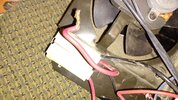
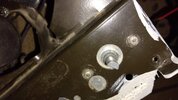
Thermocouple burned out. I'm lucky I had a spare. Haven't tested it yet but I'm fairly certain that is what happened.
 

Attachments

  • 16775345413947541485608864320681.jpg
    16775345413947541485608864320681.jpg
    106.1 KB · Views: 6
  • 16775345803112624479653449064227.jpg
    16775345803112624479653449064227.jpg
    274.1 KB · Views: 6

roughshawd

Jul 13, 2020
616
Joined
Jul 13, 2020
Messages
616
As ever, you're over-thinking things. There's probably nothing wrong with the motor. Leave it alone (for now).

Remove the thermostat. Point a hot air gun at it and see (listen) for the bi-metallic strip 'clicking'. If it clicks the metallic strip (mechanical action) is fine. Clean the contacts of the thermostat. Re-heat it and check the contacts close (use your meter on the continuity range). If the contacts show a short (when heated and clicking) then refit the thermostat.

All should be good from there.
Thermostats are fine. I found on one of the heaters the thermocouple that heats up before the fan turns on is already on, so it's shorted out. Because these aren't made to repair, they sell the entire element package as one unit. Where a person might get some thermocouples like these is beyond me. So. Once again. Drop the dime, replace the unit.
 

ivak245

Jun 11, 2021
143
Joined
Jun 11, 2021
Messages
143
The first picture is a thermal fuse. They will measure as a short if good. There is a temperature usually stamped on the side. The second picture is of a "Klixon" which will go open when a set temp. is reached. This is what acts as your thermostat or it could be an overload. A thermocouple is a bimetallic temperature sensor, which needs to be connected to a circuit so the temp. can be read or controlled.
 
Top