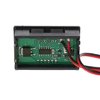
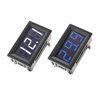
Ampere/voltagemeter

Rockgirl

Aug 26, 2021
22
Joined
Aug 26, 2021
Messages
22
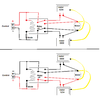
I was wondering if I could use relays with the meter. My drawing is poor but somehow this way. I don't know if the yellow wire is still a problem here either?

Oh no, I just realized this doesn't work because the voltage from the controller varies and the relay coil doesn't like it :(
 

Attachments

  • meter-relay.png
    meter-relay.png
    47.4 KB · Views: 4

hevans1944

Hop - AC8NS
Jun 21, 2012
4,968
Joined
Jun 21, 2012
Messages
4,968
I'm really afraid I can't do this. My skills are not enough :(
I don't know how old you are, or how long you have been interested in electronics, or what your current skills are, but no one follows the path you have chosen without learning some new skills. Entering a dialog with other EP members, in addition to resources you find on the Internet, is a good way to build on your knowledge and learn new skills.

It is unfortunate that your digital panel meters can measure only one polarity of input voltage with respect to power supply and signal commons, which are internally connected together by design. This particular design is less expensive to produce than a meter that reads inputs of either positive or negative polarity with respect to signal common. One solution to your problem is to full-wave rectify the DC signal before applying it to the meter, after low-pass RC filtering to remove the PWM pulses. That will allow the meter to read a motor drive signal that is either direction. Unfortunately, the circuit does not provide polarity indication of the input signal. If you need to display polarity, more circuitry is needed.

Building an accurate full-wave rectifier circuit may be beyond your current skill level, but I suggest that you at least try to do so. It generally requires the use of two operational amplifiers which can be dual op-amps in a common package. Usually two power supply rails, one positive and one negative with respect to power supply common are required, but some circuits can be used with a single positive supply rail if a special op-amp is also used. Most circuits require at least one small-signal diode (1N914, 1N4148, etc.) and sometimes two, as shown in the circuit below.

Almost any general-purpose op-amp will work, but the resistors values should be closely matched for a symmetrical output.
images
 
Last edited:

Rockgirl

Aug 26, 2021
22
Joined
Aug 26, 2021
Messages
22
I don't know how old you are, or how long you have been interested in electronics, or what your current skills are, but no one follows the path you have chosen without learning some new skills. Entering a dialog with other EP members, in addition to resources you find on the Internet, is a good way to build on your knowledge and learn new skills.

It is unfortunate that your digital panel meters can measure only one polarity of input voltage with respect to power supply and signal commons, which are internally connected together by design. This particular design is less expensive to produce than a meter that reads inputs of either positive or negative polarity with respect to signal common. One solution to your problem is to full-wave rectify the DC signal before applying it to the meter, after low-pass RC filtering to remove the PWM pulses. That will allow the meter to read a motor drive signal that is either direction. Unfortunately, the circuit does not provide polarity indication of the input signal. If you need to display polarity, more circuitry is needed.

Building an accurate full-wave rectifier circuit may be beyond your current skill level, but I suggest that you at least try to do so. It generally requires the use of two operational amplifiers which can be dual op-amps in a common package. Usually two power supply rails, one positive and one negative with respect to power supply common are required, but some circuits can be used with a single positive supply rail if a special op-amp is also used. Most circuits require at least one small-signal diode (1N914, 1N4148, etc.) and sometimes two, as shown in the circuit below.

Almost any general-purpose op-amp will work, but the resistors values should be closely matched for a symmetrical output.
images
I am no longer young and my skill level is definitely the lowest on this forum. Somehow I feel like I don’t get these meter to work very easily. And my skills are not enough. I can't spend too much time trying to get these meter work. These are just a small part of my project. I have options and a meter is not necessary but it would be great if they were. Of course I could try to find a meter that shows volts regardless of polarity. I am grateful for the help!
 

Alec_t

Jul 7, 2015
3,817
Joined
Jul 7, 2015
Messages
3,817
One solution to your problem is to full-wave rectify the DC signal before applying it to the meter, after low-pass RC filtering to remove the PWM pulses.
That works for measuring the motor voltage, but won't the commoned -ve pins preclude measuring motor current?
 

Harald Kapp

Moderator
Moderator
Nov 17, 2011
14,273
Joined
Nov 17, 2011
Messages
14,273
but won't the commoned -ve pins preclude measuring motor current?
Definitely.

@Rockgirl :
This kind of meter cannot be used for simultaneous measurement of voltage AND current with a single instrument when the polarity changes.
You can use my diode circuit to measure current only.
You can use a second meter as I said in my post #10 and a bridge rectifier across the motor to measure voltage. But then you will have to account for the voltage drop across the bridge rectifier plus you will need separate power supplies for the two meter. Otherwise you will create a short circuit via the power supply of the meters.

Imho the main problem is that you bought these meters without giving prior thought to the usability of these in your application. Now that you are aware of your needs, mainly a unit that can measure voltage and current in both polarities, you should look out for other instruments suitable for this. It will probably be easier if you go for separate voltmeters and amperemeters.
 

Alec_t

Jul 7, 2015
3,817
Joined
Jul 7, 2015
Messages
3,817
You can use my diode circuit to measure current only.
For the post #10 circuit I don't see how. The digi-meter current-shunt -ve end and the meter -ve supply terminal are commoned at the D3/4 junction, the current-shunt +ve end is at the D1/2 junction, but where does the meter get its +ve supply? It can't come directly from V1 because that reverses polarity.
 

Harald Kapp

Moderator
Moderator
Nov 17, 2011
14,273
Joined
Nov 17, 2011
Messages
14,273
I assumed a separate supply for the meter, of course. A shown in post#1.
 

hevans1944

Hop - AC8NS
Jun 21, 2012
4,968
Joined
Jun 21, 2012
Messages
4,968
Sometimes it helps if we can see "the big picture" before jumping in with advice. So, please tell us (1) wtf your "project" is and (2) why it would be "interesting" to add digital motor-voltage and motor-current indications. Since the power supplied to the dc motor is in the form of pulses, presumably from a commercial, off-the-shelf, PWM control module, what do you expect to learn by filtering these pulses (to obtain an average value) and displaying the result on a digital meter?

Here is my idea for an inexpensive solution to your metering difficulties: put the digital meters you now have aside, perhaps saving them for another project. Instead, buy two inexpensive digital multi-meters and integrate (embed) them into your project. I have seen inexpensive digital multi-meters offered by major "big box" retail stores such as Wal-Mart, Home Depot, Harbor Freight, and Lowe's, as well as the usual on-line retailers such as Amazon or eBay. One con with this approach is the need to provide a battery for the multi-meter. However, with some creative hacking, you might be able to incorporate a line-powered power supply (or supplies) for your two meters, one small power supply for each meter if necessary.

If you take this approach, you might be tempted to try to remotely locate the digital display from the multi-meter. Forget about it! For manufacturing reasons, most digital meter displays are intimately connected electrically to the multi-meter circuit board with so-called "zebra strips". It may be possible to extend the connections, but it is more likely that you would "brick" the multi-meter instead.

Not to put too fine a point on it, but it really helps us to help you if you tell us everything, or as much as possible, about your project. Maybe upload a few pictures of what you have done so far. As always, the important thing is to have fun... hopefully without letting out too much of the "magic smoke" that makes electronic thingies work. Hint: buy lots of inexpensive components to play with until you are confident enough to plug in and turn on something worthy of really big bux,
 
Top