[Amplifier][13,56 Mhz][ ~ 15 dB] Transistor IRFD110 - does it work?

duke37

Jan 9, 2011
5,364
Joined
Jan 9, 2011
Messages
5,364
In #3 I asked whether the transistor in the simulation included capacitances. I have not had an answer yet.

You say that what you are doing is not that difficult but I think you may need feedback, neutralisation or unilateralisation. Making a RF amplifier is not easy, it may even turn into an oscillator.

A good book is "Solid State Design for the radio amateur." Published by the American Radio Relay League. This wa published in 1986 but still has lots of useful information.
 

Anon_SD

Feb 8, 2014
24
Joined
Feb 8, 2014
Messages
24
Thanks a lot for your answers.

Oh sorry I forgot to answer you duke, I got the answer that yes it includes it.

You are right, this frequency is AWFUL !!

It's very annoying to work at this gamme.

The load is an antenna near 25 - 50 Ohms.

I saw your link about class B, but as I have only 2N2222 available now I will try to use them in class A, in 2 times.

i will calculate and report it thanks :p
 

Anon_SD

Feb 8, 2014
24
Joined
Feb 8, 2014
Messages
24
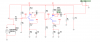
Here is my work but not really finish (just bias point set)
calcul gain.png
I find that the gain is :
AV1 * AV2 (gain of transistor 1 and 2)
with AV1 = ((-Rc1 * Rl) / (Rc1 + Rl)) / Re1 = ( Re1 * - Rc1 * Rl ) / (Rc1 + Rl)

and AV2 = ( Re2 * (- Rc2) * Rl ) / (Rc2 + Rl)

can you tell me, please, if it is right ?

Thanks :)
 

Harald Kapp

Moderator
Moderator
Nov 17, 2011
14,271
Joined
Nov 17, 2011
Messages
14,271
Sorry, I don't have the time to check the circuit thoroughly.
One issue is obvious: The values for your bias resistors R1...R4 are way too low.
The current through R1+R2 or R3+R4 is 143mA in each leg. While this is no problem in a simulation, in a real circuit this will create huge power losses.
A rule of thimb for the current through the biasing resistors is I ~ 10*1base.

Example VB1: you're trying to achieve a bias voltage of VB1=1.4V (approx.).
Subtract Vbe=0.6V from that and you get VE1=0.8V.
VE1/(Re1+R5)=0.6V/100Ohm)=6mA
The 2N2222 has a min. DC current gain of 75, therefore Ibase=80µA.
Using the rule of thumb the current through R1,R2 should be 10*80µA=800µA.
10V/800µA=12.5kOhm. R1=1.8kOhm and R2=10.7k (from the E96 series) fit the bill.

If you want to be even more precise, take into account that the current through R2 is higher than the current through R1 by the base current flowing into the transistor.
 

Anon_SD

Feb 8, 2014
24
Joined
Feb 8, 2014
Messages
24
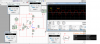
I did this amp with only one transistor 2N2222 in order to understand more ,
before designing something like a darlington push pull because I know one 2N2222 will not be enough to give me ~8 Watts output

I took a load of 5 ohms here
VCC + = 18V

I think my bias point is correct (available on screen at the bottom)

So, for designing the input, I made a norton in order to get my 5V amplitude and 0,04 A (I increased the current source to 0,08 as I didn't get the real value of 40 mA after the source).

Is there something wrong in this schematic ?

screen one 2N2222.png

I plugged my source to the emitter of my 2N2222A , can I or is it wrong ?

Is my amplifier gain = I output / I input = XMM1 / XMM5 = 582 mA / 32 mA = 18 ?

Is it very harmful if I don't put a capacitance in the emitter of my 2N2222A ?
I didn't put it because it was taking all the current and there was none current left for the output.

Thanks a lot
xoxo
 
Top