Bass/Treble System

Mukhalled

Aug 17, 2004
137
Joined
Aug 17, 2004
Messages
137
Hi,
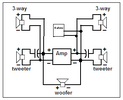
I have a different question today  ;D. This is my speaker system in my car (the attachment), Did I connect the woofer in right way (speaker no. 1)?

1 = woofer
2 & 3 = 3-way speakers
4 & 5 = tweeters

Speaker_system.JPG


Staigen1

Oct 26, 2003
695
Joined
Oct 26, 2003
Messages
695
Hi Mukhalled

Is the amps bridged? And do you have crossovers connected to the speakers?


//Staigen


Mukhalled

Aug 17, 2004
137
Joined
Aug 17, 2004
Messages
137
Hi Staigen,
This is the amp I've built :
http://www.electronics-lab.com/projects/audio/006/index.html


Staigen1

Oct 26, 2003
695
Joined
Oct 26, 2003
Messages
695
Hi

Ok, that amp is bridged, what is the impedance of your speakers, and do they have crossovers buildt in?

//Staigen


Mukhalled

Aug 17, 2004
137
Joined
Aug 17, 2004
Messages
137
The impedance of each side is totaly 4 Ohms. Yes they have crossovers built in. ;D

 
Last edited by a moderator:

audioguru2

Apr 6, 2004
12,026
Joined
Apr 6, 2004
Messages
12,026
How do you figure the impedance for each side?
Car speakers are usually 4 ohms each. Therefore at high frequencies each side has a 3-way and a tweeter in parallel, resulting in 2 ohms.
Adding the woofer lowers the resulting impedance at low frequencies the same.

The TDA1554 IC is designed to power no less than 4 ohms for each side, so it is overloaded at both low and high frequencies.

You need to add a separate amp to power the tweeters and you should add a 3rd more powerful amp for the woofer. I have never seen a woofer connected to both channels like you have, but I guess it will work allright. This connection does not give you separate control of woofer and tweeter levels but maybe resistors can be added to the tweeters to attenuate them.

The tweeters should have capacitors in series with them to keep low frequencies out of them. The woofer should have an inductor in series with it because woofers play medium frequencies strangely. Try it without an inductor and if you don't like the sound, an inductor can be added later. The inductance of the woofer prevents it from being in parallel with the tweeters so the amp isn't overloaded.
The system will end up looking like this:

View attachment 37920
 
Last edited by a moderator:

Mukhalled

Aug 17, 2004
137
Joined
Aug 17, 2004
Messages
137
I meant speakers no. 4,2 and ( "1" is connected to both sides) have 4 ohms totaly. and the same thing for 5,3 and 1 = 4 ohms , I have measured it.

The tweeters have caps in series and the woofer also has an inductor connected in series

 
Last edited by a moderator:

Staigen1

Oct 26, 2003
695
Joined
Oct 26, 2003
Messages
695
Hi

Mukhalled, how did you measured the impedance of the speakers?

Audioguru, dont you think the amp #2 is going to be slant loaded by the subwoofer speaker? There is speakers with 2 voicecoils, specially made for this purpose.

The right way to do it, i belive, is to use one amp for the subwoofer and an active filter and a summing amp before that.

//Staigen


audioguru2

Apr 6, 2004
12,026
Joined
Apr 6, 2004
Messages
12,026
Hi Mukhalled,
If the 3-way speakers and the tweeters are all 4 ohms each, then each amplifier has a 3-way speaker in parallel with a tweeter and has a 2 ohm load at high frequencies. Therefore the amp is overloaded.
You probably measured the DC resistance, but the capacitor in series with the tweeter prevented you from measuring it.

If your woofer is also 4 ohms then the amps are also overloaded at low frequencies.
Since the woofer is connected between different amps then you can't measure its resistance in parallel with a 3-way speaker.

Your amp is overloaded and will fail! :eek:
I use Microsoft Paint to copy, paste and sketch schematics.

Hi Staigen,
I think Mukhalled discovered a cool way to power his woofer in mono. Then he doesn't need to replace it with a dual voice-coil one. The amps for the tweeters won't even notice its odd wiring. If he needs more power for it then he'll need a separate amp for it. ;D

View attachment 37921


Mukhalled

Aug 17, 2004
137
Joined
Aug 17, 2004
Messages
137
Hi Staigen & Audioguru,
I will draw how I exactly connected the five speakers and I'll show you how I measured thier impedance  ;D, but I might be wrong  :'(.


Mukhalled

Aug 17, 2004
137
Joined
Aug 17, 2004
Messages
137
Hi again,
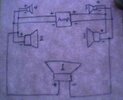
It was hard to draw schematic circuit so i took the one that Audioguru did before and made some changes on it  ;D.
When I measured the impedance like it shows in the attachment, I disconnected the amplifier and it was not 4 ohms but i added some resistors in parallel, then it became 4 ohms  8). This was the right side. I measured the left side and did the same thing to get 4 ohms.
*(There is a filter connected to the bass speaker to get low frecuencies)

amp.PNG


audioguru2

Apr 6, 2004
12,026
Joined
Apr 6, 2004
Messages
12,026
Hi Mukhalled,
Don't do that!
By adding 4 ohms to the amp now its load impedance is 1.33 ohms.

Hi Staigen,
Mukhalled previously sketched the speaker system that shows each channel with a 2 ohm load at high frequencies, and a 2 ohm load at low frequencies, with the heating brilliantly divided between the amps for low frequencies.

The amps attempted to drive peak currents of at least 5A though the speakers but the absolute max peak current rating of the TDA1554 IC is only (!) 4A.

Amps don't have a massive current capability like the mains where you can keep connecting stuff in parallel with it. Now Mukhalled added even more stuff as a load for his amp.


audioguru2

Apr 6, 2004
12,026
Joined
Apr 6, 2004
Messages
12,026
Hi Mukhalled,
You said you disconnected the amplifier and added resistors in parallel. Then you posted a sketch with "a  4 ohm resistor" added in parallel.

Post a sketch of how it is wired including the resistors you added!

View attachment 37927


audioguru2

Apr 6, 2004
12,026
Joined
Apr 6, 2004
Messages
12,026
Mukhalled,
You can't measure impedance with an ohmeter, just measure resistance. You can't measure the resistance of the tweeters because they have a capacitor in series with them. You can't measure the resistance of a channel including the woofer because the woofer is connected between different amps.
The 3-way speakers also have a cap in series with their mid-range and tweeter parts so you can't measure the resistance of them, just the woofer part of them.

A 4 ohm speaker has a resistance of about 3.5 ohms plus the resistance of your meter's probes.

Please show a sketch of the amp, speakers and the resistors you added. ;D


Staigen1

Oct 26, 2003
695
Joined
Oct 26, 2003
Messages
695
Hey Mukhalled, you must use AC to measure the impedance. In this case you also must use several freqs to get a usable measurement, say at 100 Hz, 200 Hz, 400 Hz, 800 Hz and so on, but i would not do it that way, i would have used 3 or 5 amps, one for the subwofer and the others for the other speakers.

//Staigen

 
A

Alun

Jan 1, 1970
0
You could measure the resistance by connecting to a signal generator and measureing the voltage drop (use a true RMS meter or oscillosope) at differant frequencies when the speakers are connected to it, if you know the internal resistance of the signal generator then it's quite easy to calculate the impedance connected accross it.


audioguru2

Apr 6, 2004
12,026
Joined
Apr 6, 2004
Messages
12,026
You don't need to measure anything!
Just read the labels on the speakers, use a little common sense and calculate their parallel impedance.

 
Top