Blinking LED

quantum1

Jun 24, 2004
153
Joined
Jun 24, 2004
Messages
153
Does anyone have a simple schmatic for
a blinking LED.

Thanks ;D


ante1

Jan 24, 2004
4,138
Joined
Jan 24, 2004
Messages
4,138
quantum,

You can buy a LED that blinking, this is the easy way. ;D

Ante ::)


hotwaterwizard2

Jan 8, 2004
2,022
Joined
Jan 8, 2004
Messages
2,022
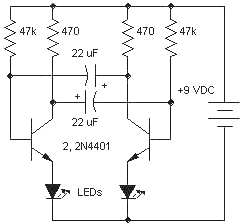
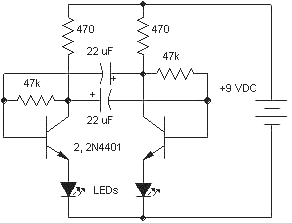
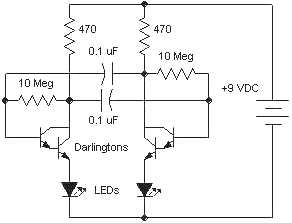
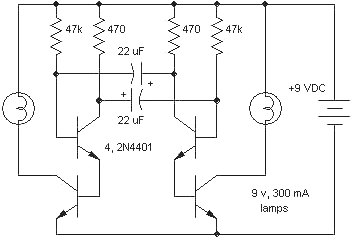
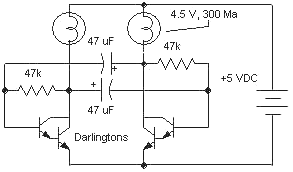
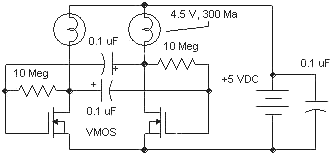
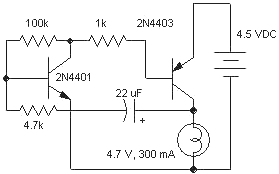
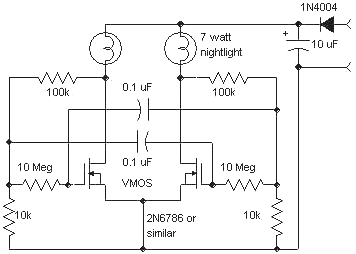
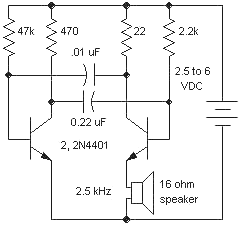
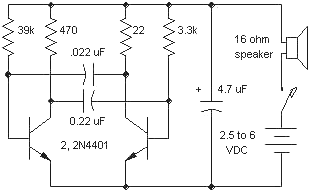
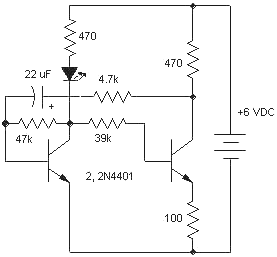
Here are some from the web.


2qflash.gif


flash2.gif


Last edited by a moderator:
K

Kasamiko

Jan 1, 1970
0
quantum,

You can buy a LED that blinking, this is the easy way. ;D

Ante ::)
Ante is right..LED's with build in flasher are flooding the market today!! 8) They are available in various colors too or a combination of BLUE and White in a single package that flashes alternately..

BR,

Rhonn ;) ;)
 

quantum1

Jun 24, 2004
153
Joined
Jun 24, 2004
Messages
153
Thanks for the advice!
I should have added more description on my question. I wanted the blinking LED to be built from scratch using components and what not.
;)


MP1

Dec 7, 2003
3,399
Joined
Dec 7, 2003
Messages
3,399
Are the ones that hotwaterwizard posted good for your need or do you need more? There are many variations of the blinking LED using many different types of components. It is also the first project most students make with a microcontroller chip.
If you have more specifics, let us know.

MP


quantum1

Jun 24, 2004
153
Joined
Jun 24, 2004
Messages
153
MP
Thats what thinking about, Hotwaterwizard's schematics.
If you or anyone else have blinking LEDs with microcontrollers, that would be great ;D. I am just getting into plcs, and microcontrollers.

One other thing. The schematic that Hotwaterwizard post that involved two NPN trasistor I actually built with the exact supplies it contained. However, the LEDs did not blink alternately. One blinked every second or so and the other every 30 millisecond or so. Is that suppose to happen, or am I doing something wrong? ???

 
K

Kasamiko

Jan 1, 1970
0
Are the ones that hotwaterwizard posted good for your need or do you need more? There are many variations of the blinking LED using many different types of components. It is also the first project most students make with a microcontroller chip.
If you have more specifics, let us know.

MP
Just what you need check this out..
http://www.talkingelectronics.com/html/PIC-Page01.html

Hope this help..


Rhonn
;) ;) ;) ;)
 

MP1

Dec 7, 2003
3,399
Joined
Dec 7, 2003
Messages
3,399
Here is also a PIC based blinking LED project. This one is based on Basic Stamp:
http://users.minet.ca/tcumming/public_html_renamed/Electronics/circuits/lightdir.html

MP


quantum1

Jun 24, 2004
153
Joined
Jun 24, 2004
Messages
153
MP,
I have a question relating to microcontrollers. I have a vague definition of relays. I know that they have to do with the binary system, however whats confusing me is I heard they were transducers. ??? Is it just me, or do they produce an electromagnetic field to trigger something? From what I heard.


MP1

Dec 7, 2003
3,399
Joined
Dec 7, 2003
Messages
3,399
quantum, when using a mechanical relay, you will charge a coil which will move the switch contact. In a solid state relay this is achieved with LEDs and Phototransistors or a similar solid state type of device. When using microcontrollers, you do not want to source or sink a lot of current, so you usually trigger a transistor with the micro. The transistor then triggers the relay since the transistor is better able to handle the current. For example, if the coil on your mechanical relay is rated at 80 ohms, we know the micro will send 5 volts out the pin, so V/R=I (5/80=63 mA). Your micro pin cannot handle much more than 10 to 20 mA, so this would fry your micro if connected directly.

Hope I have answered what you wanted to know.

MP


audioguru2

Apr 6, 2004
12,026
Joined
Apr 6, 2004
Messages
12,026
One other thing. The schematic that Hotwaterwizard post that involved two NPN trasistor I actually built with the exact supplies it contained. However, the LEDs did not blink alternately. One blinked every second or so and the other every 30 millisecond or so. Is that suppose to happen, or am I doing something wrong? ???
Quantum,
The circuit is symmetrical so should alternate the lighted LED with similar timing as the other. If you are using a supply voltage that is more than about 6V, then you should connect a diode between each transistor's emitter and ground (cathode to ground), so that the timing is not messed-up when the base-emitter reverse voltage rating of the transistors are exceeded, causing avalanche (zener) breakdown and damage to the transistors.
One of your transistors may have a higher breakdown voltage than the other, causing the different timings. ;D
 

quantum1

Jun 24, 2004
153
Joined
Jun 24, 2004
Messages
153
Audioguru,
I was using a 9 volt battery so I will try adding the diode. I have 4001 diodes, and I'm wondering if they would work.

I know how diodes work, but what do the numbers on them mean?


audioguru2

Apr 6, 2004
12,026
Joined
Apr 6, 2004
Messages
12,026
Quantum,
4001 diodes will work fine in your 9V, 2-transistor circuit. You need 2 diodes, 1 for each transistor.
1N numbers are assigned to diodes and 2N numbers to transistors in sequence, unfortunately the numbers don't mean anything, just pointing out the assigned component. Its specifications (voltage and current limits, etc.) apply only to this assigned number.
Use a search engine like Google on the internet to find specifications or applications. Click on "search www" below my name and then enter 1N4001 into the search box that appears, and you will be given a Google list of anything on the internet that applies to the 1N4001 diode. Then try entering 1N4148 and see the difference.

 
Top