ElectronMan1
- Oct 24, 2015
- 7
- Joined
- Oct 24, 2015
- Messages
- 7
Hi,
This will sound like a homework question. All I can say is that it isn't, and I'm not looking for any answers so I can pass any tests (those days are behind me, I hope!) For those interested I'm an IT professional dabbling in electronics.
I am designing this Dark Activated Light for fun and I'm having a problem understanding how to calculate the value of the resistor that goes into the Base of the Transistor.
The item is R2 (as below).
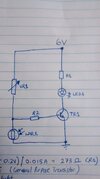
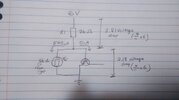
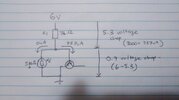
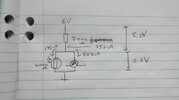
Some calculations below
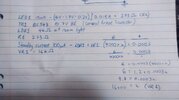
I just made up a figure of 300uA, seemed small enough not to waste battery but large enough to turn on the transistor.
This is the part I am struggling with:
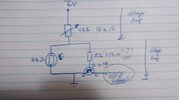
How do I calculate the value of R2, to give the right voltage drop of 0.7V when the LDR has a higher resistance.
I tried blocking off the 4k (say when dark) and focus on the VR1 + R2 path to give 0.7V -> 6V - 0.7V = 5.3V -> 5.3V / 200uA = 26500 ohms. I have 16000 ohms above, so I have about 10000 ohms which I plugged in to make up 26000-ish ohms.
However wouldn't this always switch on the transistor as the voltage drop across the parallel path will be equal?
I calculated the current through this leg of the circuit, determined the ESR to be 2857 ohms for the 4k || 10k part, which was 318uA. The LDR leg had 227uA and the Base of the transistor 91uA. I checked the BC548 data sheet but couldn't find if it's enough current to switch on the transistor.. just the voltages. https://www.fairchildsemi.com/datasheets/BC/BC547.pdf
But am I on the right track, I just starve the Base of current so it can't turn on? Technically it has the voltage but not enough current.. ? Then when the LDR gives resistance it gets the full 318uA which is enough to switch it on?
Also is this how electrical engineers do these calculations? Is there is a better way? I'm really just flying solo with these calculations, and you can probably tell
This will sound like a homework question. All I can say is that it isn't, and I'm not looking for any answers so I can pass any tests (those days are behind me, I hope!) For those interested I'm an IT professional dabbling in electronics.
I am designing this Dark Activated Light for fun and I'm having a problem understanding how to calculate the value of the resistor that goes into the Base of the Transistor.
The item is R2 (as below).
Some calculations below
I just made up a figure of 300uA, seemed small enough not to waste battery but large enough to turn on the transistor.
This is the part I am struggling with:
How do I calculate the value of R2, to give the right voltage drop of 0.7V when the LDR has a higher resistance.
I tried blocking off the 4k (say when dark) and focus on the VR1 + R2 path to give 0.7V -> 6V - 0.7V = 5.3V -> 5.3V / 200uA = 26500 ohms. I have 16000 ohms above, so I have about 10000 ohms which I plugged in to make up 26000-ish ohms.
However wouldn't this always switch on the transistor as the voltage drop across the parallel path will be equal?
I calculated the current through this leg of the circuit, determined the ESR to be 2857 ohms for the 4k || 10k part, which was 318uA. The LDR leg had 227uA and the Base of the transistor 91uA. I checked the BC548 data sheet but couldn't find if it's enough current to switch on the transistor.. just the voltages. https://www.fairchildsemi.com/datasheets/BC/BC547.pdf
But am I on the right track, I just starve the Base of current so it can't turn on? Technically it has the voltage but not enough current.. ? Then when the LDR gives resistance it gets the full 318uA which is enough to switch it on?
Also is this how electrical engineers do these calculations? Is there is a better way? I'm really just flying solo with these calculations, and you can probably tell
Last edited by a moderator: