Chinese Hiland 0-30V/Audioguru PSU build (down the rabbit hole)

Audioguru

Sep 24, 2016
3,656
Joined
Sep 24, 2016
Messages
3,656
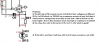
I see a few problems with your voltage measurements:
 

Attachments

  • Chinese Hiland PS.png
    Chinese Hiland PS.png
    85.5 KB · Views: 195

bushtech

Sep 13, 2016
1,025
Joined
Sep 13, 2016
Messages
1,025
Thank you so so much for looking at this Audioguru

1.Pin 6 of U3 is 1.7V. I think this is new and hopefully good news
2. R21 is 10k, waiting for replacement C8
3. I am probing with red + probe. Black probe attached to neg of C1. Do I need to reverse the probes to read pin 4. If so, then it is -1.5V
4. My led is blue
 

Audioguru

Sep 24, 2016
3,656
Joined
Sep 24, 2016
Messages
3,656
1) Pin 6 of U3 is low because its - input voltage is higher than its + input voltage. But its - input voltage is too high.
2) Did you unsolder one wire of R21 and measure its 10k resistance?
3) Always connect the black meter probe to the negative wire of C1. Then -1.5 should show -1.5V, not +1.5V.
4) Yes, 3.18V is correct for a blue LED. The LED lights to warn you that the current regulator is reducing the output voltage. Isn't red used for warnings?
 

bushtech

Sep 13, 2016
1,025
Joined
Sep 13, 2016
Messages
1,025
U3 Voltages currently:
1 1.68V
2 0.92V
3 0.75V
4 1.5V Then this is +1.5V
5 1.71V
6 1.80V
7 31V
8 0V
 

Audioguru

Sep 24, 2016
3,656
Joined
Sep 24, 2016
Messages
3,656
You keep saying that the negative supply is actually positive 1.5V. It might be causing U3 pin 2 voltage to be too high. The polarity problem is caused by the diodes D5 and D6 that have been connected backwards or they are Chinese and they are marked backwards. Maybe the Chinese pcb is labelled backwards?
Do you know how to do a "diode test" with your multimeter?
 

Audioguru

Sep 24, 2016
3,656
Joined
Sep 24, 2016
Messages
3,656
You said you had -1.5V on pin 4 of U3 a while ago. Then it jumped up to +3.8V or something and pin2 also had a voltage too high. Then you removed the U3 IC which caused the U3 pad 4 voltage to drop to +0.3V or -0.3V instead of -1.5V. Now you have U3 installed and its pin 2 is too high at +0.92V and its pin 4 the wrong polarity at +1.5V.

It looks like D5 and D6 are modern Western 1N4148 so they should be fine and they are the correct way around. The pcb is also correct. On a photo of "Paul's" Chinese pcb it looks like pin 4 of U2 connects to the pin 4 of U3 like on the original Greek kit but I changed it so that U2 does have too high of a total supply voltage. My circuit has pin 4 of U2 connected to the negative wire of C1 because the TLE2141 opamp does not need a negative supply as much as -5.1V or -5.6V.

Maybe your pcb still has pin 4 of U2 connected to pin 4 of U3 but you correctly connected pin 4 of U2 to 0V but did not cut the trace between U2 and U4? But that would cause the negative supply to be 0V, not +0.93V.
Maybe your bridge rectifier diodes are connected wrong?
Maybe one wire of the transformer secondary is shorted to 0V?
 

bushtech

Sep 13, 2016
1,025
Joined
Sep 13, 2016
Messages
1,025
"Maybe your bridge rectifier diodes are connected wrong?"

Been doing a lot of checking and your comment above made me relook that area.
I noticed that I did not have the R2 line connected to Neutral, so I ran a lead from N on the bridge rectifier to R2.

These are the readings I am getting on U3:
1 5.6V
2 0.8V
3 0.8V
4 -1.3V:)
5 -1.2V
6 31.9V :oops:
7 32.5V
8 0V

I don't know if this is a step forwards or backwards

Keep in mind that R12/C6 still connected to pin6 of U2
Thanks for the help Audioguru and I hope you have a great 2018
 

Audioguru

Sep 24, 2016
3,656
Joined
Sep 24, 2016
Messages
3,656
I am glad that you discovered the problem with the -1.3V. Pin 6 of U3 is at a normal high voltage which prevents the current regulation from limiting the output voltage through D9 and it also turns off the LED.
But pin 2 should be almost 0V since R7 is only 0.47 ohms connecting its R21 to 0V when there is no load. Measure the resistance of R7, is it 47 ohms by mistake?
Happy new year to you too!
 

bushtech

Sep 13, 2016
1,025
Joined
Sep 13, 2016
Messages
1,025
Thanks Audioguru
Sorry. bit of dyslexia there
pin 2 = 0.013V
pin 3 = 0.0.17V
The pin 2 and 3 readings of 0.8V are actually for U2

So the neg reading on pin 5 is OK?
 

Audioguru

Sep 24, 2016
3,656
Joined
Sep 24, 2016
Messages
3,656
Good, pin 2 voltage is normal. Also check that its pin 3 can go from almost 0V to +1.41V when adjusted by the current setting pot P2.
Pin 5 is not used in this circuit.

Now see if the output from pin 6 of U2 can go from 0V to about +34V (adjusted with the voltage setting pot P1) when it is connected to R12 and C6 that are connected to only pin 2 of U2.
 

bushtech

Sep 13, 2016
1,025
Joined
Sep 13, 2016
Messages
1,025
Cookin' with Gas!

pin 3 U3 = 0 - 2.37V
Pin 6 U2 = 0 - 34.5V

R7 is 0.47Ω

Just noticed that R2 has also joined the exclusive hot resistor club with R1
 

Audioguru

Sep 24, 2016
3,656
Joined
Sep 24, 2016
Messages
3,656
Good, U2 works properly.
R2 was glowing red hot on the original Greek kit because it was only 1/4W. It is 2W and fairly warm on my parts list and should be fine.
Time to connect the BD139 and output transistors? Use a load resistance because it doesn't have anything.
 

bushtech

Sep 13, 2016
1,025
Joined
Sep 13, 2016
Messages
1,025
How would a load of 5W resistors totalling 7.5kΩ do?
Got some housekeeping first eg R12/C6
 

Audioguru

Sep 24, 2016
3,656
Joined
Sep 24, 2016
Messages
3,656
7.5k with 30V across it uses a current of only 4mA which is too small. Five 7.5k in parallel use a 30V current of only 20mA which is also too small. If your BD139 and output transistor are on heatsinks then first try a load of 100 ohms/12W or 15W to make a current of 300mA at 30V.
 

bushtech

Sep 13, 2016
1,025
Joined
Sep 13, 2016
Messages
1,025
Now that I am starting to assemble again in the hopes of switching on some time I need to sort sort this out so I can see what's going on when I switch on.

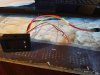
This is a photo of my display:
Display 1.jpg

And this is a photo of paulv's display:
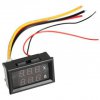
Paulv display.JPG
Thick and thin wires transposed.o_O

Now my reasoning says the 2 thick wires are the current sensing ones to be inserted in a break in the + out line.

And the 3 thin ones are for Voltage sensing, 1 on the neg. out, 1 on the pos. out and the 3rd supplying stable power for the display?

So which is which?

And then the big question: Where are the correct places to connect these wires?
 

Audioguru

Sep 24, 2016
3,656
Joined
Sep 24, 2016
Messages
3,656
Try using your 25W/12V= 2.1A soldering iron as the load. Since it is a heater then its resistance is less when cold so it might draw more than 3A then the project will not work. Try it with the voltage set to 10V.

Most digital meter products need a power supply that is completely separate from what they measure. The one you bought has no instructions so it is useless.
A separate current meter ruins the voltage regulation of the circuit. You should use a voltmeter measuring the voltage across R7 instead.
 
Top