Exactly what I used to do.i get some electronic board from say radio or any other not used device and get all the transistors from it then get their datasheets and put them in boxes for future use. this makes me familiar with many of these transistors.
Yes, and BC557 for PNP. The BC549 NPN and BC559 PNP are especially low-noise types.autir said:So, audioguru, I take it as you recommend me to stick just with the BC546-550 family?
I disagree, I encourage using transistors from old appliances providing you can find the datasheets.audioguru said:I don't use transistors from radios and things. They have too many different types and I can't purchase them if I need more.
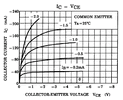
I found the section describing the transistor curves in my theory book.I think the 2SA1015 curves are a fake!
What I understand from your reply is that it is impossible to replicate with 100% accuracy the input signal? Even with class A?!?Then look what happens to the distortion of any transistor with a pure voltage input and the transistor circuit doesn't use any negative feedback:
Yes, that is why opamps use so many transistors. Class-A transistor stages produce even-harmonics distortion like I showed before with a voltage input.autir said:[What I understand from your reply is that it is impossible to replicate with 100% accuracy the input signal? Even with class A?!?
For the second time you shock me completely.Yes, that is why opamps use so many transistors. Class-A transistor stages produce even-harmonics distortion like I showed before with a voltage input.
Class-A transistor stages produce even-harmonics distortion like I showed before with a voltage input.
Then those people are making their own opamps from separate transistors.For the second time you shock me completely.
What about all these people who scorn at op.amps and ICs and design these very expensive class-A amps claiming to be Hi-Fi?
They cost 0.05 Euros each down here.I used to use BC547B and C and BC557B and C transistors when I worked for Philips, but they are hard to get in Canada.