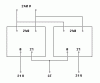
Hi polyal.
I am not 100% sure as ive not done it before, i did read some where if there in phase it will work, i am not sure putting them in series and using a meter to see, then maybe reconfigure if not, try that, personally i dont see the point, ok for series connection or parallel. Somethings telling me its no, but i might be wrong, iam a hobbyist, ive used single series and parallel but not tried what your asking. Dave.
Hi Resqueline.
So the center of the series connection can be used at 0 volts AC for a center tap rectification, if yes that answers my own not completely being sure. Dave.
Cut the top of the transformers off (in your mind, of course ), extend the central core (I'm assuming an E core) and drop the windings of the other transformer on the core. Then replace the top you cut off. Excluding saturation issues, the two cores should now behave like a center-tapped transformer, as long as the windings' phases are the same. At least that's my mental model...
Yes, you wire them just like you would DC supplies, and you get twice the VA rating of each. Of course you also need to pay attention to the primary polarity.
That answers the op for me, and handy to know, ive a couple of low VA transformers in the cupboard, it adds more options, thanks to you both for your input. Dave.
thanks for the replies.....i suppose if the primaries were wired in series
it would become a 10.5v - 0 - 10.5v since there would be 120v across
each primary ( and a combined VA )
Two transformers instead of one has the disadvantage that if they are to feed a diode rectifier, there will be a net DC current in the transformer giving the possibility of core saturation.
If you want a +/- DC supply you might be better using a bridge rectifier on each transformer and then putting these in series.