Connecting a power supply to battery

istvanb

Dec 10, 2012
18
Joined
Dec 10, 2012
Messages
18
Hi,

I have an application which has two circuits. Circuit1 controls relays in Circuit2. Circuit1 is operated by a power supply, while circuit2 uses a battery. If all the relays are in the defined state then a resistor loads the battery and current starts flowing in circuit2.

I'd like to add some functionality to the application by measuring the voltage at different parts of both circuits. The input module I have has only 1 common terminal, all the input voltages are referenced to that terminal.

Can I connect the power supply- to the battery-? Theoretically I can do I guess, but are there any practical issues with that?

Also does it makes sense to connect both these terminals to earth ground? This seems logical to me, but I don't think I have the full picture. Any precautions/best practices?

Please help me out. Thanks.
 

BobK

Jan 5, 2010
7,682
Joined
Jan 5, 2010
Messages
7,682
If the battery operated part has no other ground, just connect it to the ground of the power supply.

Bob
 

Starbuckin

Jan 22, 2013
10
Joined
Jan 22, 2013
Messages
10
istvanb,
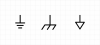
Since you are learning, I thought you should know that the proper term in this case is "chassis ground" and not "Earth ground", unless you actually have a rod driven into the Earth and connected to your circuit. The picture shows (in order from left to right) Earth ground, Chassis ground, and Signal ground. Some older schematics show the Earth ground symbol as "common". I too got in that habit but now use the Chassis ground symbol.
Of course Chassis ground is supposed to indicate a direct connection to the metal cabinet housing a circuit. Every ground point shown in many schematics using this symbol are not directly connected to the cabinet, but since ALL grounds are supposed to be a "common" or "EXACTLY the same" point, and most circuits do NOT have a direct connections with the Earth, then the "Chassis ground" is the more appropriate symbol and term. Even though the circuit may not be in a metal cabinet, the "Chassis" is an appropriate term for the "ground plane" of the circuit board. Therefore the Chassis ground symbol is always what I use now and so do most of the modern schematics that I have dealt with...
 

Attachments

  • quiz-ground-1305526104_500_225.png
    quiz-ground-1305526104_500_225.png
    39.2 KB · Views: 10,449

istvanb

Dec 10, 2012
18
Joined
Dec 10, 2012
Messages
18
istvanb,
Since you are learning, I thought you should know that the proper term in this case is "chassis ground" and not "Earth ground", unless you actually have a rod driven into the Earth and connected to your circuit. The picture shows (in order from left to right) Earth ground, Chassis ground, and Signal ground. Some older schematics show the Earth ground symbol as "common". I too got in that habit but now use the Chassis ground symbol.

Well, first of all thanks for the reply for both of you. About the quote above: I have used the terminology can be found on wikipedia about the normal electrical outlets (live, neutral, earth). Since we connect this so called "earth" to the chassis I guess many times the chassis ground and the "earth" ground of the plug is the same.

Now based on my understanding the solution to my problem is this: consider the power supply negative as a signal ground. This can be connected to the battery negative in order to use the input device I have. I have a cabinet which for sure should be grounded. This is chassis ground and it equals the earth ground wire of the power outlet.

I am still wondering though if it makes sense to connect my signal ground as well to the chassis ground. If not why, if so what are the implications?

I would definitely appreciate your thoughts.

thx
 
Top