Convert 0-30V 3A PSU to 5A or more

Kain

Jun 16, 2004
236
Joined
Jun 16, 2004
Messages
236
Ok now, I already actually have 1k for R4 and


audioguru2

Apr 6, 2004
12,026
Joined
Apr 6, 2004
Messages
12,026
Hi Kain,
Where is your voltage being lost?
1) D8 is 5.6V. R5 and R6 are equal so the output at pin6 of U1 should be 11.2V.
2) U2 has a high input impedance so there shouldn't be much loss to its input pin3.
3) U2 has 56k for R12 and 27k for R11 so it and the outputs gain should be 3.074.
4) The max output voltage should be 11.2 X 3.074 = 34.43V.

I know! You used the original value of 1.5K for R14, instead of the revised value of 1.2k. Then Q1 is turned on all the time.

No? Then you used the original value of 1k for R15, instead of the revised value of 100 ohms.

No again? Check that the positive power supply pin7 of U1 is at the 43V unregulated voltage. A "Smarter" schematic here had an error with it connected to the output pin6 of U3 instead. ;D


Kain

Jun 16, 2004
236
Joined
Jun 16, 2004
Messages
236
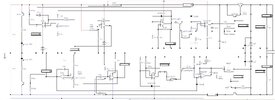
Well, this is the schematic stright from the CAD. I believe it is the correct one that I should be using. Do you see anything wrong with this one?

View attachment 37270


Kain

Jun 16, 2004
236
Joined
Jun 16, 2004
Messages
236
I just measured voltage between pin 6 and pin 4 for on U1 and it was 9.08V. When one calculates the gain on U2 it's arround 3.8 which is what it's supposed to be. I wonder why I don't get 11.2V on pin 6 of U1


audioguru2

Apr 6, 2004
12,026
Joined
Apr 6, 2004
Messages
12,026
Hi Kain,
With a quick look, your schematic is fine.
Your U1 stage is sick, its output should be 11.2V.
Check that the values of R5 and R6 are equal.

The gain of U2 and the output stage is (56k/27k) + 1 = 3.074. Your 9.08V X 3.074 = 27.9V.
U2 will have a little more gain by itself because it makes-up for the small loss in the outputs. ;D


maksar

Apr 29, 2005
23
Joined
Apr 29, 2005
Messages
23
Hi Kain!

Good job, your psu looks very good. And you know - ugly planes don't fly.  ;D ;D ;D Can you make some more pictures of your psu? Especially I interested in the bottom side of the board and the case.  :)
I begin to build the same psu as well.  8)

Maksar


audioguru2

Apr 6, 2004
12,026
Joined
Apr 6, 2004
Messages
12,026
maksar said:
ugly planes don't fly.
Sorry to be off-topic for a minute: :-[
I am making a very ugly looking plane that I expect will fly very well. Instead of using a radio control system, I'm going to use adjustable timers and PWM for its electric engine's speed and elevator control:
1) Full power for about 15 seconds for its takeoff roll and climb.
2) Up elevator for about 1 second when the plane is halfway down the runway.
3) About 1/2 power for cruising for about 1 minute. It won't go straight, it will circle like a hawk.
4) About 1/10th power for about 15 seconds for a gentle landing.
5) Over-current sensing of its motor to cut power if my plane hits a tree or me! ;D

I won the ugly thingy as a door prize at the very 1st model airplane club meeting I attended. ;D ;DView attachment 37314


maksar

Apr 29, 2005
23
Joined
Apr 29, 2005
Messages
23
Hi!

Can I use zener diode 1N4735A instead of BZX79C5V6? If the answer is yes, which resistances I need?

Thanks for the answer.

Maksar


audioguru2

Apr 6, 2004
12,026
Joined
Apr 6, 2004
Messages
12,026
Hi Maksar,
Why?
They are completely different animals:
1) The BZX79C5V6 is rated at 5.6V, while the 1N4735A is rated at 6.2V.
2) The BZX79C5V6 is rated and tested at 5mA, while the 1N4735A is rated and tested at 41mA.
3) The BZX79C5V6 has a low differential resistance at low currents for good voltage regulation, while the 1N4735A has a high differential resistance for lousy voltage regulation.

The 1N4735A appears to be a pretty good voltage regulator at 41mA, so why can't we change the circuit so it operates at 41mA?
1) It is driven by an opamp. Opamps can't output anywhere near a current so high.
2) At 41mA, it dissipates about 1/4W. Therefore it will heatup a lot causing its voltage to change. D8 is the project's main voltage reference. You don't want a voltage reference in the project that changes its voltage.

In my comparison chart, I included the BZX79V6V2 so you can make a direct comparison of 6.2V zener diodes. Since the BZX79V5V6 has a lower zener voltage, its differential resistance is higher. ;D

View attachment 37316


maksar

Apr 29, 2005
23
Joined
Apr 29, 2005
Messages
23
Hi!

Ok, thanks audioguru. The problem is that I don't have these diodes and my local electronics store don't have them too. So I tried  ;) ;D ;D ;D  But it seems that I'll need to search BZX79C5V6 in the other stores  :-\

By the way, I understand nothing in planes, however, your model doesn't look ugly at all. Pretty, small plane... But I believe to expert's word  :p ;D ;D

Maksar


audioguru2

Apr 6, 2004
12,026
Joined
Apr 6, 2004
Messages
12,026
Hi Maksar,
Don't buy special stuff in local stores, order nearly anything online.

I'm painting my plane the colour "Red Hot" right now, to make it extra ugly. It's styrofoam with bamboo spars, so I hope the paint (deluxe acrylic) will make it stronger. ;D
I'll have an empty phoney "radio control transmitter" so people will think the timers' actions are me controlling it.


maksar

Apr 29, 2005
23
Joined
Apr 29, 2005
Messages
23
Hi!

Do you think the heatsink 234-2520 on www.rsisrael.com (use search) for each 2n3055 is suitable or it is too big?  ???

Maksar


audioguru2

Apr 6, 2004
12,026
Joined
Apr 6, 2004
Messages
12,026
Hi Maksar,
With this project driving 5A into a low voltage or short, its 3 output transistors will dissipate a total of 190W, or 63W each.
The thermal resistance of a T03 2N3055 is 1.5 degrees C/W, an insulator is 0.7 and that heatsink is 1.4. The total thermal resistance would be 3.6 degrees C/W.
If the ambient temp is 30 degrees C, then with 63W dissipation the transistor's junction will be 257 degrees C. Its absolute max is 200 degrees C so more cooling is needed.
Even if you remove the insulator more cooling is needed.

You could use a high velocity fan to allow that little heatsink to be used for each transistor.
You could use a heatsink with a thermal resistance of 1.2 degrees C/W without an insulator (insulate the heatsink from the chassis) and the transistor would be exactly at its absolute max temp.
Or you could use a heatsink with a thermal resistance of 1.0 degrees C/W and the transistor's junction will be still very hot at 187.5 degrees C.

I would use larger heatsinks without an insulator, and use a fan. ;D


maksar

Apr 29, 2005
23
Joined
Apr 29, 2005
Messages
23
Hi AUDIOGURU!

Thanks for this explanation. I didn't think that it is so simple to calculate and determine the needed heatsink  :eek:  (After your post I got some reading on this topic).

It seems like I'll have to use fan. But does an airflow has big influence on the effective heatsink resistance? What will be the temperature of 2n3055 if I will put the 80mm computer fan on the 1.4 C/W heatsink?
Maybe I'll do termal control of this fan (or fans..) by using Maxim's temperature sensor.

By the way, should I make aluminium case for psu? It has low termal resistance and is
easy to work with, but it won't too soft?

Maksar


maksar

Apr 29, 2005
23
Joined
Apr 29, 2005
Messages
23
Hi!

And one more question.  :)
According to the datasheet of 2n3055, after rising of the temperature above 100C the power dissipation falls under ~65W. So in this project 100C for 2n3055s is the max?

Maksar


audioguru2

Apr 6, 2004
12,026
Joined
Apr 6, 2004
Messages
12,026
Hi Maksar,
In the datasheet they show a derating graph for the amount of power a 2N3055 transistor can dissipate when its case is at a certain temp and its junction is at its absolute max temp.
My graph shows 115W if its case is 25 degrees (impossible), about 65W if its case is 100 degrees, and 0W if its case is 200 degrees. I never operate things at their absolute max.

Datasheets from heatsink manufacturers show the improvement in thermal resistance of their heatsinks with a fan at a certain airflow that is measured in cubic feet/min.
I went to www.wakefield.com and they have a heatsink similar to the one you posted.

An aluminum case would be a good heatsink for the driver transistor Q2, the rectifier bridge and R7. It wouldn't be good enough to be a heatsink for the output transistors. ;D


Thomas1

Feb 20, 2005
29
Joined
Feb 20, 2005
Messages
29
Hi anyone

I've got a suggestion to make the project cheaper and perhaps less temperature-dependent. TI's TL431 makes a temperature-compensated Z-Diode, which output voltage can be adjusted by two (temperature-stable) resitors. That can replace the expensive U1.

There is a problem, though, because the thing can only stand 37VDC. That could be solved by putting a resistor in series with it, and a Z-Diode of, let's say 15V, parallel.

This way, we would get our 11.2VDC reference cheaper, with less space needed and with better stability over the temperature range.

What do you think?

The datasheet: http://www-s.ti.com/sc/ds/tl431.pdf


audioguru2

Apr 6, 2004
12,026
Joined
Apr 6, 2004
Messages
12,026
Hi Thomas,
A BZX79C5V6 zener diode is fairly temperature stable but you can use a TL431 reference if you want.

You have a better way[/b[ to make the modified project cost less. ;D
The output voltage of U1 is only 11.2V so will work fine with a cheap 18V/0.5W zener diode across it and a 1.8k/1W resistor feeding them from the 40V unregulated supply. A 100uF capacitor should be used to decouple and filter the 15V. Then a cheap TL081 or just about any opamp can be used for U1. ;D ;D


narog

Aug 9, 2005
2
Joined
Aug 9, 2005
Messages
2
Hello.

I am electronic engineering student and for 3 weeks I have been studding this power supply. Now I understand 98% of the PSU, and I decided to design a symmetric PSU. Here is my schematic. This is not a finished job, but maybe can help you. If you have Electronics Workbench you can simulated and maybe understand how it works.

Right now this schematic has a big problem in the current limiter. The problem is very simple the current limiter only works if the load is connected to ground. If you have a load connected to +32 -32 V the PSU don’t work very well.  Maybe some one can help and figure the solution out.


Sorry I am Portuguese and my English is not the best.

Schematic.JPG

PSU.zip


Attachments

  • PSU.zip
    30.9 KB · Views: 118

audioguru2

Apr 6, 2004
12,026
Joined
Apr 6, 2004
Messages
12,026
Hi Narog,
Welcome to our forum. ;D
I don't have Electronic Workbench so I didn't see your zipped file.

I like the way you added an opamp then sensed the current in the active supply, instead of sensing the ground current in our project. ;D
But the opamps sensing both supply's currents have their inputs reversed. Or the opamps they are driving have their inputs reversed. :(
I would use red LEDs instead of green to warn that current regulation is reducing the output voltage.

These and the opamps they drive are operating with a 39V supply, but their absolute max rating is only 36V. >:(

Where did you find little 2N2369 VHF transistors? I have some that are about 40 years old! They are rated for only 15V Vce, and will quickly melt if your circuits supply 5A at a low voltage. :'(  ;D

 
Top