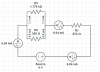
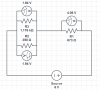
But you do -- the results are exactly the same given the number of significant digits you're using.
Part of my mental math was that the 390 ohm resistor was somewhat less than 1/4 of the resistance of the 1776 ohm resistor, so the current should be a little more than 4 times as large. Plus, the currents should add up to around 6mA. Both of these hold true.
Likewise the parallel combination of the 390 ohm resistor and the 1776 ohm resistor is going to be around 80% of the value of the 390 ohm resistor so say approx 310 ohms (it's actually closer to 320, but I had to calculate that) and that is just under half the resistance of the 673 ohm resistor, so I'd expect the voltage across the 673 ohm resistor to be a fraction over double the voltage across the pair of parallel resistors. And it is.
You can check your work in your head (and that's good practice for exams -- if you can estimate a value that turns out to be close to the answer you calculate then you can be more confident in your calculations)