design buck converter with arduino controlling pwm

Shahroll Azahari

Nov 18, 2014
5
Joined
Nov 18, 2014
Messages
5
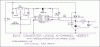
i need a help. i am designing a buck converter which step down voltage from 24v to 12v. i am using irf 540 for my mosfet. inductor value is 90u and capacitor value is 20u. load resistance is 15ohm. i am a beginner to all this. i am confusing which mosfet driver circut should i use and how im gonna control pwm using arduino uno which the volt is 5v. really need help cause my project deadline is just around the corner. im attached my buck circuit below.USED CIRCUIT.JPG
 

chopnhack

Apr 28, 2014
1,576
Joined
Apr 28, 2014
Messages
1,576
Do you mean that you are going to use more than one mosfet? Like in a synchronous design that has an upper/lower gate? or?

Where you show V2 is where the Arduino with PWM would go - see this site for some info.
 

KrisBlueNZ

Sadly passed away in 2015
Nov 28, 2011
8,393
Joined
Nov 28, 2011
Messages
8,393
Are you using an IRF540 as you say in your text, or an IRF510 as shown on your schematic?

In either case, it's an N-channel MOSFET. To turn it ON strongly, you need to bring the gate about 10V more positive than the source. But when the MOSFET is ON, its source will be at +24V. So you need a way to generate a voltage of about 34V to drive the gate. You need a "high-side MOSFET driver" IC.

The International Rectifier IR2111 (http://www.digikey.com/product-detail/en/IR2111PBF/IR2111PBF-ND/1928026) will do what you want. It uses a technique called bootstrapping to generate the gate drive voltage, using an external diode and capacitor. The IR2111 actually has a high side and a low side driver; you don't need the low side driver.
 

BobK

Jan 5, 2010
7,682
Joined
Jan 5, 2010
Messages
7,682
Or, you could use a P channel MOSFET.

Bob
 

KrisBlueNZ

Sadly passed away in 2015
Nov 28, 2011
8,393
Joined
Nov 28, 2011
Messages
8,393
I think I would stick with the N-channel MOSFET. Once you have the driver with its bootstrap circuit running, it will give good results. P-channel MOSFETs have higher ON-resistance and poorer performance generally, compared to N-channel MOSFETs, and some kind of non-standard driver would be needed; it's unlikely to perform as well as a MOSFET driver IC especially in terms of propagation delay.
 

BobK

Jan 5, 2010
7,682
Joined
Jan 5, 2010
Messages
7,682
I have successfully used a P channel in a buck converter that takes a 19V laptop brick and provided constant current (1A) to charge NiCad batteries in my drill/driver. The only thing needed to drive it was a PN2222 used as a level converter. And a micro to do the PWM and monitoring.

In lower power applications, I would always use a P-channel.

Bob
 

Shahroll Azahari

Nov 18, 2014
5
Joined
Nov 18, 2014
Messages
5
Do you mean that you are going to use more than one mosfet? Like in a synchronous design that has an upper/lower gate? or?

Where you show V2 is where the Arduino with PWM would go - see this site for some info.


chopnhack,

im using mosfet irf 540z and the mosfet driver ir 2101. i dont understand how to connect the vpulse to the pwm with arduino.can u explain to me?sorry.im new in this field :)
 

Shahroll Azahari

Nov 18, 2014
5
Joined
Nov 18, 2014
Messages
5
Are you using an IRF540 as you say in your text, or an IRF510 as shown on your schematic?

In either case, it's an N-channel MOSFET. To turn it ON strongly, you need to bring the gate about 10V more positive than the source. But when the MOSFET is ON, its source will be at +24V. So you need a way to generate a voltage of about 34V to drive the gate. You need a "high-side MOSFET driver" IC.

The International Rectifier IR2111 (http://www.digikey.com/product-detail/en/IR2111PBF/IR2111PBF-ND/1928026) will do what you want. It uses a technique called bootstrapping to generate the gate drive voltage, using an external diode and capacitor. The IR2111 actually has a high side and a low side driver; you don't need the low side driver.

KrisBlueNZ,

im using mosfet irf 540z and the driver ir 2101. so you mean im need to use Vinput 34V? and after the voltage pass through the mosfet, it will turn to 24V?
 

Shahroll Azahari

Nov 18, 2014
5
Joined
Nov 18, 2014
Messages
5
I have successfully used a P channel in a buck converter that takes a 19V laptop brick and provided constant current (1A) to charge NiCad batteries in my drill/driver. The only thing needed to drive it was a PN2222 used as a level converter. And a micro to do the PWM and monitoring.

In lower power applications, I would always use a P-channel.

Bob

Bob, im using N-channel mosfet. and a driver ir 2101 to drive the mosfet.
 

KrisBlueNZ

Sadly passed away in 2015
Nov 28, 2011
8,393
Joined
Nov 28, 2011
Messages
8,393
The IR2101 will work fine. You will need another supply voltage of around +12V for it - you can use a 7812 supplied from the 24V input. You don't use the low-side switch.

The bootstrap circuit (diode and capacitor) around the IR2101 will ensure that the MOSFET gate is pulled up to about +34V to turn it ON. You don't need to provide that voltage.

The circuit input voltage should still be 24V.

271386.001.GIF

Edit: I added CD, a 1 µF low-ESR ceramic, as shown to provide a solid firm voltage rail for M1 to switch against.
 

Shahroll Azahari

Nov 18, 2014
5
Joined
Nov 18, 2014
Messages
5
The IR2101 will work fine. You will need another supply voltage of around +12V for it - you can use a 7812 supplied from the 24V input. You don't use the low-side switch.

The bootstrap circuit (diode and capacitor) around the IR2101 will ensure that the MOSFET gate is pulled up to about +34V to turn it ON. You don't need to provide that voltage.

The circuit input voltage should still be 24V.

View attachment 17197

Edit: I added CD, a 1 µF low-ESR ceramic, as shown to provide a solid firm voltage rail for M1 to switch against.

KrisBlueNZ,

can i know what software u used to make this circuit? and how im gonna relate the pulse-width modulation (PWM) with this circuit?.
 

KrisBlueNZ

Sadly passed away in 2015
Nov 28, 2011
8,393
Joined
Nov 28, 2011
Messages
8,393
For schematics I use a very old program called OrCAD/SDT III. It is an MS-DOS app and runs under DOSbox under Windows. It was commercial software and is not available for download.

You need to control the duty cycle to achieve regulation. That means you need to monitor the output voltage, compare it to the desired output voltage, and adjust the duty cycle as necessary to achieve the desired output voltage. But I guess you knew that. If you want to know how to do it, I guess that depends on the capabilities of your MCU, including the resolution of the PWM output. There are quite a few variables here and I have no experience with using MCUs to directly generate control signals for regulators.

Someone else may be able to help. I think BobK has done this before.
 

muhammad hassan

Mar 29, 2016
1
Joined
Mar 29, 2016
Messages
1
The IR2101 will work fine. You will need another supply voltage of around +12V for it - you can use a 7812 supplied from the 24V input. You don't use the low-side switch.

The bootstrap circuit (diode and capacitor) around the IR2101 will ensure that the MOSFET gate is pulled up to about +34V to turn it ON. You don't need to provide that voltage.

The circuit input voltage should still be 24V.

View attachment 17197

Edit: I added CD, a 1 µF low-ESR ceramic, as shown to provide a solid firm voltage rail for M1 to switch against.
Sir i am using the schematic as provided by you but the output at HO is constant whether duty cycle is 20% or 80%??
Can you guide me on this
 

Alec_t

Jul 7, 2015
3,817
Joined
Jul 7, 2015
Messages
3,817
I doubt that KrisBlueNZ can help you; he passed away. :(.
What load do you have connected to the output? If there is nothing to pull the source of the FET down then the bootstrap won't work properly.
 
Top