I have been fascinated with weaving for a long time, but have never tried to build even a hand-loom. So, I Googled some information on dobby looms and their advanced enhancement, the Jacquard loom. A computer-controlled dobby loom is a common thing, but usually only a maximum of 24 harnesses or dobbies with their attached heddles are implemented. Are you going to have 128 harnesses? That's a lot of dobbies! I am suspecting you really want to control 128 heddles independently like Jacquard did with his paper-tape programmed loom. The image below (
copied from this Wikipedia web page) of Jacquard gives some idea of the complexity of weaving patterns you can produce if you can control each weft thread (or groups of weft threads) with each pass of the shuttle. Very few of these silk self-portraits were made, but it is said that Charles Babbage owned one, inspiring him to use punched cards to "program" his analytical engine. Said cards were the precursor to 80-column by 12-row Hollerith cards popularized by International Business Machines (IBM) at the beginning of the 20th Century.
The solenoid power supply and the logic power supply have separate commons, but they
are connected together at just one point, generally by means of a small-gauge wire connecting the solenoid common to the logic common. Ideally, the solenoid return wire does not also serve as the logic return wire because any voltage drop in this wire caused by solenoid current will appear in series with the logic signal with respect to the logic power supply common. Hopefully, for the short distances and small solenoid currents you anticipate, this will not be a problem. If it were a problem, optically-coupled isolators could be used to separate the logic returns from the solenoid power returns. I would normally do this anyway since I don't like having the "real world" interact directly with digital electronics without the protection of optical or transformer isolation of input as well as output signals. But that's just my design philosophy. It's not cast in stone, so sometimes I will not use isolation to interface with the real world. It all depends on the specific application.
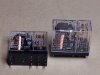
I would imagine you are planning to drill a hole through the plastic case and weld or cement an actuator rod to the armature, said rod to somehow mechanically determine whether a dobby is raised or lowered. I would be interested in seeing a close-up picture of such a mechanism. Be aware that the armature moves through a short arc on a pivot, so your rod will move up and down as well as swing to and fro. Or did you plan to disassemble these relays and modify them?
Years ago I had an idea to use solenoids to control when an overhead valve (OHV) cam in an internal combustion engine (ICE) opened and closed the intake and exhaust valves. The cam would provide the energy to "cock" the mechanism that opened the valves, but the solenoid would "trigger" the valve action. Thus the valve timing could be computer controlled according to the load demands placed on the ICE. Might be useful for high-performance engines used in racing, but operating the valves directly from the cams is so much simpler. Got the idea in the 1960s when I learned that "hot rod" builders replaced stock cams with special profiles to eek out more high-end performance. The idea never went anywhere, and AFAIK cars still use cam-operated intake and exhaust valves, relegating computer control to spark timing and fuel injector timing.
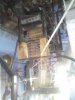
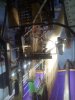
Could you provide some photos of the dobby loom you will be modifying? Is this just a school project, or do you have a product in mind? There are plenty of computer controlled dobby looms on the world wide web to look at for inspiration. Apparently weaving is a world wide hobby right now. Maybe I will look into how American Natives do it. You can buy plenty of Navajo and Mexican tapestry if you visit the American West, but I wonder if upon close inspection I would find that many are made in India!

And at last I don't have any logic analyzer to see out puts. Normal visible outputs only I can take for my verification
.
Well, a 'scope is nice but if you add the second open-drain NAND gate in parallel with the wired-OR NAND gate, and use it to illuminate an LED when an error occurs, that might be all the troubleshooting assistance you need. Since the relay has some unused contacts, maybe you could use a pair of those to light up a second LED to see when a solenoid is actuated. Depends on how fast the loom operates as to whether or not you will be able to use these visual indications. At the very least the LEDs will make for an interesting visual display, especially if the loom is motor-driven with a flying shuttle.