Electric fencer from a 12V battery

OhMy

Apr 5, 2014
63
Joined
Apr 5, 2014
Messages
63
Hello!

It has been a while, since I wanted to build a fencer, powered from a car battery, but I never had a chance to find a real and working circuit with a capacitor discharge system in it, all seem to be using direct driven ignition coils. That is a no-no for me, although I have built one.
I finally managed to make something similar to a regulated 12V to 250-330V converter, which could be used for charging the main capacitor.
What I can't find or create by myself, is the circuit, that would communicate the capacitor from charging up and then discharging through a high voltage transformer. But it never should happen, that the primary coil gets connected directly to a 300V supply to avoid a short circuit.
The charging should be on all of the time, except for a short impulse time, when the capacitor gets discharged. It would need to be able to change the cycle frequency, maybe starting from 4 pulses in second to just one pulse per 3 seconds. For charging connection probably would fit a mosfet, but for discharging- I'm not sure- SCR, triac ar another mosfet?
The simpler the circuit, the better and, probably, more reliable.

I appreciate your help.
 

Attachments

  • Fencer.JPG
    Fencer.JPG
    9.4 KB · Views: 2,196

duke37

Jan 9, 2011
5,364
Joined
Jan 9, 2011
Messages
5,364
I have repaired a few fencers in the last 45 years or so. The simplest was an HSI unit which used a valve radio 120V battery to charge a capacitor through a relay coil When the capacitor was charged, the relay dropped out and connected the capacitor to the output transformer, so starting the charging again.
Batteries were very expensive and became unobtainable so I made a push-pull invertor and replaced the unreliable relay with a SCR which was triggered with a neon indicator. The relay coil was replaced with a resistor which of course wastes energy.
This was used for some years, on 10V (12V tractor battery with one shorted cell) until some lightning demolished the invertor. It now works again but has been replaced with more powerful fencers. The original electrolytic capacitor still work although it has a bulged end and has leaked.

I have a Kestral fencer with the circuit and transistor leads rotted away. I am thinking of making a new circuit which can run on 5V to 14V.

If you make a convertor which passes a charge to the output, it can run into a short circuit so the capacitor can be connected to ground with impunity. Capacitor discharge ingnition sytems were made using self oscillating invertors which would withstand a short circuit, the oscillator would stop until the short was removed.

Corrosion and ligtning seem to be the most common reasons of failure but the output transformers seem to withstand the environment.

The storage capacitor needs to be of good quality but pulse capacitors are expensive. An alternative is a motor start/run capacitor but some contain a discharge resistor (about 1M) which wastes power. A pulse energy of about 1J is a resonable compromise.

I will have a look for some circiut diagrams.
 

OhMy

Apr 5, 2014
63
Joined
Apr 5, 2014
Messages
63
The converter I'm going to use can be seen here. It didn't come out powerful enough for other uses, but should be plenty strong for a fencer.
I once did some minor repairs to a 230VAC operated capacitor discharge fencer, and it used a rectified AC through fairly big resistance for charging a capacitor. The SCR was triggered by a diac with a help of some other resistances. There were other things, which I had no chance/understanding to study. It used an iron core E type transformer for high voltage generation. It had no adjustments of pulse energy or frequency.
My main goal is to make an electrically effective and adjustable fencer, which could run from 8 to 13V supply with a steady output.
Some circuits would be great, although I don't think, that there are many fencers with a circuitry, that would fit my needs.
The only hopefully suitable capacitors I can get, would be the ones like in a picture.
 

Attachments

  • PICT7033.JPG
    PICT7033.JPG
    73.2 KB · Views: 659

duke37

Jan 9, 2011
5,364
Joined
Jan 9, 2011
Messages
5,364
I cannot read the details on the capacitor.
If you are not repairing a fencer but building new, you will need to design a 1:40 step up transformer with superb insulation.
 

OhMy

Apr 5, 2014
63
Joined
Apr 5, 2014
Messages
63
The details on the capacitor are weakly visible, that's why I wrapped it in a clear tape to preserve the text from wearing off. It says something like:
35uF +- 5% HY
400V~ 10000h /cl.B
450V~ 3000h /cl.C
500V~ 120/20% 1000h /cl.D
25/85/21 PO
*Some mystical symbols*
EN60252 CE
09/2012

I'm building a new fencer, so I'll have to make the transformer, I could use an ignition coil, but it would give out an awful amount of voltage (problems with insulating the fence wire), if driven hard enough to produce an adequately strong impulse. I guess, the spark should be able to jump through some 5mm of air and be strong enough to make cattle stay away from the fence and not get "eaten" away by a single grass stem touching the wire.
The turn ratio of 1:40, is it taken from a fencer transformer or from an ignition coil? How many turns for a primary would be necessary? Probably the iron core would be better for this purpose, because most ignition coils use it (maybe just cheaper and more durable), but winding one would be easier on a round ferrite core from a CRT TV.
 

duke37

Jan 9, 2011
5,364
Joined
Jan 9, 2011
Messages
5,364
I got the transformer ratio wrong ! The 1:40 is more like an ignition coil.
I am not too sure of the diffeence between a fencer transformer and an ingnition coil but the ignition coil has somwhat higher resistance and presumably will give a shorter pulse since the magnetic circuit is a multiwire core with a VERY large air gap.
Fencer transformers are more like power or audio transformers with iron laminations and a small or no air gap. You may not get enough inductance with a TV transformer core.

Voltages are about right, you need about 6kV. A spark needs about 3kV/mm. Energy should ba about 1J.

I attach a circuit which I never tested. I could have another go at it sometime. T1 (JGG) is out of a valve TV power supply, it has a ferrite core.

The type of your capacitor is unknown to me. It has different lifetimes at different class ratings and different voltages. An electrolytic capacitor is not suitable for pulse work although it may be adequate for testing. I do not know what type this is. Is it marked with any polarity and is the physical size bigger than a normal electrolytic of similar voltage and capacity?
 

Attachments

  • KestrelJPG.jpg
    KestrelJPG.jpg
    60.9 KB · Views: 1,195

OhMy

Apr 5, 2014
63
Joined
Apr 5, 2014
Messages
63
Thanks for the circuit, but I'm afraid, that I won't be able to use it. I don't have anything similar to the CD4093 chip at hand, and the data for transformers is unclear to me :confused:. Just for the record- there is just one IC in there- all 4 parts come from CD4093 alone?
The type of your capacitor is unknown to me. It has different lifetimes at different class ratings and different voltages. An electrolytic capacitor is not suitable for pulse work although it may be adequate for testing. I do not know what type this is. Is it marked with any polarity and is the physical size bigger than a normal electrolytic of similar voltage and capacity?
This capacitor has no polarity markings and is quite large at 45mm in diameter and 70mm length.

If only I could get somewhere the circuit for replacing the SPDT switch in post #1 circuit, that would be all I need...for now ;). But I just can't figure it out.
 

duke37

Jan 9, 2011
5,364
Joined
Jan 9, 2011
Messages
5,364
The 4093 is a quad Schmitt trigger so all four gates are in one chip. The CMOS series consume very little power and will run from 4V to 18V. The cost is also good.

T1 in my circuit is a transformer rescued from an old TV, it my not be optimum. T2 is the only original part from the Kestrel fencer. By measuring the inductance, the turns ratio can be calculated.
Gates A and B supply drive to the fet gate until the current is about 600mA when it is turned off and the stored energy goes into the big capacitor. The drive is inhibited when the capacitor is fully charged or is being discharged. Gate C is an oscillator running at 1/sec, this is used to inhibit the charging circuit and put a pulse into the SCR gate.
The circuit is different to yours, with the capacitor in series with the output transformer. This enables the switch (SCR) to be grounded.
In your circuit, you could use a relay but this will take considerable power and the contacts will wear as it switches a high current pulse.

You could use a floating SCR to replace the output part of your switch but it would need a small pulse transformer to trigger it.

I would not use a pulse frequency switch for reliability reasons.
 

OhMy

Apr 5, 2014
63
Joined
Apr 5, 2014
Messages
63
Thank you, duke37, for clarifying. I could give it a try someday, if I had all the parts needed.
You could use a floating SCR to replace the output part of your switch but it would need a small pulse transformer to trigger it.
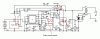
I guess, something similar was on my mind too, as no one really wants to help me (I didn't mean you, duke37) with solving the switching problem. So far the best solution I could think of, is like this- "Fencer.jpg". I'm pretty sure, that this design won't be very efficient, but better this than nothing.
Can someone, please, check the configuration of 555 and the circuit itself? From 555_Etcetera I understood, that I should be able to change the intervals between output pulses, but still I have a great suspicion, that I got it all wrong.
Also, would it be any good to have a C3? I was hoping, that it would give a tiny delay in switching time, to avoid shorting the DC converter.

Any thoughts, please?
 

Attachments

  • Fencer.JPG
    Fencer.JPG
    51 KB · Views: 6,586

duke37

Jan 9, 2011
5,364
Joined
Jan 9, 2011
Messages
5,364
This is getting quite complicated.
I have not studied the 555 to see if it is correct. I would not include a variable for R6 for reliability, I would stick with one speed or use a switch, corrosion is a problem in fencers which results in poor connections.

C3 across the SCR gate will cause problems. You need a sharp pulse which disappears before the load current reduces to zero so rather than a capacitor across the gate, I would use a small capacitor in series with R7 and replace C3 with a resistor. If the input pulse is too long the SCR will not turn off.

If you choose a 300V convertor which will stand a short circuit then the fet will not be necessary. Also the convertor could be inhibited when the pulse is generated until the SCR turns off.

What sort of convertor do you plan to fit?
 

OhMy

Apr 5, 2014
63
Joined
Apr 5, 2014
Messages
63
Yes, it really looks like something is wrong with at least the 555 circuitry, so I'm redoing it. Installed LTspice simulator, and it shows, that the R6 has a different effect. So I'm going to use a DPDT switch to change the 555 timing resistors to achieve two pulse intervals at about 5% duty cycle. Say- once in 1.5 seconds and twice in one second.
C3 across the SCR gate will cause problems. You need a sharp pulse which disappears before the load current reduces to zero so rather than a capacitor across the gate, I would use a small capacitor in series with R7 and replace C3 with a resistor. If the input pulse is too long the SCR will not turn off.
That C3 looked suspicious to me too, but I gave it a try anyway. Putting it in series with the gate would be a better idea.

DC converter can be seen here. Well, after looking at UC3843 datasheet, I discovered, that it can be shut down by grounding of pin1. Tested and it worked! That would make the whole thing much simpler- no need for a charging mosfet and such. Then I would have to remove the main output capacitor from converter's output and use only the discharge capacitor.

I'll redraw the schematics.
 
Last edited:

OhMy

Apr 5, 2014
63
Joined
Apr 5, 2014
Messages
63
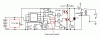
Here it is, hopefully the final version :rolleyes:.
I'm just thinking about using a triac (BTA41-600B) instead of SCR, because The SCR I have (TYN612MRG) is rated to just 12A continuous.
 

Attachments

  • Fencer_2.JPG
    Fencer_2.JPG
    45.1 KB · Views: 1,232

duke37

Jan 9, 2011
5,364
Joined
Jan 9, 2011
Messages
5,364
I still have not examined the 555 circuit in detail, however, I assume that R6/R10 controls the pulse width and R14/R15 the time between pulses.

I see no need to control pulse width. You have changed R6 to R10 and R14 to R15. A better solution would be to use the higher resistor and switch in another resistor in parallel to drop the value. Thus if the contact does not make properly, you still have the higher resistance to fall back on. You only need a single pole, single throw switch. If you already have a double pole then put the two poles in parallel for reliability.

The SCR you have should be plenty big enough. The pulse current may be quite high but there is plenty of time for the chip to cool between pulses. I have used much smaller SCRs than this.

One commercial fencer I looked at had a triac switch, I assumed this was because it was available or a fraction cheaper.

A capacitor from UC3843 pin1 to ground could keep the invertor off for a short time (0.1 sec) until the SCR has reset.
 

OhMy

Apr 5, 2014
63
Joined
Apr 5, 2014
Messages
63
So, the version in my previous post turned out to be a total disaster (who would have known :D). I managed to blow out 6 UC3843 ICs in a row :cool:. It seemed like all it took for them to burn, was just to take a look at them. I used a PC817 in place of the pull-down transistor and to drive the SCR, but the result remained unchanged. As they say- the situation is hopeless, but stable :D.
That was it for that circuit, so I grabbed on to another one, more complicated- attached. It works almost like a charm, except for the fact, that the DC booster's mosfet overheats lethally, when it has to recharge 33uF capacitor to 330V twice per second.

Thanks for assistance.
 

Attachments

  • FENCER_3.GIF
    FENCER_3.GIF
    17.7 KB · Views: 3,636

duke37

Jan 9, 2011
5,364
Joined
Jan 9, 2011
Messages
5,364
Congratulations on getting a working circuit.

Two points
You appear to alter the pulse frequency - that is fine, but also the SCR trigger duration,. Why?

You should be able to inhibit the 300V invertor so could eliminate the IRF740. Would you then need any optical isolator?
 

OhMy

Apr 5, 2014
63
Joined
Apr 5, 2014
Messages
63
Thanks.

The pulse frequency changes from 1Hz to 2Hz with a duty cycle ~5%. The SCR gets triggered through a 0.1uF capacitor, so the actual pulse duration shouldn't change much.

My attempt at stopping the inverter via the shut down pin1 of UC3843 was terrible. I even tried to isolate both the SCR and the UC3843 from all the rest as good as I could, but still- after killing six UC3843 for no obvious reason I abandoned this approach. At that time I even used a simple 2 Ohm resistance in place of the fencer transformer in order to avoid some inductance caused spikes. The non-working circuit is attached.
 

Attachments

  • FENCER_2.GIF
    FENCER_2.GIF
    15.1 KB · Views: 2,538

duke37

Jan 9, 2011
5,364
Joined
Jan 9, 2011
Messages
5,364
I see that you have used the SCR to short the HT line in one case and to switch in series with the transformer in another case. Do you see any difference in performance?

Perhaps the optocoupler cannot pull pin 1 of the UC3843 low enough?
 

OhMy

Apr 5, 2014
63
Joined
Apr 5, 2014
Messages
63
Well, one obvious difference in performance was, that one circuit worked and the other one didn't ;).
I can't remember in details now, but it appeared to me, that the stopping alone of UC3843 worked well both with a transistor and an optocoupler (I could hear the stopping of the converter), but, as soon as I connected the 300V line to the pulse control board, it all went wrong. Maybe I had made some mistake in an actual assembly or the moon phase wasn't good enough, but it didn't work for me. Perhaps someone else could make it work.

As for the other circuit (the kinda working one)- most likely I missed the sweet spot of the high voltage output transformer, because in order to get reasonably strong impulses from it, I have to switch to a total capacitor value of 28uF (8+20) and use a 330V charging voltage, but it seems to be too much for the DC booster to handle- it overheats.
 
Top