Electronic Stethoscope

audioguru2

Apr 6, 2004
12,026
Joined
Apr 6, 2004
Messages
12,026
Hi Dazza,
I can hear your heartbeat!  ;D
It sounds pretty good at about 1/4 volume but the crackling with more volume seems to be the LM386 clipping at its max output. It also seems to be motorboating at about 8 or 10Hz. I wish I had 'scope software on my computer to see it.
During my tests I could never turn-up the volume, it would be way too loud in my 32 ohms (16 ohms when paralleled) Walkman headphones. And besides, it would make terrible howling acoustical feedback when turned-up too high.
Are your headphones any good for the very low frequencies?  ???
Is your mic any good to pickup the very low frequencies?  ???

I think that you need a softer and thicker isolation grommet between the mic and the jar lid.
My mic has a dense foam sleeve about 1mm thick around it. I pushed it into the hole in the jar lid with the cable hanging out the back. I could hear my hands touching the cable.
Maybe your skin is too loose and is flapping around!  ;D ;D
You could try hot-gluing the thingy directly to your chest!  ;D

 
A

Alun

Jan 1, 1970
0
You could connect this circuit to an FM transmitter an listen to your baby's heart beat on your radio.


Dazza

Jun 21, 2004
591
Joined
Jun 21, 2004
Messages
591
Hi, audioguru, Alun

Sorry Audioguru for sending you on a wild goose chase  :(, it seems as though my electronic stethoscope is working the way it should, and it is I that doesn't understand that it is :-[.
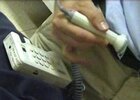
The electronic stethoscope that they used at the hospital sounded much different, I think that the sound that we were hearing, was a higher frequency representation of the actual heartbeat, so basically it worked the same way as this project filtering out all the sounds except for heartbeat sounds, but then modified the heartbeat sounds so that it could be clearly played at high volume on a small speaker.

So what I would like to try to do is take the signal from pin 7of UB1 then modify the signal to a higher frequency or in a way so that it can be fedback to be amplified and played at high volume on a speaker without distortion,

I guess the add-on circuit would work in a similar way as a voice changer?, if you were to say hello in a deep voice into it, it would come out the other end, clearly as (hello) but sounding like a chipmunk.

Now the big question is how do I go about achieving this ;D, how do I take a low frequency sound and turn it into a higher frequency sound ???.

Alun, that's a good idea I'll have to try that :D.


audioguru2

Apr 6, 2004
12,026
Joined
Apr 6, 2004
Messages
12,026
Hi Dazza,
Do you want it to "beep" like heart monitors in hospitals? They pickup electrical impulses to trigger the beep, not the actual sound from the heart.
First you must eliminate the friction crackling noises.  ;D


Dazza

Jun 21, 2004
591
Joined
Jun 21, 2004
Messages
591
Hi audioguru,

HAY if I can't get it to work well as a stethoscope, it sure does make a great AM radio :D ;D.

I connected one leg of a 0.1uF ceramic disc capacitor to pin 3 of U5, and the other leg touching my soldering iron, then I adjusted the volume control to tune into 1332AM 8).  The capacitor was heating up a little but I had to keep it their, because there was a heated discussion about Dr Jayant Patel, who was the head surgeon here in Bundaberg and has fled the country because he was illegally performing surgery, including surgery on my partner Paula :eek: >:(.  He was working here illegally using forged documents because he had been struck off the medical register in America.  This guy is bad news, he is responsible for many deaths and botched surgerys :'(.

O I've gotten off track here a bit.  I'm still trying yet more different stethoscope heads hoping to make a difference, as well as different microphones from my junk box. I tried connecting it to my stereo and I was able to turn the volume control up to nearly half, without any distraughtion or crackling noises, then I increased the volume using the stereo volume control, "WoW" it was loud and those little subwoofers were fairly thumping ;D.  Even when I turn the stereo volume control write-down low there was very little noise but the speakers were still moving quite a bit.

Well my main goal with this project is to be able to here my unborn Childs heartbeat, so it doesn't really matter what it sounds like, as long as you can be certain that it is actually the heartbeat of the baby that you can here ;).

Hang on hold the phone, actually I don't think it is even the heartbeat that we were hearing at the hospital, I'm pretty certain it was the blood rushing through the heart that we could here, so would it be just a matter of isolating that frequency ???


audioguru2

Apr 6, 2004
12,026
Joined
Apr 6, 2004
Messages
12,026
Hi Dazza,
I am sorry to hear about the "surgeon". I hope that everthing is alright.

You have a great idea!  ;D
Of course the baby's heartbeat will be hard to hear, but maybe the bloodflow is better heard.
Try decreasing the value of C3 and C4 for a 1KHz low-pass cutoff frequency, and decreasing the value of C2 to 0.47uF for a 160Hz high-pass cutoff frequency. You could even try eliminating C3 and C4 for wideband sound. Turn-up the volume slowly so you can avoid acoustical feedback.  ;D 


Dazza

Jun 21, 2004
591
Joined
Jun 21, 2004
Messages
591
Hi audioguru,

These changes are giving very good results :D, I can hear heartbeat sounds very clearly with increased volume without distortion, I changed C2 to 0.47uF as you suggested and for C3 and C4 I used to 3.3uF, unfortunately I don't have much in the way of MKT capacitors of many different values to try, but come Thursday I shall get a few to try.

We tried listening for the babies heartbeat or four at least the sound of the blood rushing through the placenta, which sounds much like a heartbeat, which was what we heard when they used the electronic stethoscope at the hospital, but we could not hear any think.

I'm beginning to think that this project will not be able to do what I want it to do, but still it has been a very successful project performing the way it was meant to, and will be very useful 8).

Audioguru, this might be a completely stupid idea ::), but what would be the results of adding an extra 2 Mike's in parallel, then replicating every think from C2 to just before R11, so basically you would have three separate parallel TL072 stages feeding U5, would this give increase sensitivity and allow for a combination of filtering, basically allow for more flexibility of what sound you want and don't want and the amount of that sound to be allowed through to the final stage ???.


audioguru2

Apr 6, 2004
12,026
Joined
Apr 6, 2004
Messages
12,026
Hi Dazza,
It is great to hear that it is working better.  ;D
You probably used 3.3nF (not uF) for C3 and C4 for a low-pass cutoff frequency of about 1.4KHz.

Changing the equal values of R5 and R6 changes the low-pass cutoff frequency the same as changing C3 and C4. You could try a 100K stereo volume control for R5 and R6 with each part wired as a rheostat and in series with a 3.3K resistor, with 4.7nF caps for C3 and C4, for variable control of the low-pass cutoff frequency fom 330Hz to 10KHz.

I don't think adding extra mics is a good idea.
The sensitivity of the circuit is controlled by its volume control and the value of R4.  ;D 


Dazza

Jun 21, 2004
591
Joined
Jun 21, 2004
Messages
591
Thanks Audioguru, that's exactly what I want to be able to do :), have as much control as possible to experiment with,  while actually using the device.

Now I need to be able to do one more thing ;D, before I make these changes.

Can I replace R4 with a variable resistor, will doing this allow me to adjust its gain, the reason why I want to do this is because the way that I have made the stethoscope head.


I'll post more sound files as I progress 8).


Dazza

Jun 21, 2004
591
Joined
Jun 21, 2004
Messages
591
And also Audioguru, we will soon be going to the hospital for another checkup, and I'm going to record the sound from their electronic stethoscope :D, I'll post the sound file to night :).


audioguru2

Apr 6, 2004
12,026
Joined
Apr 6, 2004
Messages
12,026
Hi Dazza,
I dislike multiple volume controls. The main volume control might be set too low and someone will turn-up the R4 gain causing clipping distortion of the preamp.


Dazza

Jun 21, 2004
591
Joined
Jun 21, 2004
Messages
591
Thank you Audioguru :), you have explained very well as usual ;), how I am to go about making these changes.

The quality of the sound file that I've posted didn't turn out as good as I hoped :(, I had to hold the microphone I use for my computer, next to the speaker from my digital video camera to record it to the computer :(, and I've also posted a pic of the device, one of the stethoscope heads I've made is much like the one in the pic.


19_04_2005_2_34_PM_0001.jpg

heart_baby.zip


Attachments

  • heart_baby.zip
    1.5 MB · Views: 58

audioguru2

Apr 6, 2004
12,026
Joined
Apr 6, 2004
Messages
12,026
Hi Dazza,
That's cool!  ;D
Your little rascal's heart is racing like mine does after running around the block.
It sounds like a frequency upshift circuit is used to convert the approx. 20Hz heartbeat sound up to a few hundred Hz.
About 15 years ago I designed a voice encryption circuit for boardroom wireless mics. It converted low frequencies to high frequencies and visa-versa. It would do the job but is fairly complex.

I found an article in Google where a doctor made his own electronic stethoscope with frequency upshifting: 

View attachment 36889


Dazza

Jun 21, 2004
591
Joined
Jun 21, 2004
Messages
591
Hi Audioguru :),

Ahh! I was on the right track in my earlier post, so it's called frequency upshifting :), I knew exactly what it was I wanted to try to do, but I didn't know what it was called ???.

So it's a difficult thing to do frequency upshifting :(, I've tried many google searches with different keywords, to first find out what it was called, then try to find some examples circuits, I should have better luck now ;).

What do you think of my idea of adding an extra stage, another TL072 or maybe more that way they could be dedicated to isolating Pacific frequencies that are all related to a Pacific sound, for example respitory sounds would be made up of many different frequencies, some of which would be the same as other sounds, so you would want to isolate as many sounds as possible related to only that of what you want to here, then these frequencies/sounds can be delivered to the  frequency upshifting stage then to the final amplifying stage, you did mention that it's not a good idea to use extra microphones, so would there be any problems with using just the one, that is ideally suited for this purpose, I guess it would be one that is ideally suited to respond to those specific frequencies, that is once you know what they are.

Now I am not looking to design a new high-tech device ;D, just one that will work as good as I can make it, to listen to my babies heartbeat 8).

If these extra stages will work the way I think they will (but I could be very wrong :-\) it would give a lot of flexibility, for example say there was a Pacific frequency/sound of the heartbeat that was the strongest loudest and it was also the strongest loudest frequency of the respiratory sounds, then the gain of that stage that is dedicated to that frequency could be adjusted accordingly (likely to be reduced), so it's still part of the combination of sounds introduced into the final stage. Also if you have isolated a sound of high frequency you wouldn't want to deliver that to the frequency upshifting stage with too much gain ;D.

Nice article Audioguru, very helpful.
Do you have any example circuits of frequency upshifting, that won't give me a fright :eek: ;D.

Just one more thing to add, the doctor said that the heartbeat sounded perfect, that is music to my ears 8).


audioguru2

Apr 6, 2004
12,026
Joined
Apr 6, 2004
Messages
12,026
Hi Dazza,
You don't need to isolate many specific sound frequencies. As the doctor says in his article and are shown in 'scope pics in this thread, heartbeats are a pressure wave at a very low frequency, straining the lower limit of your hearing, microphones and he didn't mention the speakers or headphones. I remember hearing thump, thump of my unborn kids using just an ear.

To change the frequencies, you need a frequency mixer. I used an MC1496 multiplier IC with single-sideband-suppressed-carrier modulation in my voice encryption circuits.
Frequency mixing makes sum and difference frequencies and I had to filter the heck out of it to eliminate the sum frequencies. I used a switched-capacitor low-pass-filter IC as a very sharp filter.
The carrier frequency was 3580Hz, divided down from a cheap 3.58MHz colour TV quartz crystal. Your TV's use a little bit higher frequency. The clock for the switched-cap IC was 358KHz. It was easy to make the clock and divide-by-ten frequencies with a 74HC4060 and a CD4017 IC's.

Since my carrier was 3580Hz, 20Hz input resulted in 3560Hz output, way too high for your application. If you use a carrier of 358Hz, 20Hz input would give a 338Hz output, just about right. The output faithfully follows envelope changes in the original sound frequency.  ;D 


Dazza

Jun 21, 2004
591
Joined
Jun 21, 2004
Messages
591
Hi Audioguru,

I think I'd better do what I should have done before I started this project, find and read all the postings relating to this project, instead of just reading some of them ::).

Ok, I think I will keep well away from the frequency upshifting idea ;D, as it seems to be well beyond my capabilities :eek:, but still you have given me enough information, to at least look into it and try to understand how it works ;).

I'll have a play around/experiment, and I will post my findings.

Thanks again Audioguru :).


Dazza

Jun 21, 2004
591
Joined
Jun 21, 2004
Messages
591
Hi audioguru,

Your just being cheeky now, pulling my leg ;D ;D, are you mistaking me with somebody that actually knows what they're doing :eek:. sure why not if you do the easy part "design it" and put a big red circle on the schematics around the "on switch" so I know where it is ???, then I'll make the PCB and put it together, as long as you design it using components from the early Seventies, that way I'll have no problems finding components, I'll be able to get everything from my local Dick Smith Electronics shop ;D.


Actually I did come across a web site some time ago and I haven't been able to find it again, where someone was working on an ultrasound project, but I really don't think it would be a good idea using a home-made ultrasound device on an unborn child, sure it's only sound waves but I still wouldn't feel comfortable with it :-\


audioguru2

Apr 6, 2004
12,026
Joined
Apr 6, 2004
Messages
12,026
Hi Dazza,
You're right, its best to keep any kind of radiation away from your unborn child.
I learned about Dick Smith Electronics, the surplus parts place, on another website. They sell used cars too, don't they?  ;D

On the other site are guys making circuits for their guitars. They break all the rules of electronics and post their schematics with weird names. They even post WAVE files of their results and some might convert your heartbeat sound into a fuzzy twang with vibrato and tremolo if you want. It would be cool to hear a heartbeat with flanging. A doctor would go nuts. ;D 


Dazza

Jun 21, 2004
591
Joined
Jun 21, 2004
Messages
591
Hi audioguru :),

I have come up with a circuit that might help me achieve what I am wanting :D, with the electronic stethoscope.

I have this idea working on the breadboard the way I want ;), and now I just need to connect them together, to see if it will work the way I want, but I'm having problems with this project that I found( http://sound.westhost.com/project43.htm ) which I thought would be good for powering both these projects.

I've attached pic's of the redrawn schematics and the PCB I designed for it, I'm fairly confident I didn't make an error, however it isn't working as expected, could it be that this project simply won't power the electronic stethoscope?, I did make some changes, I used a LM358? instead of a 1458 and I also removed C7 and C8 from the stethoscope.

When I connected this circuit to the electronic stethoscope to power it, I could barely hear my voice through the headphones when I spoke directly into the microphone, also when I adjusted the volume control to about half I could hear oscillation. When I read the authors description of how this project worked, I thought it would be ideal for powering the electronic stethoscope and my add-on circuit, but it looks as though I've gotten something wrong but I can't work out what :-\.

Any help would be very much appreciated.

Well it wouldn't surprise me one bit if Dick Smith did start selling used cars ;D.  At one time Dick Smith was the place to go for electronic enthusiast and pretty much the only place to get components, now they have just gone to the dogs >:(.

Yes it would be cool to hear a heartbeat with a bit of a twang to it ;D, in fact the circuit I am working on might just be able to do that, but first I need to try and get it to work for the purpose I intend to use it for 8), then I'll have some fun with it, to see what sounds I can make a heartbeat sound like ;D


View attachment 36914

View attachment 36915

 
Top