Electronics seems like magic!

Status
Not open for further replies.

Omega Supreme

Oct 9, 2014
156
Joined
Oct 9, 2014
Messages
156
Funny booklet
I really like these old electronics booklets published in the 70’s, 80’s, and 90’s. They feel like time capsules when people were hands-on, do-it-yourself electronics buffs——before the internet was a thing.

Now that the economy has been globalized, with the internet connecting every corner of the planet, and it’s cheaper now just to have things made overseas.

The company I worked for farmed out all their manufacturing of products to the lowest bidder, much of the time to a foreign country who could build it for pennies on the dollar. And we just put our brand label and logo on it and called it our own (ie. proprietary). I think the job of our engineers as far as I could see was to come up with the product specifications, white papers, concept, etc.

I don’t think I could possibly compete with a nuts and bolts engineer who has the fine motor skills (eg. soldering), is a master at breadboarding, and can skillfully use equipment like oscilloscopes and network analyzers.

I’m looking more for a domain of engineering where I’m taking pen to paper, with a calculator in hand, and crunching numbers using advanced math and science equations.
 

Delta Prime

Jul 29, 2020
2,987
Joined
Jul 29, 2020
Messages
2,987
I’m looking more for a domain of engineering where I’m taking pen to paper, with a calculator in hand, and crunching numbers using advanced math and science equations.
Finally, some honest honesty therefore, you have been drafted.
Here you go, buddy.
Instead of a electronic calculator, you should try a Slide rules: A mechanical analog calculator used for multiplication, division, roots, logarithms, and trigonometric functions
Drafting board: A flat, smooth surface, often made of basswood, to which paper is attached.
T-square: A ruler with a crossbar at one end that slides along the edge of the drafting board to draw perfectly horizontal lines.
Triangles: Used for drawing vertical lines and lines at specific angles.
Mechanical pencils: For making precise marks on the drawing.
Drafting compass: A tool for drawing arcs and circles.
French curves: Stiff, irregular curves used to draw non-circular curves.
Drafting tape: Used to secure the paper to the drafting board.
:cool:
 
Last edited:

Omega Supreme

Oct 9, 2014
156
Joined
Oct 9, 2014
Messages
156
Aristotle believed men could mold themselves through their actions like clay; too bad he learned everything from Plato… :p
Plato said:

“An unexamined life is not worth living. “

I think he learned this from Socrates.
 

Omega Supreme

Oct 9, 2014
156
Joined
Oct 9, 2014
Messages
156
I love toys infused with the magic of electronics:


I’m a sucker for battery-powered and motorized toys.
 

Omega Supreme

Oct 9, 2014
156
Joined
Oct 9, 2014
Messages
156
I remember when people were really into texting on those Blackberries which had a physical keyboard. And I found it absolutely amazing that such a small device could have the power to transmit a signal to a tower that is probably tens if not hundred of miles away. A small device like that could only generate a transmit signal in the microvolt range. How is it possible that it could travel that vast of a distance at the speed of light, almost instantly? That’s magic! My only guess would be that it uses quantum mechanics, what Einstein called “spooky action at a distance. “
 

Omega Supreme

Oct 9, 2014
156
Joined
Oct 9, 2014
Messages
156
I don’t find a soldering iron useful for fixing broken electronics around the house. What typically breaks most often around my home are Antennas or other pieces of metal that get bent and broken. Somehow they get snapped in two.

I’ve tried to solder the two metal pieces back together with a soldering iron and some solder, but it does not work, it won’t hold together and it falls apart at the slightest movement.

Solder does not adhere to most metal surfaces, at least using a soldering iron.

I feel what would be more useful is an acetylene torch. I think jewelry makers use torches with solder to join metal pieces together.

A soldering iron does not work.
 

Omega Supreme

Oct 9, 2014
156
Joined
Oct 9, 2014
Messages
156
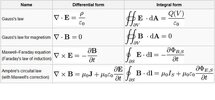
The real magic behind electronics lies in Maxwell’s Equations:

IMG_3038.jpeg
All of electrical engineering (eg. Ohm’s Law, Kirchoff’s Laws, all of the inductance, capacitance, resistance formulas which form the foundation for all radio communications apparatus, etc.) is derivative of these equations.

Einstein described Maxwell's work as "the most profound and the most fruitful that physics has experienced since the time of Isaac Newton".

Einstein's own theories of relativity were directly inspired by Maxwell's equations of electromagnetism, which demonstrated that the speed of light is constant, a key insight that led Einstein to his revolutionary ideas about space and time.

Einstein's work on special relativity and quantum theory were direct outgrowths of the foundation Maxwell laid.
 

AnalogKid

Jun 10, 2015
3,045
Joined
Jun 10, 2015
Messages
3,045
The constancy of the speed of light is not covered in the equations you show, which were BTW *not* Maxwell's.

In 1884, Oliver Heaviside took Maxwell's work, something like 18 equations with 21 variables, condensed and combined some things, and cooked them down to the four equations you show. As shown by the titles, none were Maxwell's work completely. He (through Heaviside) restated equations already known, and tweaked two of them.

In other equations not shown, Maxwell introduced the idea that light, electricity, and magnetism were all variations of the same thing, and provided an introductory mathematical framework for this. Aside from all of that relativity stuff, this is what Einstein picked up and ran with, all the way to Stockholm. His Nobel prize was *not* for the theories of relativity, but for the photo-electric effect.


ak
 

ivak245

Jun 11, 2021
143
Joined
Jun 11, 2021
Messages
143
I don’t find a soldering iron useful for fixing broken electronics around the house. What typically breaks most often around my home are Antennas or other pieces of metal that get bent and broken. Somehow they get snapped in two.

I’ve tried to solder the two metal pieces back together with a soldering iron and some solder, but it does not work, it won’t hold together and it falls apart at the slightest movement.

Solder does not adhere to most metal surfaces, at least using a soldering iron.

I feel what would be more useful is an acetylene torch. I think jewelry makers use torches with solder to join metal pieces together.

A soldering iron does not work.
A soldering iron does not work if you don't know how to solder. Acetylene torches are great for electronics, especially SMD devices.
 

Omega Supreme

Oct 9, 2014
156
Joined
Oct 9, 2014
Messages
156
A soldering iron does not work if you don't know how to solder. Acetylene torches are great for electronics, especially SMD devices.
You use a torch to solder when you need high heat for large or thick metal pieces, such as joining copper pipes in plumbing, or when a soldering iron lacks sufficient heat. Common torch soldering applications include plumbing, metalwork, and repairs that require the metal to be heated quickly and evenly.

When to use a torch versus a soldering iron
  • Use a torch for:
    • Thick or large metal objects, like copper pipes, that require a significant amount of heat to reach the soldering temperature.
    • Soft soldering applications like plumbing, metalwork, and general repairs, especially with larger fittings.
      • Situations where a fast, powerful heat source is needed to bring the metal up to temperature quickly.
    • Use a soldering iron for:
      • Small, delicate work, such as soldering to printed circuit board (PCB) traces, which requires less heat and more precision than an open flame can provide.
 

Omega Supreme

Oct 9, 2014
156
Joined
Oct 9, 2014
Messages
156
In 1884, Oliver Heaviside took Maxwell's work, something like 18 equations with 21 variables, condensed and combined some things, and cooked them down to the four equations you show. As shown by the titles, none were Maxwell's work completely. He (through Heaviside) restated equations already known, and tweaked two of them.

ak

I do recall the name Heaviside being mentioned by one professor in one class who said about him, “Yes we all know Einstein is the best but the Atomic Bomb does not really effect and improve our everyday lives in a practical, direct way like what Heaviside did. “

He spoke of Heaviside as a practical genius, phenomenally smart, in a way that Einstein was not.

Heaviside developed practical inventions and theories crucial for modern telecommunications and electrical engineering. His inventions include the coaxial cable, which enabled long-distance telephone and cable TV, and the distortionless transmission line, which dramatically improved telegraph speed. He also invented the Heaviside step function and operational calculus, a method for solving differential equations
 
Last edited:

AnalogKid

Jun 10, 2015
3,045
Joined
Jun 10, 2015
Messages
3,045
Einstein, like Edison, had an excellent and very visual imagination. This was a limitation for both of them; if they couldn't imagine it, then didn't have the math skills (or in Edison's case, science training) to understand it. Einstein could not "see" or "get" quantum mechanics, and in this area the world of physics kinda passed him by. His main contribution was that of a hugely credible critic, forcing Bohr et al to a higher level of rigor in their science.

ak
 

ivak245

Jun 11, 2021
143
Joined
Jun 11, 2021
Messages
143
You use a torch to solder when you need high heat for large or thick metal pieces, such as joining copper pipes in plumbing, or when a soldering iron lacks sufficient heat. Common torch soldering applications include plumbing, metalwork, and repairs that require the metal to be heated quickly and evenly.

When to use a torch versus a soldering iron
  • Use a torch for:
    • Thick or large metal objects, like copper pipes, that require a significant amount of heat to reach the soldering temperature.
    • Soft soldering applications like plumbing, metalwork, and general repairs, especially with larger fittings.
      • Situations where a fast, powerful heat source is needed to bring the metal up to temperature quickly.
    • Use a soldering iron for:
      • Small, delicate work, such as soldering to printed circuit board (PCB) traces, which requires less heat and more precision than an open flame can provide.
I wonder if you could use MIG or TIG? Must try it next time I build something. I can always grind off the bad welds with an angle grinder.
 

Omega Supreme

Oct 9, 2014
156
Joined
Oct 9, 2014
Messages
156
The operational amplifier (op amp) is often described as "magical" and "mysterious" primarily because of its seemingly ideal behavior and incredible versatility in practical analog circuit design. This perception stems from several key characteristics and uses:
  • Versatility Through External Components: An op amp is a single component that can be configured with just a few external resistors and capacitors to perform a wide variety of functions, including amplification, addition, subtraction, integration, differentiation, and filtering. This flexibility, where external, easily swappable components dictate the circuit's function, can seem "magical" compared to designing each circuit from scratch using discrete transistors.

    • Idealized Behavior (The "Golden Rules"): When negative feedback is applied, the circuit's behavior is primarily determined by the external feedback components, not the complex internal structure or imperfections of the op amp itself. The "golden rules" of op amps (infinite input impedance, zero input current, and the two inputs being at the same voltage) are simple concepts that allow for straightforward circuit analysis, making complex internal electronics seem simple and elegant in application.

    • High Gain and Abstraction: Op amps have extremely high open-loop gain (often 100,000 or more). In a closed-loop configuration, this high gain forces the feedback loop to maintain the ideal conditions described by the golden rules. For many engineers, especially those in digital design, they are a convenient, self-contained "black box" that just works as a building block without needing to understand the intricate internal workings of its many transistors.

    • Ease of Use vs. Internal Complexity:While the op amp is very easy to use at a high level of abstraction, its internal circuitry is quite complex, involving multiple stages of differential amplifiers, gain stages, and current mirrors. This contrast between simple external application and complex internal operation contributes to its "mysterious" reputation.

    • Historical Context: In early electronics, building high-performance amplifiers required unwieldy vacuum tubes or meticulous selection of discrete transistors. The advent of the integrated circuit op amp (like the iconic 741) provided a robust, inexpensive, and predictable component that made advanced analog design accessible and reliable, making it feel like a significant leap in engineering capability.
In essence, the "magic" comes from the fact that a tiny, inexpensive, and simple-to-use component can solve numerous complex analog design problems almost effortlessly, appearing to follow ideal physical laws rather than messy real-world imperfections.
 

Omega Supreme

Oct 9, 2014
156
Joined
Oct 9, 2014
Messages
156
Wozniak was a magician. I don’t think anyone today could have done what he did as a lone engineer.

He developed the Apple I into the computer that launched Apple.

Wozniak designed it from scratch using a whole bunch of chips that were manufactured at the time, and soldered it together in his garage.

He was the primary designer of the Apple II, known as one of the first highly successful mass-produced microcomputers.

I remember these were introduced in elementary and middle schools, placed in the back of classrooms for children to play on and learn to type BASIC commands.

It was seen as a child’s toy by adults and the grownup world back then in the early 80’s, who were still using typewriters, paper folders, and file cabinets to do their work at their jobs.
 

Omega Supreme

Oct 9, 2014
156
Joined
Oct 9, 2014
Messages
156
Classic Antenna Physics in Action

The change in reception when you move or sit near your antenna happens because your body interacts with radio waves. Here’s why it happens:

1. Your body affects radio waves

The human body is mostly water, and water absorbs and reflects electromagnetic signals, especially those used for TV (VHF and UHF frequencies).
  • When you move near an antenna, your body can:
    • Reflect signals toward or away from the antenna.
    • Absorb part of the signal, weakening it.
    • Change the local “field pattern” (the electromagnetic field around the antenna), which can alter the signal strength or clarity.
So depending on where you stand or sit, your body might actually help bounce signals into the antenna — or block them.

2. Indoor reflections (multipath interference)

Indoors, TV signals bounce off walls, furniture, and metal surfaces before reaching your antenna.
  • These multiple reflections can interfere with each other — some waves add together (stronger signal), while others cancel out (weaker signal).
  • When you move, even a few inches, you can change the interference pattern, which changes whether the antenna sits in a “hot spot” or “dead zone” of signal strength.
3. Antenna tuning and impedance

Many small antennas are sensitive to the environment — the nearby materials (like you, the wall, or even a window) slightly change the electrical resonance of the antenna.
  • When you move closer, the antenna’s “tuning” may shift, making it better or worse at receiving the frequency your TV is tuned to.
4. Why it sometimes gets better when you move
In some cases, your body or position can redirect or boost weak reflections into the antenna.
  • For example, if a station’s signal is weak or coming from a difficult direction, your body may act like a passive reflector — improving reception by accident.
How to get stable reception

To reduce this problem:

Place the antenna as high as possible and near a window facing the broadcast towers.
  • Avoid placing it behind the TV, near metal objects, or against interior walls.
  • Once you find a good position, mark or fix the antenna’s orientation and avoid moving it.
  • If your antenna has an amplifier, make sure it’s powered properly — otherwise, movement effects can seem worse.
 

poormystic

Jul 23, 2023
187
Joined
Jul 23, 2023
Messages
187
Hi @Omega Supreme
I keep finding myself wanting to suggest that you put a strengthening armature inside the (tubular) antenna... is that what you were fixing? Just something stiff inside the tube to keep it the right shape.
I hope that's ok
 

Omega Supreme

Oct 9, 2014
156
Joined
Oct 9, 2014
Messages
156
Hi @Omega Supreme
I keep finding myself wanting to suggest that you put a strengthening armature inside the (tubular) antenna... is that what you were fixing? Just something stiff inside the tube to keep it the right shape.
I hope that's ok

That’s a great idea for permanent antennas like those used for ham radio or TV antennas mounted on top of the roof.

I was mainly referring to antennas on cheap, disposable electronics (eg. AM radios) or TV antennas (eg. rabbit-ears).

I was just surprised at how useless and ineffective a soldering iron is at soldering back together these antennas that inevitably get bent or broken around the house, maybe by your kids.

Outside of a printed circuit board, soldering irons seem like a pretty useless device.

A torch, on the other hand, can weld metal pieces back together just fine using solder because it can make the metal pieces hot enough for the soldering to work.

A soldering iron simply cannot achieve high enough temperatures to be practically useful for anything other than soldering components onto a circuit board.

This surprised me considering how the soldering iron is hailed as one of the electrical engineer’s ultimate tools.
 
Last edited:
Status
Not open for further replies.
Top