YAY! i got it to work. Thanks Steve. I'm going to try it out with some apps. Btw, how do you make the IR LED go farther in terms of distance so i can cover more ground?
OK, firstly, were you able to modulate the light intensity and prove it by using a phototransistor etc., to receive the signal and convert it back to sound?
There are several ways of increasing the range. You may have to try all of them.
The first and simplest is to increase the average current to the LED (possibly using multiple LEDs) and ensure your depth of modulation is high. This will be a lot easier if you drive the LED (s) from a constant current source where the current is set by an incoming voltage (your signal).
However, that's only going to go so far.
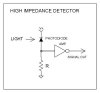
Next you'll need to make a far better receiver, and one which is sensitive to variations in incoming IR sensitivity (rather than the absolute amount it sees). This will allow your receiver to work with higher ambient IR illumination.
To get even more range you need to move to a digital signal where the LED is only tuned on for brief periods (typically at a very high current). This is pretty much how IR remote controls work. The encoded data can be at a higher data rate than your audio signal, does not rely on analog input signals, and can use compression and redundancy to allow errors to be corrected.
As you move from one level of complexity to another, the complexity of your circuit will also rapidly increase.