help of a 23A battery to 12v Car battery project

onlyblue

Feb 2, 2013
11
Joined
Feb 2, 2013
Messages
11
Hi to all

I would like to connect to my car battery a device that takes one 23A battery.
I'm concern when the car voltage goes higher than 12 volts.
How would I do it with out causing problems to the device?
 

davenn

Moderator
Sep 5, 2009
14,470
Joined
Sep 5, 2009
Messages
14,470
hi there
welcome to the forums :)

what is a 23A battery ?
what is the device ?
what is its voltage and current requirements ?

lots more info needed so we can help you :)

Dave
 

onlyblue

Feb 2, 2013
11
Joined
Feb 2, 2013
Messages
11
hi there
welcome to the forums :)

what is a 23A battery ?
what is the device ?
what is its voltage and current requirements ?

lots more info needed so we can help you :)

Dave

a 23A is 12V alkaline battery ideal for small remote control devices such as car and garage door remotes. http://en.wikipedia.org/wiki/A23_battery

The device is a wireless doorbell and I don't know the current requirements
 

(*steve*)

¡sǝpodᴉʇuɐ ǝɥʇ ɹɐǝɥd
Moderator
Jan 21, 2010
25,510
Joined
Jan 21, 2010
Messages
25,510
In essence, all you need is to connect it up to the battery.

However, car electrical systems are noisy and you really need to filter the 12V so that you don't get large voltage spikes which will (potentially) disrupt or even destroy the wireless doorbell.

I would recommend that you connect a 220 ohm resistor in series with the +ve leas, and a 1000uF capacitor after that between +ve and -ve. These components will probably take up about as much room as the original battery.

220 ohm 1/4W or 1/2W (or higher power, but it will just be larger)
1000uF 16V or (preferably) 25V

There are other methods of doing this, but these parts can be obtained from pretty much anywhere that sells electronic parts.
 

onlyblue

Feb 2, 2013
11
Joined
Feb 2, 2013
Messages
11
In essence, all you need is to connect it up to the battery.

However, car electrical systems are noisy and you really need to filter the 12V so that you don't get large voltage spikes which will (potentially) disrupt or even destroy the wireless doorbell.

I would recommend that you connect a 220 ohm resistor in series with the +ve leas, and a 1000uF capacitor after that between +ve and -ve. These components will probably take up about as much room as the original battery.

220 ohm 1/4W or 1/2W (or higher power, but it will just be larger)
1000uF 16V or (preferably) 25V

There are other methods of doing this, but these parts can be obtained from pretty much anywhere that sells electronic parts.

Thank you Steve for your reply. I’m not an electronics guy so I had made a diagram. Please let me know if this is the correct way.

Also why should I use a 16v or even 25v capacitor on a device that takes 12 volts?
how much current will take from the car battery? Is there any chance of draining the battery overnight?
I'm also concern if this solution will get hot, especially in the summer?
 

Attachments

  • 12v.JPG
    12v.JPG
    5.8 KB · Views: 153

BobK

Jan 5, 2010
7,682
Joined
Jan 5, 2010
Messages
7,682
Nope, the capacitor should go across the + and - terminals at the devide side.

Bob
 

duke37

Jan 9, 2011
5,364
Joined
Jan 9, 2011
Messages
5,364
It is usual to show the positive voltages above the negative voltages.

A 16V capacitor will have a little bit of leeway when running on 12V. Overvoltaging any component is obviously risky.

Make sure that the capacitor is connected the correct way round or it will fail.
 

(*steve*)

¡sǝpodᴉʇuɐ ǝɥʇ ɹɐǝɥd
Moderator
Jan 21, 2010
25,510
Joined
Jan 21, 2010
Messages
25,510
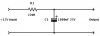
Here is a schematic of what you want to do.

As has been mentioned, it is conventional to place the +ve rail at the top, an the negative at the bottom.

attachment.php


It's also conventional to have the general flow from left to right. So inputs on the left, and outputs on the right.
 

Attachments

  • filter.png
    filter.png
    4.1 KB · Views: 222

onlyblue

Feb 2, 2013
11
Joined
Feb 2, 2013
Messages
11
Here is a schematic of what you want to do.

As has been mentioned, it is conventional to place the +ve rail at the top, an the negative at the bottom.

attachment.php


It's also conventional to have the general flow from left to right. So inputs on the left, and outputs on the right.

Thank you again Steve

how much current will take from the car battery? Is there any chance of draining the battery overnight?
I'm also concern if this solution will get hot, especially in the summer?
 

(*steve*)

¡sǝpodᴉʇuɐ ǝɥʇ ɹɐǝɥd
Moderator
Jan 21, 2010
25,510
Joined
Jan 21, 2010
Messages
25,510
It is almost certain that the device draws no current from the battery unless you push the button. That leaves any current draw being the leakage in the capacitor, and that is likely to be measured in uA (millionths of an amp).

So the current drain will be effectively zero.

Likewise, since very little current flows, the amount of heat generated will be very small.

I would advise placing the components (the capacitor especially) in a place that doesn't get too hot. Where the battery went would be ideal.

Be very careful you don't short out any wires or you could have high currents and lots of heat!
 

onlyblue

Feb 2, 2013
11
Joined
Feb 2, 2013
Messages
11
I had implemented the circuit but I haven't achieved to have a constant 12 volts.

If I have as input 12.6 volts I get the same as output. Similarly 14.5 inputs 14.5 as output.
I had even put similar components on a breadboard and the results are the same.
Please advice
 

Harald Kapp

Moderator
Moderator
Nov 17, 2011
14,270
Joined
Nov 17, 2011
Messages
14,270
This circuit will folow he input voltage, as you have measured. If you want a fixed 12 V output, you'll need a regulator (example). However, even a good low dropout regulator will require at least 12.5 V at its input pin.

Or simply place a 12V zener diode in parallel to the capacitor to protect from overvoltage. However, if your input voltage is below the zener voltage, so will be the output.
Generating a 12 V output from less than 12 V input will require a so called buck-boost regulator
 

onlyblue

Feb 2, 2013
11
Joined
Feb 2, 2013
Messages
11
This circuit will folow he input voltage, as you have measured. If you want a fixed 12 V output, you'll need a regulator (example). However, even a good low dropout regulator will require at least 12.5 V at its input pin.

Or simply place a 12V zener diode in parallel to the capacitor to protect from overvoltage. However, if your input voltage is below the zener voltage, so will be the output.
Generating a 12 V output from less than 12 V input will require a so called buck-boost regulator

Harald, thank you for explaining, my only concern is having more than 12volts. So in case the car battery drops below 12v is ok,
If I put a 12v zener diode how many amperes I will get in the output?
I would much appreciate it if you could update the circuit diagram
 

Harald Kapp

Moderator
Moderator
Nov 17, 2011
14,270
Joined
Nov 17, 2011
Messages
14,270
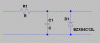
Here's a schematic:
attachment.php

Note that the cathode of the zener diode is connected to plus!
You may need to add a normal diode (1N4001) in series with the zener, this time the cathode ist to minus! The additional diode will add another 0.6V on top of the zener voltage, thus the limiting will begin at 12.6V.

The zenerdiode will not limit your output current. This is the resistor's job.
 

Attachments

  • ovvprot.gif
    ovvprot.gif
    3.2 KB · Views: 218
Top