
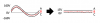
I have a live device I am studying with a two channel oscilloscope. There are three locations where I can touch the probes which I have labeled A, B, and C. When the probe is placed in A you would see a reliable repeating waveform with clean lines. Though the shape is unique and not sine it is at least predictable. If the second channel probe was placed at location C it has the same exact pattern as location A except that it runs in parallel at a vertical offset of about -15V.
My interest here is studying the pattern of location B. I've learned that the signal at location B is no lower than the voltage of C and no higher than the voltage of A. Using these upper and lower limits as a tool, is there some way I can subtract the underling wave of B with either that of A or C? What circuit can I make so that given any combination of inputs A, B and C that it produces an output of B with a stable 0V reference as shown on the right side of my attached image?
Alternatively I'm open for any suggestions that would achieve the same ends of being able to study the deeper signal at location B without the distraction of the waveform that it rides on top of.
One last note: If a circuit is made to remove the big wave, it must be very high impedance so not to disturb the equipment it is studying, thus the inputs to such a circuit probably needs to be 1Mohm or higher.
Thank you in advance for your help!


