HP8165A Cooling Fan Direction?

shrtrnd

Jan 15, 2010
3,901
Joined
Jan 15, 2010
Messages
3,901
Got me an HP8165A Programmable Signal Source with extensive heat damage.
Somebody 'helpfully' removed the cooling fan, and never repaired it.
Does anybody know if the replacement cooling fan is supposed to direct airflow into,
or out of the instrument?
thanks
 

jackorocko

Apr 4, 2010
1,284
Joined
Apr 4, 2010
Messages
1,284
Hmm, no idea, but I have always been one to believe that it is easier to pull air then push air inside an enclosure.
 

shrtrnd

Jan 15, 2010
3,901
Joined
Jan 15, 2010
Messages
3,901
I work a lot of Test and Measurement instruments. Some pull air in, and others push
air out. I'm sure the engineers that design the stuff decide what their circuits need.
Considering the fact that there's obvious heat damage inside the chassis, and I don't
know why the fan is gone, (maybe somebody already stuck one in there the wrong way),
I figure I better find a way to find out for sure how the designers wanted this done.
Problem with old HP gear is that it's no longer supported by the new company, Agilent.
Advantage of old HP gear, is that it was well built, and a lot of people are familiar with
them.
Hoping I get the answer here. I dug up a manual, and can't any info on airflow direction.
(I'll keep reading, in case it is).
 

Resqueline

Jul 31, 2009
2,848
Joined
Jul 31, 2009
Messages
2,848
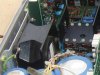
I found a picture on the web which seems to indicate that the fan pushes air into the cabinet (if the fan works the way most of them do).
 

peterlonz

Feb 11, 2010
28
Joined
Feb 11, 2010
Messages
28
Generally it just does not matter.
It may be obvious when you have the replacement fan, screw hole placement can be a guide for example.
What matters is that you don't "leak air". In other words be sure 90% at least of the cooling air is actually flowing into or out of the compartment to be cooled.
If you smoke you can use a fag to create a smoke trace or sometimes an incense stick can be used & this can help to show you what the cooling air is doing.
If you have reason to be concerned about one or maybe several components you can create a "paper cone" (or similar convergence baffles) to direct the air flow but be careful you do not restrict the flow by so doing.
In especially troublesome situations I have mounted an additional CPU fan very close to the problem site, maybe worth considering.
 

kwoolsey94

Feb 14, 2011
22
Joined
Feb 14, 2011
Messages
22
With the placement of the fan it really wont matter. As long as there some sort of vent to let air in then the fan could either be exhaust or an intake fan. If their are no vents then it must me an intake fan. An intake fan will allow more dust to come in.
 

jackorocko

Apr 4, 2010
1,284
Joined
Apr 4, 2010
Messages
1,284
What matters is that you don't "leak air". In other words be sure 90% at least of the cooling air is actually flowing into or out of the compartment to be cooled.

This makes like no sense to me. If you have a fan blowing air into an enclosure then you will need to remove that same amount of air in the same amount of time as the fan can supply it or the pressure will increase inside the case and limit the amount of air flow. "Air leaks" as you put it seem to only be beneficial as far as I am concerned. The idea is to remove the heat, for that to happen you need to be able to completely exchange the air inside the case as fast as necessary to keep the components within tolerances.

I think if I was shrtrnd and I had an inclination that heat might be a concern in this equipment. I think I would try and increase air flow through the enclosure. Bigger fan and possibly more holes in the enclosure over the problem area to increase air flow in that section of the case.
 
Last edited:

Resqueline

Jul 31, 2009
2,848
Joined
Jul 31, 2009
Messages
2,848
There are pro's and con's to either way of mounting fans.

Fan pushing air into the cabinet:
Pro's: Inlet air can be filtered, keeping interior clean, dust easily cleaned. Coolin can be directed at a hot-spot.
Con's: Inlet air is preheated by the fan. Cooling utterly fails if inlet filter is not cleaned. Hard to make inlet filter large.

Fan pulling air out of the cabinet:
Pro's: It'll take a lot of dust to clog the cabinet. The inlet air is kept as cool as it can get. Several hot-spots can be adressed with careful design.
Con's: The cabinet and all its ports & cracks will get filled with dust. Hard to keep clean. Almost impossible to apply an air filter.

Then there's the placement of the fan and the air direction (hot-spots vs temperature sensitive circuits).
If the flow is from hot-spots to temperature sensitive circuits then the latter will obviously be affected and will take quite some time to settle.
If the flow is from temperature sensitive circuits to hot-spots then the first will not be affected by the temperature rise and will settle "instantly".

I'll take my chances and post a portion of that picture. Here you can see that they have traded efficiency (recirculation cracks) over rubber vibration damping mounts.
The air is pushed into the cabinet (being preheated by the fan) and passing over the PSU & output stage first, thus heating up all the rest of the circuitry as well.
 

Attachments

  • HP8165A fan.JPG
    HP8165A fan.JPG
    40.5 KB · Views: 350

davelectronic

Dec 13, 2010
1,087
Joined
Dec 13, 2010
Messages
1,087
I think the best solution is a path, from intake to exit clear defined path will cool all components, extra hot items would benefit from a fan of its own, in short clear unobstructed circulation, fans generate very little heat. simple. :)
 

davelectronic

Dec 13, 2010
1,087
Joined
Dec 13, 2010
Messages
1,087
Over kill.

index-2.jpg


A wicked idea.

pc-cooling2_lMXEf_2263.jpg


:)
 

jackorocko

Apr 4, 2010
1,284
Joined
Apr 4, 2010
Messages
1,284
I'll take my chances and post a portion of that picture. Here you can see that they have traded efficiency (recirculation cracks) over rubber vibration damping mounts.

Now back to the thread, they have also reduced efficiency with the added restriction holes in the mounting plate(this maybe why they added the re-circulation cracks, force re-circulation). It also seems as though it was designed to maintain a hotter temperature then ambient without cooking the components. I don't see any real vents behind the fan, so where does the air come from? Looking at that picture now, I would attend to agree with resqueline that the fan is meant to push air into the case.

Would make sense to hold the components at a steady temperature seeing as how it is test equipment and all. Temperature has great effect on these sorts of things.
 
Last edited:

jackorocko

Apr 4, 2010
1,284
Joined
Apr 4, 2010
Messages
1,284
Con's: The cabinet and all its ports & cracks will get filled with dust. Hard to keep clean. Almost impossible to apply an air filter.

I am not so sure this is a con. I always find it harder to clean a fan that pushes dirty air then a few hundred holes in the side of a metal case.
 

peterlonz

Feb 11, 2010
28
Joined
Feb 11, 2010
Messages
28
Mostly the posted advice is sound.
My earlier contribution was not as carefully worded as it should have been.
I meant to say that "air leaks" which result in reduction of the air flow are to be avoided.
It should be clearly understood that the flow rate of air in & out must be very nearly the same which basically means that inlet & outlet (total) areas must similarly be roughly equal.
One more point, heat extraction is always improved with improved speed of flow, so keep an eye on such things as dust collection/obstruction & if possible the distribution of the flow within the compartment being cooled.
 

shrtrnd

Jan 15, 2010
3,901
Joined
Jan 15, 2010
Messages
3,901
I talked to somebody who actually has one of these instruments.
The fan draws the air into the cabinet on this one.
I think there's a lot of good ideas and advice in the posts responding to my query, and
I appreciate all the input.
My experience with precision test and measurement equipment is that the design engineers
put a lot of time into cooling considerations, for instrument accuracy, and it's best to
try to stick with what their original design was.
Some circuits inside the chassis are precision, temperature controlled circuits, that
are specifically designed to operate at a particular temperature. Some of the HP gear
actually have 'ovens' inside the instrument, to make sure the electronic components
are at a known temperature while in operation, to assure circuit/instrument accuracy.
So anyway, thanks for the help, and I found somebody who owns one of these, so
I got the answer to my question.
 
Top